
The Honest Answer
The City Circle Tram is a free, 55-minute loop around the fringe of Melbourne’s CBD on restored wooden trams built between 1923 and 1956. It is the only heritage tram route in regular passenger service in Australia, and it costs you nothing.
It is also slow, unairconditioned, inaccessible to wheelchairs and prams, runs clockwise only, and doesn’t actually touch the parts of the CBD most visitors want to see: Collins Street, Bourke Street Mall, the laneways, the arcades. Ride it expecting efficient transport and you will be disappointed. Ride it as a 55-minute heritage experience with a running commentary and a seat near a window, and it earns its keep.
Our take: ride it once, early in the day, for the vehicle and the orientation. Then walk the laneways, or catch a modern, air-conditioned tram (also free within the Free Tram Zone) for anywhere you actually need to go.
City Circle Tram Route 35 Route Map
Quick Facts
| Detail | Information |
|---|---|
| Route | Route 35, City Circle Tram (clockwise loop only) |
| Cost | Free. No myki needed. Entirely within the Free Tram Zone. |
| Operating hours | 9:30am to 5:00pm daily (closed Christmas Day and Good Friday) |
| Frequency | Every 12 minutes |
| Full loop time | 55 to 60 minutes |
| Number of stops | 27 |
| Tram type | W8-class heritage (restored W-class, built 1923 to 1956) |
| Air conditioning | No |
| Wheelchair accessible | No (2 to 3 steps, no ramp) |
| Audio commentary | Yes: English, French, German, Italian, Spanish, Mandarin, Japanese |
The W-Class Trams: Riding Melbourne’s Living History
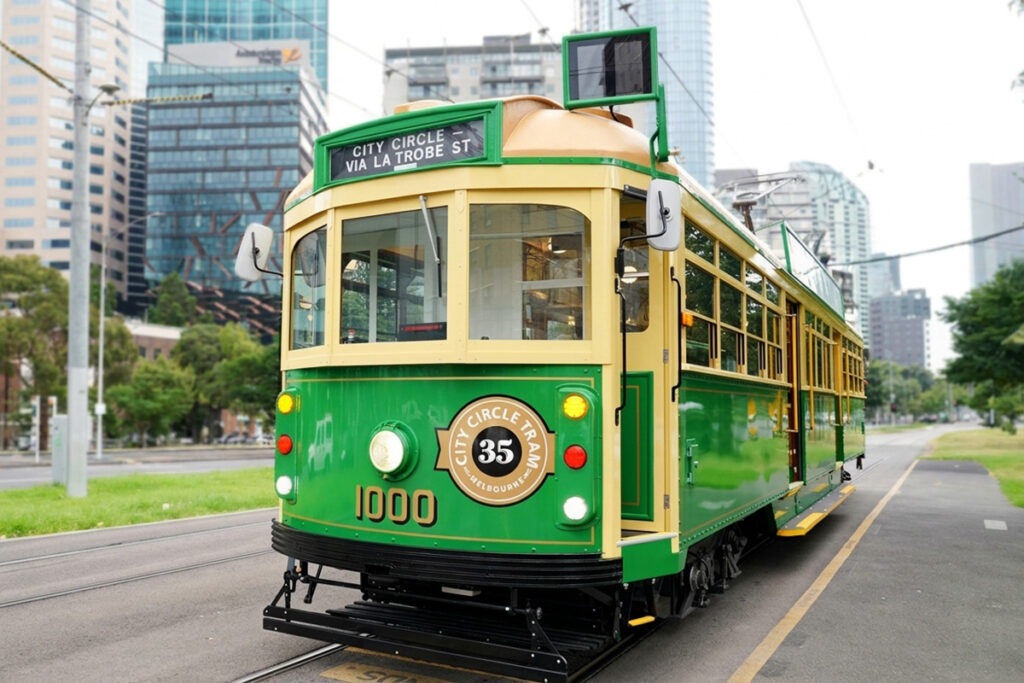
Climb the two wooden steps into a W8 and the temperature drops a degree, the light turns amber, and the floor gives slightly underfoot. These are the trams your grandparents rode. Built at Preston Workshops from 1923 onward, the W-class rolled through every decade of twentieth-century Melbourne: depression, war, the 1956 Olympics, the 1980s privatisation fights, the Docklands rebuild. Most Australian cities tore their trams up. Melbourne kept hers, and a handful still carry passengers on Route 35.
The interior is mostly original: tongue-and-groove timber walls, leather hand-straps, varnished bench seats, and bell cords running the length of the ceiling. Windows slide down in sashes. The trolley pole hums on the overhead wire. When the tram accelerates, the whole car rocks once before settling: that’s the mechanical cam controller, not a fault.
A few things to know before you board. These trams are nearly a century old in places, so they get withdrawn for maintenance without warning (you may occasionally see a modern Z-class substitute on the route). The steps are high and the floor pitches slightly toward the centre aisle. There are no seatbelts, no USB ports, and no air conditioning: the open windows are the cooling system. And when the driver applies the brakes hard, everything that isn’t bolted down (including you, if you’re standing) slides forward. Hold on.
One local tip, quoted often: worth doing two full circuits. The first loop you’re getting your bearings. The second you’re actually looking.
Stop-by-Stop: What You’ll Actually See
Route 35 runs clockwise only, a change introduced on 30 October 2023 to ease driver rostering. The loop traces the fringe of the CBD grid, plus a detour through Docklands. We’ve clustered the 27 stops by area below, with notes on which are worth alighting for.
Flinders Street and CBD Entry
Flinders Street Station. If you only board at one stop, board here. The ochre facade, the copper clocks, and the intersection at Flinders and Swanston (the busiest tram intersection in the world) are the quintessential Melbourne photograph. Step off the tram and you’re at Federation Square, opposite St Paul’s Cathedral, with the Yarra fifty metres south.
Federation Square / Russell Street. Alight here for Hosier Lane (the city’s most photographed street art), ACMI (Australia’s moving-image museum), NGV Australia at Federation Square, and Birrarung Marr park along the river.
Western CBD and Spencer Street
Spencer Street / Flinders Street. Southern Cross Station is a short walk north; Crown Casino and the Yarra promenade are a short walk south. Nearby you’ll find the Immigration Museum (in the old bluestone Customs House) and SEA LIFE Melbourne Aquarium.
Docklands (Harbour Esplanade)
Here the tram leaves the grid and loops through reclaimed dockland: wide modern plazas, glass apartment towers, and water on one side for roughly a third of the journey. Not everyone’s highlight, but useful if Docklands is on your list.
Marvel Stadium (D1). AFL matches, concerts, stadium tours.
Central Pier and Harbour Esplanade. Waterfront views, the Library at the Dock, ferry departures.
NewQuay / Waterfront City (D10 to D11). The Docklands dining strip, O’Brien Group Arena ice rink, and Harbour Town outlet shopping. The old Melbourne Star observation wheel still stands here but has been dormant since 2021.
La Trobe Street (Heading East, Back into the CBD)
Spencer Street / La Trobe Street. One of six La Trobe Street stops upgraded in September 2024 with level-access platforms, TramTracker displays, and new shelters. Note: the platforms are level, but the heritage trams still have steps.
Flagstaff / William Street. Short walk to Flagstaff Gardens, Melbourne’s oldest public park, dating to the 1840s.
Melbourne Central / State Library. One of the best alighting points on the loop. The State Library of Victoria is free and houses the domed La Trobe Reading Room and the original Ned Kelly armour. Across the road, Melbourne Central’s glass cone encloses the heritage Shot Tower, and Emporium Melbourne is a short walk south.
Elizabeth Street / La Trobe Street. Queen Victoria Market is a 5 to 7 minute walk north from here. The tram does not go to QVM directly, despite what some maps suggest.
Exhibition Street / La Trobe Street. The Old Melbourne Gaol is a block north: entry fee applies, but the Ned Kelly cell, the death masks, and the nighttime hangman tours are worth it for anyone interested in colonial history.
Victoria Parade and East Melbourne
Nicholson Street / Victoria Parade. The single best alighting stop for attractions, if you have a day to spend. Within a 5 to 10 minute walk: the Royal Exhibition Building (UNESCO listed, 1880), Carlton Gardens (also UNESCO), Melbourne Museum with its IMAX theatre, Fitzroy Gardens, and Cook’s Cottage. Easily a full day’s worth of things to do on its own.
Albert Street / Nicholson Street. Leafy East Melbourne: Victorian terraces, tree-lined streets, and views across to St Patrick’s Cathedral’s twin bluestone spires.
Spring Street (The Most Architectural Stretch)
If any stretch justifies the ride on its own, it’s Spring Street. You roll past four of Melbourne’s grandest nineteenth-century buildings in under five minutes.
Lansdowne Street / Spring Street. Parliament House of Victoria (free tours when parliament isn’t sitting), the Old Treasury Building, Treasury Gardens with its John F. Kennedy memorial, and the Princess Theatre (1886, and supposedly haunted).
Parliament Station / Spring Street. Parliament adjacent, with the Melbourne Club’s discreet facade opposite. A short walk west and you’re in the Block Arcade.
Collins Street / Spring Street. The tram clips the top of the Paris End of Collins Street: Hotel Windsor (1883, still taking afternoon tea bookings), grand plane trees, and Melbourne’s original luxury shopping blocks.
From here the tram rounds the corner and returns to Flinders Street Station, completing the loop.
Is It Worth It? The Real Pros and Cons
The genuine pros
- Completely free. No myki, no tap-on, no ticket. Walk up, board, ride.
- Heritage W-class tram. A rare piece of working transport history: wooden interiors, authentic rattle, a vehicle older than most of your grandparents.
- CBD orientation in under an hour. If you’ve just arrived in Melbourne, a full loop gives you a mental map of the grid, the river, and Docklands.
- Hop-on, hop-off. No booking, no time slot. Board at any of 27 stops during operating hours.
- Audio commentary in seven languages. English, French, German, Italian, Spanish, Mandarin, Japanese. Useful if English isn’t your first language.
- A photography platform. Large windows, slow speed, and elevated vantage for street-level shots.
- Slow is the point. Reframe the pace as leisurely sightseeing rather than transit and it stops being a flaw.
- Connects to every tram route it crosses. You can hop off Route 35 onto any modern tram to continue your day.
The genuine cons
- Very slow. The full loop takes 55 to 60 minutes. You could drive it in under 20 but that’s not the point.
- Circles the fringe only. Route 35 does not run down Collins Street, Bourke Street, or through the laneways: the parts of the CBD most first-time visitors want to see, although the other Free Zone Trams do.
- No air conditioning. Melbourne summers regularly hit 40 degrees Celsius. A packed W-class in January is a test of endurance.
- Crowded midday. 10am to 2pm on weekends, school holidays, and cruise ship days can mean standing room only, or waiting two or three trams for a seat.
- Limited hours. 9:30am to 5:00pm only. Evening services were removed in 2020 and haven’t returned.
- Not wheelchair or pram accessible. 2 to 3 steps to board, no ramp, no wheelchair space inside. You’ll need a second adult to lift a pram.
- Audio commentary can be drowned out. On a full, rattling tram, you may catch half of it.
- Clockwise only. Miss your stop and you ride the full remaining loop to get back.
- Maintenance withdrawals. Heritage trams break, and they’re pulled from service without notice.
- Docklands section is modern. About a third of the loop runs through reclaimed waterfront: new plazas, new apartments, limited heritage interest.
One local summed it up neatly: it’s leisurely transit, not efficient transportation, but it’s free, historically significant, and photogenic.
When to Skip It (and What to Do Instead)
Skip the City Circle Tram if any of these apply.
You’re in a hurry. Melbourne’s CBD is compact. Flinders Street Station to Parliament House is about one kilometre, roughly 12 minutes on foot, and you’ll walk through the best laneways and arcades on the way. Walk it.
You want to see the laneways. Hosier Lane, Degraves Street, Centre Place, Royal Arcade, Block Arcade, AC/DC Lane, Tattersalls Lane: the real Melbourne is interior grid, and none of it is on Route 35. Pick up a laneway walking map and go on foot.
It’s over 30 degrees. Catch a modern tram instead. Routes 86 (Bourke Street), 96 (Bourke Street and St Kilda Road), 75 (Flinders Street), 70 (Flinders Street east), and 109 (Collins Street) are all air-conditioned, wheelchair accessible, run more frequently, and are free within the Free Tram Zone. See our Free Tram Zone map for the full boundary.
You’re travelling with a wheelchair, pram, or mobility aid. The heritage trams have steps and no ramp. Use a modern tram on another route instead: all post-1995 trams in Melbourne are fully accessible.
You want a broader sightseeing loop. A commercial City Sightseeing hop-on-hop-off bus (around $40 to $60 AUD) covers St Kilda, Fitzroy, South Yarra, and the Shrine of Remembrance: well beyond the CBD fringe. Route 35 stays inside the grid.
Practical Tips
- Board early or late. Catch it just after 9:30am or after 3:30pm for the best chance of a seat and a quieter audio commentary. As one local put it: get on early in the morning or late afternoon for a quieter trip.
- Sit on the right-hand side. Clockwise means the best views (Docklands water, Spring Street architecture) sit to your right. Left-side seats mostly face buildings.
- Start at Flinders Street Station. Easy to find, plenty of trams waiting, and you’re ending your loop where the major laneways begin. Alternative: start at Parliament if you want to finish near a train or a pub.
- Plan the hop-off, not the loop. Rather than riding all 55 minutes, use it to connect two or three sights: Nicholson Street for Carlton Gardens, then Spring Street for Parliament, then back to Flinders for dinner.
- Check the weather. No air conditioning, remember. If the forecast is over 32 degrees, pick a modern tram route instead.
- Don’t rely on it for Queen Victoria Market. The closest stop is Elizabeth Street / La Trobe Street, and it’s a 5 to 7 minute walk north from there. A tram on Route 19 or 57 drops you closer.
- Expect maintenance substitutions. Occasionally a modern tram runs the route in place of the heritage fleet. You still get the loop, just without the wooden interior.
- Charge your phone. No USB, no power, and you’ll take more photos than you expect.
For context on how Route 35 fits into the wider network, see our Melbourne Trams guide.
Frequently Asked Questions
Is the City Circle Tram free?
Yes. Completely free. No myki required. The entire Route 35 loop sits within the Free Tram Zone, so you can board and alight at any of the 27 stops without tapping on.
How long does the full loop take?
55 to 60 minutes for one continuous clockwise circuit, depending on traffic and how many passengers board at each stop.
Where is the best place to board?
Flinders Street Station is the most convenient starting point: easy to find, central to the rest of the CBD, and a natural place to end up after a full loop. Parliament (Spring Street) is a good alternative if you’d rather finish near a train station.
What direction does it go?
Clockwise only. Since 30 October 2023, Route 35 has run one direction only: Flinders Street, Spencer Street, Docklands, La Trobe Street, Victoria Parade, Spring Street, and back to Flinders Street. There is no anticlockwise service.
Is it wheelchair accessible?
No. The heritage W-class trams have 2 to 3 steps to board, no ramp, and no wheelchair space inside. The La Trobe Street stops were upgraded with level-access platforms in September 2024, but the trams themselves still have steps. If you need an accessible tram, all modern trams on other routes are fully accessible and also free within the Free Tram Zone.
Is it worth riding the full loop or hopping on and off?
Both work. A single full loop takes just under an hour and gives you a complete CBD orientation. Hopping on and off lets you combine sights (Carlton Gardens, Parliament, the State Library) with the novelty of the tram itself. A local tip worth repeating: if you do ride the full loop, consider doing it twice. The first time you’re finding your bearings, the second time you’re actually looking.
Is it the only free tram in Melbourne?
No. Every tram running inside the Free Tram Zone is free, including the modern, air-conditioned, accessible ones. The City Circle Tram’s distinction is that it’s the only heritage route, and the only one specifically aimed at sightseeing.
What’s the difference between the City Circle and other CBD trams?
The City Circle uses heritage W-class trams (wooden interiors, no air conditioning, steps to board) and runs a fixed clockwise loop around the CBD fringe with audio commentary for tourists. Other CBD trams use modern low-floor vehicles, run multiple routes through the centre of the grid, connect to the suburbs, and operate from roughly 5am to midnight. They’re free inside the zone but not designed for sightseeing.
Does it go to Queen Victoria Market?
Not directly. The closest Route 35 stop is Elizabeth Street / La Trobe Street, and the market is a 5 to 7 minute walk north from there. For a closer drop-off, Routes 19, 57, and 59 stop right outside the market on Elizabeth Street.
Is it air conditioned?
No. The W-class trams are nearly a century old and rely on sliding windows for ventilation. On a hot Melbourne day (and Melbourne summers regularly hit 40 degrees Celsius), a packed heritage tram gets very warm very quickly. Pick a modern route if the forecast is above 32.
How often does it run, and what if I miss one?
Every 12 minutes between 9:30am and 5:00pm daily, closed Christmas Day and Good Friday. If you miss one, the next is usually visible down the street. If you miss your stop mid-loop, remember it’s clockwise only: you’ll need to ride the remaining stops to get back.
What are the best stops for tourists?
Our pick of the 27: Flinders Street Station (iconic station and laneway access), Federation Square / Russell Street (Hosier Lane, ACMI, NGV), Melbourne Central / State Library (free library, Shot Tower, shopping), Nicholson Street / Victoria Parade (Royal Exhibition Building, Carlton Gardens, Melbourne Museum, Fitzroy Gardens), and Lansdowne Street / Spring Street (Parliament House, Treasury Gardens, Princess Theatre). Five stops, a full day’s worth of Melbourne.