
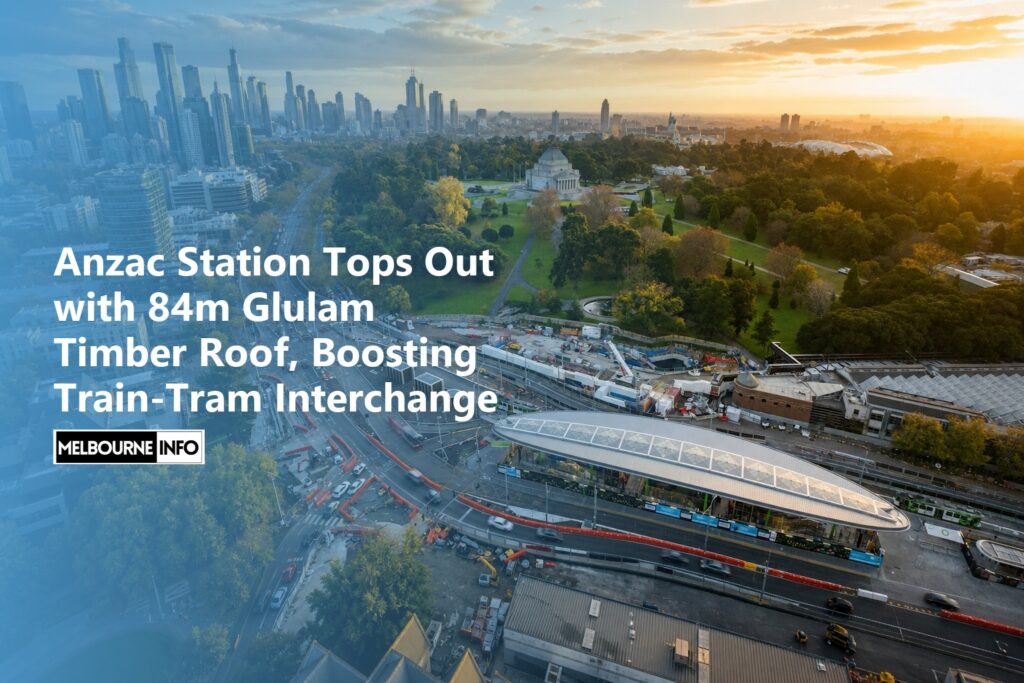
One hundred and sixty-four curved glulam sections and 190 cross-laminated timber panels now form the canopy above Anzac Station’s tram superstop. The result is an 84-metre-long, 20-metre-wide diagrid roof, the largest mass timber structure on any Australian rail station.
The roof marks the final architectural piece of Melbourne’s first platform-to-platform train-tram interchange, which opened to passengers on 30 November 2025. Part of the $12.8 billion Metro Tunnel project, Anzac Station sits beneath St Kilda Road, connecting the six tram routes that make this corridor the busiest in the world with the new Sunbury-Cranbourne/Pakenham line.
Already, the station handles an average of 14,500 passengers per peak hour, easing crowds at Flinders Street and giving southeast commuters a direct, step-free switch from train to tram without ever reaching street level.
The timber structure was fabricated in Europe by German manufacturer HESS TIMBER and Austrian firm HASSLACHER, then shipped to Melbourne in 20-metre segments for assembly. In a statement, HESS TIMBER said: “We are pleased to have been able to work with CYP Design and Construction on this project.”
On Reddit, passengers have reported that the station feels “seamless” and is ideal for spontaneous trips to the Shrine of Remembrance or events like Rising Festival. Some noted that ground-level timetable displays are absent, meaning you need to tap on before seeing departure times.
The canopy is part of a broader biophilic design intended to reflect the adjacent shrine and parklands. Exposed timber soffits, 12 skylights along the spine, and glazed light shafts draw natural light down to the platforms, while the station’s columns, standing up to 16 metres high, double as green structural elements. Above ground, the former roadway has been transformed into 5,000 square metres of new parkland, the Albert Road Reserve, with enhanced planting.
The use of low-carbon mass timber is also a sustainability milestone. The glulam beams and CLT panels store carbon and required less embodied energy than a steel or concrete equivalent, and the hybrid steel-timber frame was designed for disassembly and future reuse.
For regular commuters from the southeast, Anzac Station already outperforms other interchanges. A transfer from a Cranbourne or Pakenham train to a St Kilda Road tram takes under two minutes, saving an estimated five to ten minutes compared with negotiating stairs and escalators at Flinders Street or Richmond.
The station’s design rewards those who use it differently. The main entrance is not at street level but on a raised tram superstop that accommodates four trams simultaneously. On Grand Prix or Anzac Day weekends, when St Kilda Road is choked with car traffic and many streets are closed, arriving by Metro Tunnel train is the fastest way to reach Albert Park or the Shrine, with no station parking to contend with. If you must drive, Domain Interchange car parks charge upwards of $20 a day and fill early.
Trains run to Anzac from Sunbury via Footscray and the CBD, or from Cranbourne and Pakenham via South Yarra. Trams 3, 5, 6, 16, 64, 67, and 72 stop directly outside the station at stop 20, with lifts to both platforms. Walking from South Yarra station takes about 10 minutes.
Once you surface, the Shrine of Remembrance is opposite, the Royal Botanic Gardens are a 10-minute walk, and the Southbank dining strip is two tram stops away. It is a station built not just for commuters but for city access.
Beneath the timber canopy, sunlight now filters through 12 skylights onto the tram platform, a scene no other Melbourne station offers. For the thousands who pass through daily, that is the difference between a transfer and a journey.
Quick Facts
Metro Tunnel Project
Victoria’s Big Build twin 9km rail tunnels with 5 new stations connecting Sunbury to southeast Melbourne, doubling peak capacity to 537,000 daily passengers. Opened 2025, revolutionizing the network by bypassing City Loop. Managed by Rail Projects Victoria.
Rail Projects Victoria
Victorian Government authority delivering major rail projects including Metro Tunnel, Regional Rail Revival, and High Capacity Metro Trains. Oversees design, construction, and operations for new infrastructure.
Anzac Station
Underground Metro Tunnel station under St Kilda Road, first direct train-tram interchange in Melbourne with extra-large platforms for 4 trams. Features timber canopy pavilion blending into parklands, serving Botanic Gardens and Shrine precinct.