
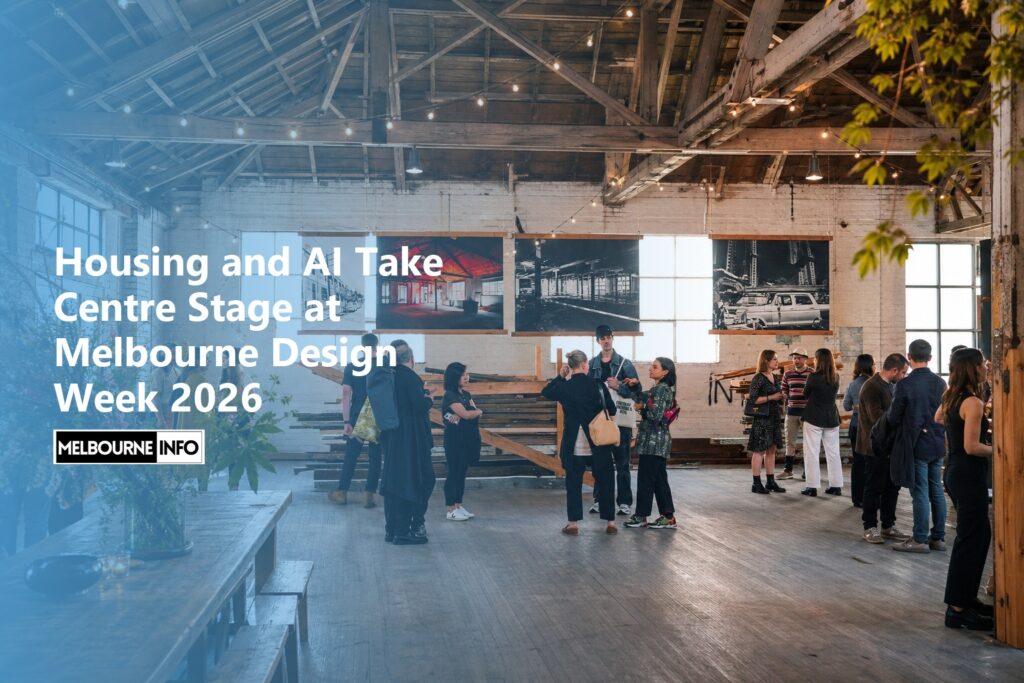
For its first nine years, Melbourne Design Week traded in possibility. For its tenth, it deals in delivery.
The festival that once filled galleries with conceptual prototypes and speculative futures has turned practical in 2026. Running 14 to 24 May, the 400-plus events across Melbourne and regional Victoria are grounded in real-world problems: how to build quality higher-density housing under Victoria’s new planning rules, and how to integrate artificial intelligence into architecture so it actually speeds up construction and cuts carbon, not just looks good in a slide deck.
The shift is clearest inside Monash University’s Future Building Initiative, where researchers have programmed workshops and exhibitions that show AI-enabled workflows already in use on live projects. “Our first speaker for AI Workflows for Future Building Delivery as part of Melbourne Design Week 2026,” the team posted on LinkedIn ahead of the festival launch, a single line that signalled a program built around practitioners, not provocateurs.
That event, hosted across NGV and Monash venues, explores how machine learning and integrated design tools are changing the way architects collaborate with engineers and builders. Attendees will see product and process integration that supports faster building delivery and measurable environmental performance, not theoretical gains.
The housing strand is equally direct. ‘Designing Density Well: Delivering Quality Homes for Victorians’ moves straight past the old arguments about whether we need density and into how to do it properly. Session leaders will walk through the design, finance and construction realities unlocked by recent planning reforms, naming specific building typologies that fit the missing middle. A companion event, ‘Notions of Home,’ presses further into what makes a well-designed apartment actually feel like home, a question that matters more when more Victorians are living in one.
The National Gallery of Victoria, which presents the festival with support from Creative Victoria, has threaded the 10th-anniversary program with the theme “Design the world you want.” But unlike anniversary editions that look back, this one uses the milestone to publish work that is already changing how buildings get approved and assembled.
If you want to understand how AI is reshaping architecture, the Monash Future Building events are the pick. The AI Workflows workshop has limited capacity, and the organisers are treating it like a professional development day rather than a lecture. Booking early is the difference between watching a demonstration and sitting at a workstation.
For residents, planners and councillors, the Density Well session is the one that will leave you with checklists rather than manifestos. It runs once during the festival and does not repeat, so treat it like a council briefing you cannot afford to miss.
A common mistake is assuming a festival of this size must be ticketed and expensive. Many exhibitions and talks are free, including Monash’s public forums on decarbonisation and building delivery. Check the official program before you write off a day because of cost. Another mistake is planning for a single visit. The program runs a full 11 days, with events clustered around the middle weekend and again in the final days. Spreading your attendance lets you catch both the AI demonstrations and the housing sessions without compromise.
The difference from earlier Design Weeks is material. Previous years used AI as a speculative lens; this year it is presented as a tool already in use on real building projects. Likewise, housing discussions have moved from abstract debate about density to the specific question of how Victoria delivers quality homes post-reform. It is the program an industry under pressure to build faster and better actually needs.
Most central venues, including NGV on St Kilda Road and Monash city sites, are easy to reach by tram. Routes 1, 3, 5, 6, 16, 64, 67 and 72 stop near the gallery, and Flinders Street Station is a short walk to many city events. Driving means hunting for parking in Southbank, which rarely ends well during a festival.
If you are making a day of it, the laneway cafes and small bars around Federation Square and Southbank are the natural bookends. Melbourne Museum and NGV International are running concurrent activations, so a single tram ride can string together a full day of design without leaving the grid.
The organisers have been careful to note that the 10th-anniversary format, with its emphasis on exclusive workshops and Monash-led research, may not return in the same way. Once the festival closes on 24 May, the demonstrations and roundtables that show how an architect can halve the time between sketch and submission will be gone, leaving only the buildings they helped produce.
Quick Facts
National Gallery of Victoria
Australia’s oldest public art museum and the presenting partner of Melbourne Design Week. It hosts major exhibitions and events that showcase design innovation and connect the public with contemporary practice.
Monash Art, Design and Architecture
Faculty at Monash University delivering research and public programs on housing, AI in design and future building. It runs multiple events at Melbourne Design Week 2026 including the Future Building Initiative.