
Say “Dandenong” to most Melburnians and two pictures arrive at once. One is misty hills, a steam train whistling through fern gullies, and a giant strawberry milkshake at the bottom of the Puffing Billy queue. The other is a flat, busy grid of streets where charcoal smoke from kebab grills drifts past trays of fresh naan and tables of mangoes stacked four deep. Only one of these is the suburb of Dandenong (it’s the second one). The hills belong to the Dandenong Ranges, a separate destination 40km further north-east, and the two get confused so often that locals have stopped being surprised by it.
Walk out of Dandenong Station on a Saturday morning and you could pass through half a dozen countries before lunch. Afghan bakeries pull bread from tandoor ovens on Thomas Street. Foster Street smells of cardamom and frying dosa batter. Inside the market, stallholders call out in Vietnamese, Punjabi, and Khmer over bins of produce that have been sold here, in one form or another, since 1866. Nothing about it is staged for visitors. There’s no archway welcoming you to a “cultural precinct,” no curated laneway of approved eateries. It’s just how the suburb runs, every day, because roughly six in ten residents of the wider council area were born overseas and more than 150 birthplaces are represented across the municipality.
That working, lived-in quality is the whole point. Dandenong functions as a genuine regional centre, sometimes called Melbourne’s “second CBD,” with its own civic precinct, courts, hospital, and major shopping strip. It’s not pretty in the postcard sense. It’s useful, busy, and consistently underrated, and for anyone chasing the best value food in greater Melbourne, that combination is hard to beat.
| Feature | Summary |
|---|---|
| Location | About 30km south-east of the Melbourne CBD, in the City of Greater Dandenong (postcode 3175) |
| Getting there | Pakenham or Cranbourne line train to Dandenong Station, around 50 minutes from Flinders Street |
| Best for | Food crawls, multicultural markets, and buyers chasing affordable train-line property |
| Signature spots | Dandenong Market, the Afghan Bazaar (Lonsdale and Thomas Streets), Little India (Foster Street) |
| Price level | Some of the most affordable eating in Melbourne, mostly $10-25 a head |
| Time needed | Half a day for a proper food crawl, longer if you’re house-hunting |
| Common mix-up | Not the Dandenong Ranges. That’s a forested area near Belgrave and Olinda, a different trip entirely |
Dandenong Boundary Map
Jump to: Who It’s For | What Makes It Different | Things to Do | Where to Eat | What Locals Know | Living Here | Is It Worth It? | FAQ
Who It’s For
Dandenong rewards two very different groups, and they’re not always the same people. As a destination, it suits anyone who treats eating as the main event of a day out: families happy to share a buffet, friends planning a self-guided crawl across three precincts, or curious eaters who’d rather queue at a market stall than book a restaurant. As a place to live, it suits buyers and renters who want a direct train line into the CBD without inner-suburb prices, and who value being part of an established multicultural community over having a leafy street or a five-minute commute.
It won’t suit everyone. If you’re after the Dandenong Ranges (the forests, the 1000 Steps, Puffing Billy), this isn’t that suburb, and the Monash Freeway will take you somewhere completely different. If you’re house-hunting for character architecture or a short hop to Flinders Street, Dandenong’s industrial edges and 50-minute commute will test your patience. Know which version of “Dandenong” you actually want before you commit to either a visit or a mortgage.
What Makes It Different
Melbourne has plenty of multicultural food precincts, but Dandenong’s version is different in kind, not just degree. Where Chinatown or the restaurant strip in Glen Waverley present a single, polished community identity built partly for visibility, Dandenong runs three or four communities in parallel, on overlapping streets, none of them dressed up for tourism. Afghan, Indian, Sri Lankan, Pakistani, Vietnamese, Cambodian, and Turkish businesses sit within a ten-minute walk of each other, and most of their customers are locals doing a weekly shop, not visitors on a food tour.
The other thing that sets Dandenong apart is scale and intent. This isn’t a strip of restaurants tacked onto a residential suburb. It’s a genuine regional city centre: the commercial and civic hub for Melbourne’s south-east, with its own courts, hospital precinct, and major retail centre in Dandenong Plaza. The Revitalising Central Dandenong project has brought more than $700 million in private investment into the area, upgrading public spaces and commercial buildings while the food precincts around it have largely kept their unpolished, working character. That contrast (serious civic infrastructure next to a 160-year-old produce market) is what gives Dandenong its particular energy. It’s not trying to be charming. It’s just getting on with being a city.
Things to Do
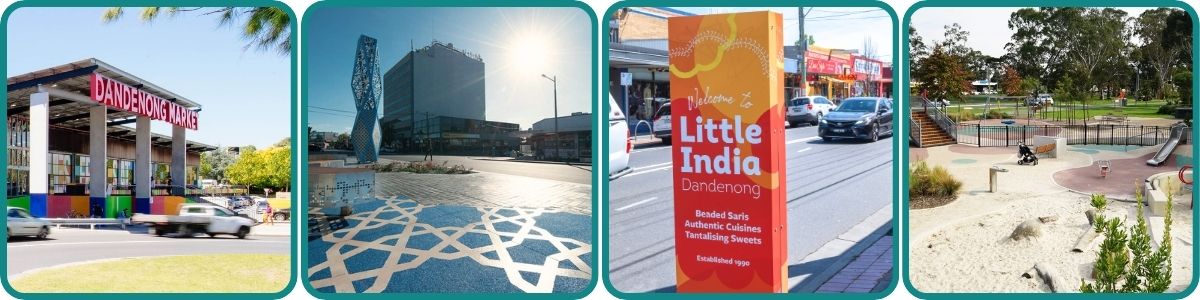
Dandenong Market
Trading continuously since 1866, Dandenong Market is one of Melbourne’s oldest and most genuinely diverse produce markets, with around 200 traders representing close to 150 nationalities. The fresh produce halls are the main draw: piles of vegetables and fruit at prices that make Queen Victoria Market look expensive, alongside spice stalls, butchers, and bakeries serving specific migrant communities rather than a general tourist crowd. Inside, the food court does double duty as a genuinely good lunch spot in its own right, with stalls covering Vietnamese, Chinese, and broader Asian cooking. Go on a weekday morning if you want to browse without crowds, or embrace the Saturday rush if you want the full atmosphere.
The Afghan Bazaar (Lonsdale and Thomas Streets)
This strip is one of the most significant concentrations of Afghan restaurants and grocers in Australia, and it’s the reason food writers from across Melbourne make the trip out. Charcoal grills, tandoor ovens turning out fresh naan, buffet counters loaded with qabuli pulao and mantu dumplings, and grocers stocked with ingredients you won’t find at a standard supermarket. It’s a working strip first and a destination second, which is exactly why it’s worth the trip: the prices and portions are set for locals, not visitors.
Little India (Foster Street)
Two blocks of Foster Street make up Dandenong’s Little India, with more than 30 South Asian specialty businesses: sari and jewellery shops, grocers stacked floor to ceiling with spices and lentils, sweet shops with trays of barfi and jalebi, and restaurants spanning Indian and Sri Lankan menus. It’s at its best during festivals (Diwali in particular draws crowds and extended trading hours), but any weekend gives you a genuine browse through one of Melbourne’s most concentrated South Asian retail strips.
Dandenong Park and the Drum Theatre
For a change of pace, Dandenong Park offers mature trees, open lawns, and a quieter, Victorian-era green space near the centre of town, useful as a halfway point between the market and the Afghan Bazaar. Nearby, the Drum Theatre is Greater Dandenong’s main performing arts venue, running a program of theatre, music, comedy, and community events that reflects the suburb’s cultural mix. Worth checking the calendar if you’re planning an evening visit.
Where to Eat
The honest answer is that you should plan to eat more than once. Here’s where to start across the three precincts.
- Afghan Mum’s Restaurant: long opening hours and a generous buffet covering qabuli pulao, kebabs, and traditional Afghan rice dishes. A reliable first stop for a casual sit-down meal.
- Afghan Salang Restaurant and Cafe: traditional staples done well, including kebabs, mantu dumplings, bolani, and rice dishes, in a no-fuss cafe setting.
- Balkh: charcoal-grilled mixed platters and kebabs, a regular favourite along the Thomas Street strip.
- Sarwari Restaurant: spans both Afghan and Pakistani menus, with enough variety to suit a group with different tastes.
- Pamir Kabob House: straightforward, well-regarded charcoal kebabs and grills, part of the Afghan Bazaar cluster.
- Afghan Charcoal Kebab and Bakery: fresh naan straight from the tandoor. Locals time their visits around the bake.
- Little Asia and Food To Go (Dandenong Market): Vietnamese and Chinese market stalls covering banh mi, noodle soups, dumplings, and roast meats. Good for a quick, cheap lunch while you browse.
- Little India eateries (Foster Street): curries, biryani, dosas, and an excellent run of Indian and Sri Lankan sweet shops for dessert.
- A La Turko: Turkish pide, kebabs, and grills, adding to the broader halal dining options around the centre.
We caught the train in specifically because we’d heard parking gets tight on market days, and it made the whole visit easier: straight off the platform and into it. The buffet at the Afghan restaurants is a great way to sample widely, but go a little before the dinner rush so the trays are freshly topped up and the bread comes out hot.
What Locals Know
- Take the train, not the car. Especially on market days, when parking around the centre gets tight fast. Dandenong Station sits a short walk from all three precincts.
- Go early for the market. The freshest bread and produce move quickly, and the food court is calmer before midday.
- Ask what’s fresh at the buffets. They’re a great way to sample widely, but trays sitting since opening won’t be at their best. A quick question to staff goes a long way.
- Walk it as a loop. The Afghan precinct, Dandenong Market, and Little India are close enough to combine into a single walking circuit, roughly in that order from the station.
- Time a visit around festivals. Diwali in particular turns Little India into one of the best nights out in Dandenong, with extended trading and a real buzz on Foster Street.
- And one more time, for the search engines: this is not the Dandenong Ranges. If you’re after 1000 Steps or Puffing Billy, you want a different trip altogether.
What It’s Like to Live Here
On paper, Dandenong is one of the better value propositions within 30km of the Melbourne CBD on a direct rail line. The median house price sits around $765,000 and units around $480,000, both comfortably below comparable middle-ring suburbs with similar commute times, and both have shown steady annual growth of around 5.5%. Median weekly rent for a house is roughly $530. For first-home buyers and renters prioritising transport access and affordability over a short commute, those numbers are hard to argue with.
Dandenong Station is a major interchange, served by both the Pakenham and Cranbourne lines plus an extensive bus network, which means frequent services even outside peak hours. The suburb also functions as a genuine employment hub in its own right: council offices, courts, a major hospital precinct, and a large retail and commercial centre mean plenty of residents work locally rather than commuting at all. For migrant and multicultural families in particular, the area has deep roots: established places of worship, community organisations, and culturally specific services that have built up over decades.
The trade-offs are real, though. The built environment is more industrial and utilitarian than leafy or architecturally distinctive, and a 50-minute train trip to Flinders Street is a genuine commute, not a quick hop. If your priority list starts with character streetscapes or a short trip to the city, Dandenong will sit lower on it. If affordability, transport, and an established multicultural community matter more, it’s a genuinely strong option, and one that’s easy to underestimate if you’ve only ever driven past on the freeway.
Is It Worth It?
As a day trip, yes, without much hesitation. The combination of Dandenong Market, the Afghan Bazaar, and Little India gives you one of the most genuinely diverse and affordable eating experiences anywhere in Melbourne, all within easy walking distance of the train station. You won’t find this combination, at these prices, with this little pretension, in many other parts of the city.
As a place to live, it’s a stronger option than its reputation suggests, provided your priorities line up with what it actually offers: affordability, transport, and community over polish and proximity. It particularly suits food lovers who want authentic Afghan, Indian, Sri Lankan, Pakistani, and Vietnamese cooking at honest prices, visitors who’d rather experience working multiculturalism than a curated cultural precinct, and first-home buyers chasing train-connected property within reach of the CBD.
It’s a weaker fit for anyone specifically chasing the Dandenong Ranges (a different destination altogether, despite the shared name), buyers who want leafy streets or a short CBD commute, or visitors expecting a polished, tourist-oriented dining strip. Know which version of Dandenong you’re after, and the rest sorts itself out.
FAQ
How far is Dandenong from Melbourne CBD?
Dandenong is about 30km south-east of the Melbourne CBD. By train on the Pakenham or Cranbourne line, the journey to Flinders Street takes around 50 minutes. By car via the Monash Freeway, expect roughly 35-45 minutes depending on traffic.
Is Dandenong the same as the Dandenong Ranges?
No. The suburb of Dandenong (postcode 3175) is a flat, busy, multicultural commercial centre in Melbourne’s outer south-east. The Dandenong Ranges are a separate area of forested hills and townships, including Belgrave, Olinda, and Sassafras, located further north-east and home to attractions like the 1000 Steps and Puffing Billy. They share a name because of the geography, but they’re quite different destinations.
What is Dandenong known for?
Dandenong is best known as one of Melbourne’s most culturally diverse suburbs, home to Dandenong Market (trading since 1866, with around 200 traders from roughly 150 nationalities), the Afghan Bazaar food precinct on Lonsdale and Thomas Streets, and the Little India cultural precinct on Foster Street. It also functions as a major regional commercial and transport hub, sometimes described as Melbourne’s “second CBD.”
What is the best way to get to Dandenong from the city?
Train is the easiest option. Dandenong Station is served by both the Pakenham and Cranbourne lines, with frequent services throughout the day, and sits within walking distance of the market, the Afghan Bazaar, and Little India. Tap on with myki as you would for any Metro train.
What are property prices like in Dandenong?
As of 2026, the median house price in Dandenong sits around $765,000 and the median unit price around $480,000, both well below comparable suburbs with similar train access to the CBD. Median weekly rent for a house is roughly $530. Both house and unit prices have grown at around 5.5% annually, reflecting ongoing investment in the area through the Revitalising Central Dandenong project.