
Preston Victoria has spent 150 years turning food into its identity, first as market gardens and dairy farms feeding early Melbourne, then as a bacon-curing and tannery town built on migrant labour, then as the home of Preston Market, and now as a High Street and Plenty Road strip that runs from Vietnamese pho to American barbecue to an Italian prosecco bar within a few blocks of each other. That through-line matters more than the usual “gentrifying inner-north suburb” label, because it explains why Preston feels different from its northern neighbour Reservoir, which shares the same council area but not the same food culture, the same market, or, as it turns out, the same rail upgrade.
Preston Suburb Map
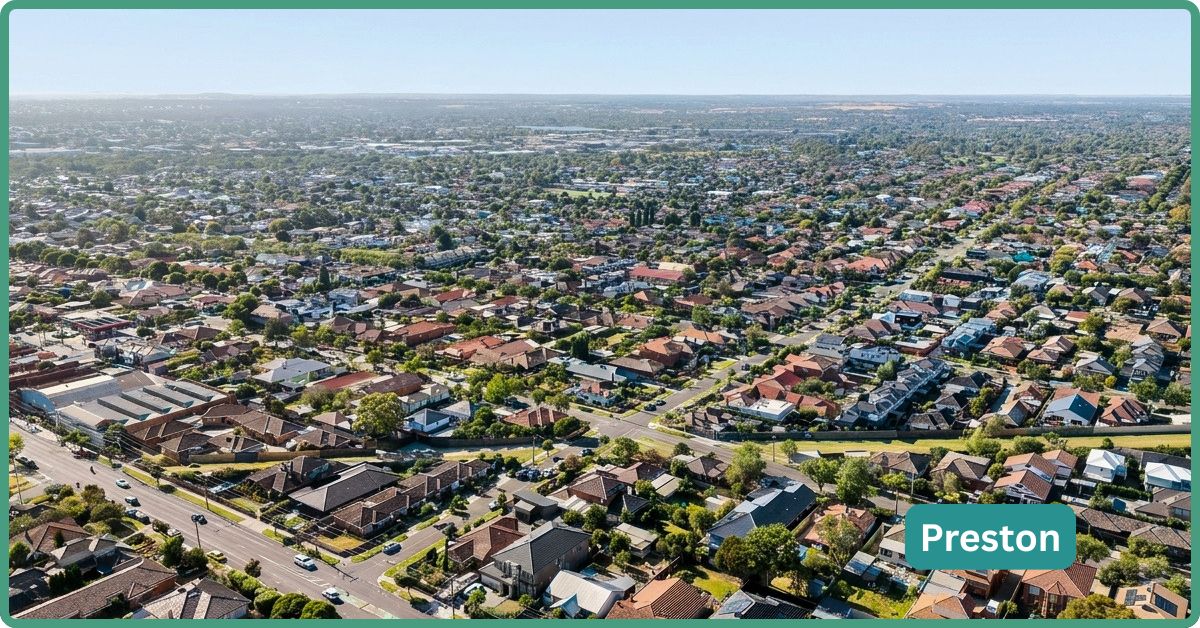
Preston sits in the City of Darebin, about 8km north of the Melbourne CBD, bordered by Reservoir to the north, Thornbury and Northcote to the south, Coburg to the west across the Merri Creek, and Bundoora further north-east.
Quick Facts
| LGA | City of Darebin |
| Median House Price | Genuinely contested between sources, ranging roughly $970,000-$1.2 million (2026 data); treat as a range rather than a single figure |
| Median Unit Price | Also contested, between roughly $529,500 and $599,747 depending on source |
| Population | 33,790 (2021 Census, whole suburb); no confirmed current figure, though gentrification and infill development suggest it’s likely higher now |
| Growth Rate | Established, infill-driven suburb rather than a growth corridor; the last rapid growth phase was the postwar industrial boom of the 1940s-60s |
| Transport | Preston station on the Mernda line. Level crossing removal at Oakover Road, Bell Street, Cramer Street and Murray Road is complete, with the line elevated and new stations open. Not on the confirmed Suburban Rail Loop North station list, unlike neighbouring Reservoir |
| Crime Rate (LGA) | City of Darebin: around 12,362 offences per 100,000, higher than the Victorian average, though the exact comparator figure and release date weren’t pinned down precisely |
| Childcare Availability | Runs through Darebin Council’s centralised waitlist system; no confirmed wait-time figure or specific NQS ratings for Preston centres found |
| School Zone Quality | Preston High School, John Fawkner College and St John’s College Preston all serve the area |
| Best For | Buyers wanting the cheapest genuine entry point into the Northcote-Thornbury-Coburg-Brunswick inner-north corridor, with a real food and market culture attached |
Our Verdict
Preston is a great choice if you want inner-north character, a genuinely famous food market, and one of the most diverse dining strips in Melbourne’s north, at a price that still undercuts every other suburb in its immediate comparison set. Preston is consistently the cheapest of the Northcote-Thornbury-Coburg-Brunswick cluster, with Northcote running as high as $1.72 million and Thornbury sitting around 23% above Preston and growing faster again. Don’t buy here expecting a Suburban Rail Loop uplift, though: that’s genuinely Reservoir’s advantage next door, not Preston’s, since Preston doesn’t appear on the confirmed SRL North station list at all.
It suits those who want walkable food and market culture over a brand-new house. It’s a weaker fit for anyone chasing the newest possible infrastructure investment, since Preston’s big recent transport win, the level crossing removals, is already delivered rather than upcoming, and its biggest current development story, the Northland transformation, is still at the planning and masterplan stage rather than under construction.
Weighed against its closest comparables, Preston is the value play against Thornbury and Northcote, both meaningfully pricier and further along the same gentrification path Preston is still walking. Coburg sits in a similar affordability tier and shares a comparable multicultural-turned-gentrifying story, a genuine cross-shop suburb rather than a stretch comparison. Reservoir, immediately north, is cheaper again and more suburban in character, without Preston’s market and dining scene, but with the genuine long-term advantage of a confirmed Suburban Rail Loop station that Preston won’t get.
Preston’s Backstory: Heritage & Origins
Even Preston’s name is a genuinely unresolved question. One account credits Edward Wood, a storekeeper who arrived from Sussex, England, and opened a store at High and Wood Streets in 1850, as the likely source of the name, after Preston in Sussex. This profile won’t assert a Lancashire connection some assume, since no source found in research actually confirms that version, and the honest answer is that several English placenames share the name Preston, and which one specifically inspired this suburb isn’t definitively settled. Before “Preston” stuck as the name, the area was known locally as “Irishtown,” after its early Irish settlers, with parts of what’s now central Preston called “Gowerville” through the 1880s.
Long before any of the retail or dining culture that defines Preston today, this was market garden and dairy farming country through the 1850s to 1880s, with remnant River Red Gum woodland still visible in places. Industry arrived from the 1860s: a bacon-curing factory in 1862, a tannery in 1865, and later larger operations including Huttons Hams and Bacons and Zwar’s Parkside Tannery, giving Preston a genuine working-class industrial identity built on migrant labour, distinct from the purely agricultural history of Melbourne’s newer growth-corridor suburbs. The former City of Preston then grew rapidly through the postwar boom, from 46,775 residents in 1947 to around 64,000 by 1954, a 37% jump, and to 84,146 by 1961, before being formally designated a suburban centre under the Melbourne Metropolitan Planning Scheme in 1954. Preston Market, which opened on 11 August 1970 as a European-style pedestrianised open-air market and the first new market built in Melbourne since the interwar period, is the direct continuation of that market-gardens-to-multicultural-retail lineage, not a modern invention layered on top of it.
Preston’s Growth Story (or welcomed lack thereof)
Preston isn’t a growth-corridor suburb chasing rapid population expansion; its last genuine growth surge was the postwar industrial boom decades ago, and today’s story is one of infill development and gentrification rather than greenfield estates. The single biggest current development story is Northland. In March 2025, Nikos Property Group acquired a 50% stake in Northland Shopping Centre from GPT Group for $385 million, reportedly Victoria’s largest retail property transaction in seven years, with the remaining 50% held by Vicinity Centres in joint venture. The proposed masterplan, still subject to regulatory approval, is a 30-year staged plan for up to 2,300 residential apartments and 47,000 square metres of office space integrated with the existing retail core, across the roughly 19-hectare Northland site within a broader 135-hectare East Preston urban renewal precinct. Worth being precise here: this is a funded acquisition and a long-term masterplan, not a construction project with a confirmed start date, so treat any “coming soon” framing with real caution. A separate Preston Activity Centre planning process also exists through the Victorian Planning Authority, related to but distinct from the Northland masterplan, though it wasn’t detailed enough in research to describe further here.
Getting Around
Preston sits on the Mernda line, and its biggest recent transport win is genuinely delivered, not pending: level crossings at Oakover Road, Bell Street, Cramer Street and Murray Road have all been removed by elevating the rail line onto a viaduct through Preston, with new elevated Bell and Preston stations open, alongside a shared walking and cycling path and new public space, seating, play areas, barbecue facilities and an amphitheatre, under the rail corridor itself. This removed the equivalent of around 82,000 vehicles a day worth of boom-gate delay, with gates previously down for up to 40% of the morning peak. If you’ve seen this described as “underway” anywhere, that’s out of date: it’s finished.
From Preston Station, on the Mernda line, it’s around 34 min into the CBD with services every 20 min. See full train map.
Tram services run through the area too, including routes along the Gilbert Road/St Georges Road corridor and the Plenty Road/High Street corridor through the main dining strip, serviced by routes 11 and 86 respectively. See full tram map.
Buses also service the area including the popular 903 SmartBus which does a loop of Northland Shopping Centre – Heidelberg – Box Hill – Chadstone – Mordialloc. Bus 251 takes you into the CBD, and seven more buses connect the suburban areas; see here for more on buses and transport.vic.gov.au/journey for journey planning.
Preston is not on the confirmed Suburban Rail Loop North station list, which runs Doncaster, Heidelberg, Bundoora, Reservoir, Fawkner, Broadmeadows and Melbourne Airport. Reservoir, immediately to the north, gets a station; Preston does not. This is a genuine, specific point against the general “Preston is on the up” narrative and worth knowing if you’re weighing long-term transport-driven value between the two suburbs.
Crime and Safety, Honestly
Victorian crime data is published at City of Darebin LGA level, not suburb level, so there’s no Preston-specific figure. The LGA recorded around 12,362 offences per 100,000 people in the most recent period found in research, with property and deception offences the dominant category, and this rate sits higher than the Victorian state average.
Schools and Childcare
Preston High School and John Fawkner College (technically zoned in neighbouring Fawkner but a genuine local option) are the main government secondary choices, with St John’s College Preston serving as a Catholic secondary alternative.
Childcare in Preston runs through the City of Darebin’s centralised waiting list system, where families register once and are contacted as places open, with wait time depending on room, days needed and demand.
Hospitals and Healthcare
Preston is well served by healthcare, with a mix of major public hospitals, specialist medical centres and local GP clinics nearby, giving residents access to comprehensive medical care without travelling far.
Key healthcare providers include:
- The Northern Hospital (about 15–20 minutes away) – A major public hospital providing emergency, maternity, surgery and specialist services.
- Austin Hospital – One of Melbourne’s leading teaching hospitals, offering comprehensive specialist care, emergency services and the renowned Olivia Newton-John Cancer Wellness & Research Centre.
- Northland Medical Centre – A large medical centre with GPs and allied health services.
- Preston Market Medical Centre – Convenient GP services in the heart of the suburb.
- Northland Homemaker Centre and surrounding precinct – Home to dentists, physiotherapists, pathology, radiology and other allied health providers.
Locals also benefit from nearby private hospitals such as John Fawkner Private Hospital and Northpark Private Hospital, while Heidelberg’s extensive medical precinct provides access to some of Victoria’s leading specialist and research facilities.
Get Outside: Parks, Attractions & Fitness
Preston isn’t renowned for greenspace; it’s quite dense urban living, although numerous ovals and small reserves are scattered across the suburb. For a nature escape, most locals head to Merri Creek Trail along the western edge of the suburb which offers walking, cycling and running trails along with picnic spots. Just south of Preston is Darebin Parklands which offers one of the best nature escapes in the inner-suburban area.
The suburb’s real standout attraction, though, is Preston Market itself: opened in 1970, growing by 2017 to around 80,000 visitors a week across 146 retail tenancies, 10 kiosks and 830 car spaces, a genuinely famous, historic fresh food market with no equivalent in neighbouring Reservoir. Worth knowing: the market’s future has been the subject of community campaigning against redevelopment threats historically, and this profile could not confirm the current 2026 status of any specific redevelopment risk, so treat this as a live, sensitive topic worth checking directly rather than assuming the market’s current form is guaranteed long-term.
Shopping and Dining
Beyond Preston Market and the Northland transformation covered above, the High Street and Plenty Road strip is Preston’s other genuine differentiator: a dining scene that runs from Dexter’s American barbecue to Sonny’s Bottega’s Italian and prosecco offering, Chumanchu’s Vietnamese pho, Maharaja’s Indian menu, and Stray Neighbour’s gastropub setup, alongside cafe culture at spots like Boundary Espresso and Sartoria. This is a genuinely diverse, destination-worthy food strip in a way that sets Preston apart from the more suburban retail character of Reservoir next door.
What It’s Actually Like to Live Here
Median age sits at 37, and the suburb’s cultural character still carries its Mediterranean migrant roots clearly: 52.3% of residents speak only English at home, with Greek (7.8%) and Italian (7.1%) the leading other languages, and Italy, Greece, England and China the top overseas birthplaces of residents’ parents, alongside a smaller but notable Vietnamese-born population. That’s a genuine layering of an older Mediterranean migrant base with newer Asian communities, consistent with a suburb gentrifying rather than starting from scratch. Owner-occupancy sits at 57.3%, up slightly from 56.7% in 2016, meaning renters still make up a substantial share of the suburb. Census-era figures for rent ($392 a week) and mortgage repayments ($2,000 a month) are both from 2021 and almost certainly understate current 2026 costs given rate rises and rental growth since, so treat those as a historical baseline rather than current pricing. Day to day, this reads as a suburb where market gardens became a food market, factories became apartments, and the food culture never really left, just changed cuisine as new communities arrived.
Trade-offs
Median house and unit prices are both genuinely contested across sources, with real, unreconciled gaps rather than one clean figure. Preston is not on the confirmed Suburban Rail Loop North list, a genuine disadvantage against neighbouring Reservoir specifically. The Northland transformation, the suburb’s biggest current development story, is still at the planning and masterplan stage, not under construction, so don’t factor it in as a near-term certainty. Specific school performance data wasn’t confirmed for local options, and childcare wait times aren’t quantified. And Preston Market’s long-term redevelopment status carries some historical community sensitivity that this profile couldn’t confirm as fully resolved.
FAQ
Is Preston a good suburb to buy in? It suits buyers wanting the cheapest genuine entry point into the Northcote-Thornbury-Coburg-Brunswick inner-north corridor, with a famous food market and diverse dining strip attached. It’s a weaker fit if you’re specifically chasing Suburban Rail Loop-driven value, since that’s a Reservoir advantage, not Preston’s.
What’s the median house price in Preston? Sources disagree meaningfully, ranging roughly $970,000 to $1.2 million as of 2026. Treat this as a genuine range rather than a single confirmed figure, and check a current local appraisal.
Is Preston on the Suburban Rail Loop? No. The confirmed Suburban Rail Loop North stations are Doncaster, Heidelberg, Bundoora, Reservoir, Fawkner, Broadmeadows and Melbourne Airport. Preston is not on that list, even though it borders Reservoir, which is.
Has the Preston level crossing removal been completed? Yes. Crossings at Oakover Road, Bell Street, Cramer Street and Murray Road have all been removed, with the Mernda line elevated through Preston and new elevated Bell and Preston stations already open.
References
- Australian Bureau of Statistics. 2021 Census QuickStats, Preston (SAL22121), Preston – West, Preston – East.
- Victoria’s Big Build. Preston level crossing removals; Bell to Preston and Reservoir project pages.
- Suburban Rail Loop Authority. SRL North station list.
- Nikos Property Group; Vicinity Centres; GPT Group. Northland Shopping Centre acquisition and masterplan announcements, March 2025.
- Victorian Planning Authority. Preston Activity Centre planning documentation.
- Crime Statistics Agency Victoria (via aggregated reporting). City of Darebin recorded offences, 2025.
- tomelbourne.com; Victorian Places-style local history sources. Preston name origin, Irishtown, Gowerville, market gardens and industrial history.
- Preston Market. History and current visitor/tenancy figures.
- Better Education; Good Schools Guide; My School. Preston High School; John Fawkner College; St John’s College Preston.
- htag.com.au; Your Investment Property Magazine; andreamonti.com.au; propereasy.com.au. Preston median house and unit price data, 2026.
- City of Darebin. Centralised childcare and kindergarten waitlist system.