
Caroline Springs was doing the master-planned lifestyle estate thing before most of Melbourne’s west had caught on. Ground broke here in 1998, a lake was dug as the organising design feature before “lake as amenity” was a growth-corridor cliché, and the whole thing won the UDIA’s national award for best master-planned community back in 2006, years before Tarneit, Truganina or Point Cook’s later stages existed as functioning suburbs at all. It’s also, contrary to what its geographic position between stationless Taylors Hill and the newer greenfield estates might suggest, a suburb with a train station carrying its own name, even if that station technically sits just over the line in neighbouring Ravenhall.
Caroline Springs Boundary Map
Caroline Springs sits in the City of Melton, bordered by Rockbank to the west, Truganina to the south, Hillside and Taylors Hill to the north, and the Deer Park/St Albans direction to the east.
Quick Facts
| Median House Price | $790,250, up 6.79% over 12 months (CoreLogic-sourced, mid-2026); a second figure of $870,073 circulates from another aggregator, genuinely unreconciled |
| Median Unit Price | $502,500, down 1.47% over 12 months (CoreLogic-sourced, mid-2026) |
| Population | Genuinely contested by boundary: ABS’s official suburb boundary gives 24,488 (2021 Census), while the City of Melton’s own demographic forecaster uses a smaller footprint giving around 20,300-20,900 and forecasts a slight decline to 2031 |
| Growth Rate | Essentially flat: +1.2% between the 2016 and 2021 Censuses on the ABS boundary, consistent with a suburb that finished building out before 2016 |
| Transport | Caroline Springs railway station (V/Line regional, opened 2017) technically sits across the boundary in Ravenhall; the $650 million Melton Line Upgrade has already extended its platforms, with electrification flagged as a longer-term ambition, not yet funded |
| Crime Rate (LGA) | City of Melton: roughly 9,403 offences per 100,000 (year ending September 2025); a much higher figure circulating elsewhere (20,345/100,000) appears to actually describe the Melton town suburb, not the LGA or Caroline Springs |
| Childcare Availability | Reasonably good: roughly 16 services identified locally, generally rated Meeting NQS, not visibly lagging population the way newer growth suburbs in this corridor often are |
| School Zone Quality | A dense, well-established cluster (Springside Primary, Creekside K-9 College, Lakeview Senior College, Brookside P-9 College), built alongside the estate rather than catching up to it; no ranking data confirmed |
| Best For | Buyers wanting an established, fully built-out master-planned suburb with genuine amenity and school infrastructure already in place |
Our Verdict
Take a look here if you want a mature, finished master-planned community with a real central lake, a dense cluster of established schools, and retail that’s already open rather than promised. Don’t buy here expecting further capital growth from population expansion: this suburb is essentially built out, and its population has plateaued or is even forecast to decline slightly depending on which boundary you use, a genuinely different story from the newer suburbs in this corridor still filling up.
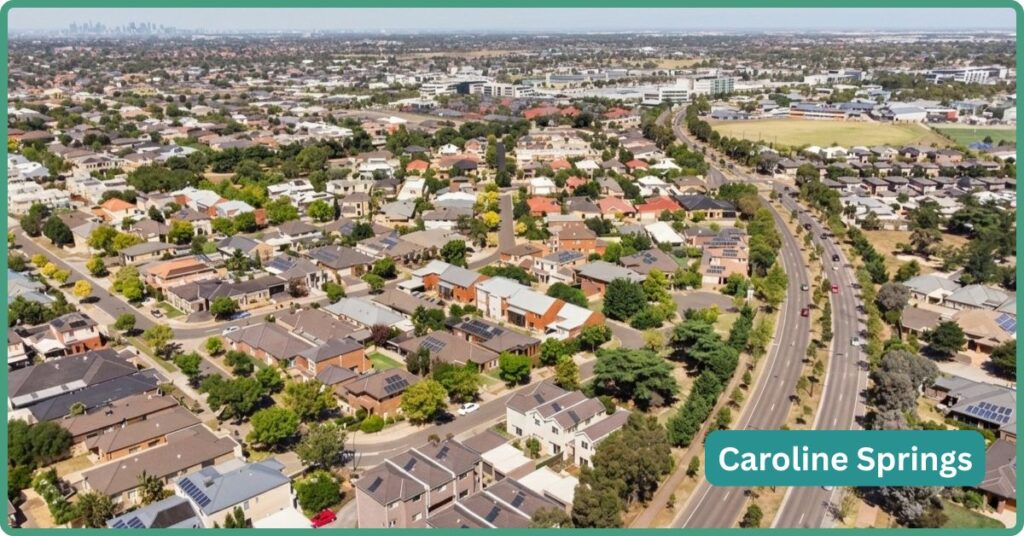
It suits established families who want the settled character and finished infrastructure of a suburb that’s had two and a half decades to mature, without needing to gamble on future amenity delivery. It’s a weaker fit for buyers chasing the sharper capital growth trajectories of Cobblebank, Plumpton or Fraser Rise, where population and infrastructure are both still actively arriving.
Weighed against Taylors Hill, its neighbour to the north already covered in this series, the genuine differentiator is transport: Taylors Hill has no station of its own at all, while Caroline Springs at least has a namesake V/Line station nearby, even if it technically sits across the boundary in Ravenhall. Against Burnside and Burnside Heights, a slightly newer master-planned pocket in a similar price bracket, the comparison comes down to how much a buyer values Caroline Springs’ longer track record and larger retail centre against Burnside’s marginally fresher housing stock. Delahey, older again and generally cheaper, is the honest trade-off comparison for buyers willing to give up some of Caroline Springs’ polish for a lower entry price.
The Caroline Springs Backstory: Heritage & Origins
Interestingly, Caroline Springs is named after Caroline Chisholm, the 19th-century philanthropist who established shelters for emigrants travelling to the Ballarat goldfields along the route now overlaid by the Western Freeway, which still runs along the estate’s southern edge today. When you unpack the name, it’s a strong reminder of who we are as a nation, what we can be, and what we were born from.
Lofty meaningful prose aside, there’s minimal pre-suburban history here; development began in 1998 on roughly 800 hectares of former farmland, led by Lend Lease Corporation through its Delfin subsidiary, a company with roots back to 1953 as the Development Finance Company before Lendlease acquired it in 2001. The suburb went on to win the UDIA’s Australia’s Best Masterplanned Community Award in 2006, a genuine, citable recognition rather than developer marketing. It’s fair to describe Caroline Springs as one of Melbourne’s earliest large-scale master-planned lifestyle communities of its type, built around an artificial lake as the organising design feature well before that became standard practice across the western growth corridor.
The Caroline Springs Growth Story
Caroline Springs’ population tells a genuinely different story from most of the suburbs in the Melton corridor. On the ABS’s official suburb boundary, population grew from 24,205 at the 2016 Census to 24,488 in 2021, an increase of just 1.2% over five years, essentially flat. It’s worth being explicit about a real boundary conflict here: the City of Melton’s own demographic forecaster uses a smaller “forecast area” footprint that puts the population meaningfully lower, around 20,300 to 20,900 across various recent estimates, and actually forecasts a slight decline to roughly 20,056 by 2031. These aren’t two estimates of the same thing disagreeing by chance: they’re measuring genuinely different boundaries, with the ABS’s suburb-locality boundary drawn more generously than the forecaster’s working area, which likely excludes some estate-edge pockets now more closely associated with neighbouring Burnside Heights or Ravenhall. Whichever boundary is used, the pattern is the same: Caroline Springs is a suburb that finished its major growth phase and has essentially plateaued, a sharp contrast to the double-digit growth still playing out in Cobblebank, Plumpton or Fraser Rise.
Transport
Caroline Springs railway station opened on 28 January 2017 on the Ballarat and Ararat V/Line corridor, sitting between Deer Park and Rockbank stations. It’s worth being precise about a genuine nuance here: the station is technically located just across the suburb boundary in Ravenhall, not inside Caroline Springs proper, having been provisionally named “Ravenhall” during planning before being renamed “Caroline Springs” during construction.
It’s a V/Line regional station, not a Metro station, meaning commuters get regional-rail-style service rather than turn-up-and-go metro frequency. It also means trips to Ballarat, Beaufort, and Maryborough are within easy reach. From Caroline Springs station into the Melbourne CBD takes around 48 min. Getting to the station by car is an easy run and takes 5 min; otherwise, the 460 or 462 bus takes around 10 minutes.
Additional car parking spaces were delivered at the station in 2023. There’s also a genuinely funded upgrade underway: the $650 million Melton Line Upgrade, jointly funded by the Commonwealth and Victorian governments, has already extended platforms at Caroline Springs and Deer Park, with Rockbank and Cobblebank platform extensions following in the second half of 2025, enabling longer nine-car VLocity trains from 2027, a year ahead of the original schedule. This is explicitly framed as paving the way for eventual Melton line electrification, but that remains a longer-term ambition rather than funded, committed infrastructure.
The Western Freeway runs along the estate’s southern edge, with Caroline Springs Boulevard as the main internal arterial connecting the suburb to it and to the town centre.
Schools and Childcare
Caroline Springs has one of the densest, most established school clusters in this corridor, a direct product of being built alongside the estate in the late 1990s and 2000s rather than lagging behind it, as often happens in newer greenfield suburbs. Caroline Springs College originally served the whole estate as a single Prep-to-12 school before closing and splitting in 2012 into four standalone schools: Springside Primary School (formerly Springside P-9 College, renamed in 2019), Creekside K-9 College, Lakeview Senior College, and Brookside P-9 College.
Christ the Priest Catholic Primary School and Southern Cross Grammar, an independent Prep-to-12 school, round out the local options.
Childcare supply looks reasonably healthy here compared to the newer growth suburbs covered elsewhere in this series: roughly 16 early learning and childcare services were identified locally, generally rated Meeting the National Quality Standard, without the visible supply lag seen in suburbs still filling up with young families.
Get Outside: Parks, Attractions & Fitness
Lake Caroline, the central man-made lake around which the whole estate was designed, remains the suburb’s defining amenity feature. The Springs Reserve also features a water body and is quite a nice spot. Caroline Springs Linear Reserve provides a long 1.5 km walking trail along the waters edge all the way the Parkway Reserve Playground.
Kororoit Creek Linear Reserve runs through the middle of the suburb from east to west and is part of the Kororoit Creek Regional Park development which has been in planning since 2018. The vision is for a 215-hectare regional park stretching between Caroline Springs, Deanside and Ravenhall that includes protected native grasslands and creek landscapes, extensive walking and cycling trails, wildlife habitat and restoration, along with picnic and recreation areas.
For golfers, the nearest genuine golf options sit some distance away, including Green Gully, Eynesbury Golf, Werribee Park Golf Club and Altona Lakes Golf Club.
Shopping and Dining
CS Square, the Caroline Springs Town Centre on Lake Street, is anchored by Woolworths, Coles, ALDI and a Kmart discount department store, with roughly 80 specialty retailers around them. For a bigger retail day out, locals often head to Watergardens Town Centre, about 20 mins to the north.
What It’s Actually Like to Live Here
Life is well settled; it’s a family-centric suburb with locals who enjoy the convenience the suburb offers, established sporting clubs, schools, and transport connections.
Caroline Springs’ 2021 Census profile shows a median age of 35, younger than the Victorian median of 38, with a distinctly family and school-age heavy structure: 9.0% of residents are aged 10-14 against a state figure of 6.0%, and both the 40-49 age bands sit well above state averages, while the young-adult renter cohort and the 55-plus retirement cohort are both under-represented relative to Victoria as a whole.
This is a classic settled-family-estate profile rather than a young-renter or retiree suburb. Tenure confirms the same story: 51.8% of dwellings are owned with a mortgage, well above the Victorian average of 36.1%, with a combined owner-occupier rate of 74.4%, consistent with a suburb filled by first and second-home buyers on long-term loans rather than investors.
Contrary to any assumption this might be a largely Anglo outer-suburb estate, only 55.5% of residents were born in Australia against a state figure of 65.0%, with India, the Philippines, Vietnam, New Zealand and Iraq the leading overseas birthplaces, and 64.2% of residents having both parents born overseas against a Victorian figure of 41.3%. Catholic affiliation runs notably higher here (32.2% against 20.5% statewide) and no religion notably lower (21.0% against 38.8%), a genuinely more religious profile than the state average. Median weekly household income sits at $2,134 against a Victorian figure of $1,759, consistent with dual-income mortgage-belt families.
Trade-offs
Population growth has essentially stalled here, and depending on which boundary is used, may even be forecast to decline slightly, a real consideration for buyers weighing future capital growth against the suburb’s established character. The suburb’s namesake train station technically sits outside its own boundary in Ravenhall, and it remains V/Line regional rather than Metro, meaning no turn-up-and-go frequency despite the platform upgrades already delivered. Crime data for the City of Melton LGA carries a real risk of being confused with a much higher figure that actually describes the Melton town suburb specifically, and no Caroline Springs-specific figure could be confirmed at the time of writing.
FAQ
Does Caroline Springs have a train station? Yes, Caroline Springs railway station, opened in 2017, though it’s technically located just across the suburb boundary in Ravenhall. It’s a V/Line regional station, not Metro.
Is there a golf club in Caroline Springs? No confirmed golf club named “Caroline Springs Golf Club” exists; the nearest genuine options are some distance away in neighbouring areas.
Is Caroline Springs still growing? No, not meaningfully. Population grew just 1.2% between the 2016 and 2021 Censuses, and one demographic forecast even projects a slight decline by 2031, a sharp contrast to the newer growth suburbs in this corridor.
Is Caroline Springs safe? City of Melton LGA-wide data shows a rate of roughly 9,403 offences per 100,000, though a much higher figure sometimes cited elsewhere actually appears to describe the separate Melton town suburb, not the LGA or Caroline Springs itself.
References
- Australian Bureau of Statistics. 2021 Census QuickStats, Caroline Springs (Vic.), SAL20500; 2016 Census QuickStats, SSC20497.
- City of Melton (forecast.id.com.au). Caroline Springs forecast area population estimates, genuinely conflicting with the ABS suburb boundary figure.
- YourInvestmentPropertyMag.com.au; HTAG; melbz.com.au (citing CoreLogic data). Caroline Springs median house and unit price data, genuinely conflicting across sources for house price.
- aucrimetracker.com (citing Crime Statistics Agency Victoria data). City of Melton LGA offence rate data, year ending September 2025.
- Premier of Victoria; Big Build Victoria. Melton Line Upgrade funding and platform extension status.
- Victorian Places. “Caroline Springs” entry, developer and heritage background.