
Mernda is the suburb in this Whittlesea growth corridor that gets to say something Doreen and Wollert genuinely can’t: it has a train station, an electrified one, and it’s had passenger rail running through it since long before any of its neighbours existed as suburbs at all. When Mernda station reopened in August 2018, it wasn’t a first, it was a return: the original line through here closed in 1959, and this end of Plenty Road went almost sixty years without a train before a $600 million extension brought it back, ahead of schedule.
Underneath the new estates, there’s a real township too, bluestone walls from an 1850 inn, churches dating to 1888, a general store and mechanics’ institute that were serving a working community decades before anyone drew up a growth corridor. This isn’t paddock-to-rooftop like some of its neighbours; it’s rooftop built back onto a place that was already there.
Mernda Boundary Map
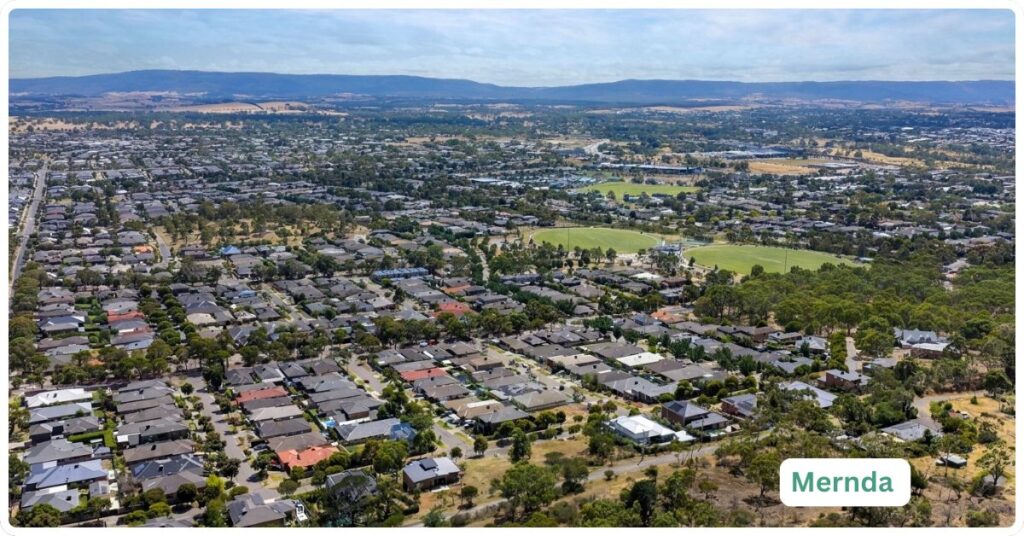
Mernda sits in the City of Whittlesea, bordered by Doreen to the north and north-east, South Morang to the south, and the broader growth corridor extending toward Wollert to the west.
Quick Facts
| Median House Price | Clustered around $727,750-$745,500 across most sources (Woodards, YIP, OpenAgent, PropertyValue), with a clear outlier at $882,039 from HtAG that this profile won’t average in |
| Median Unit Price | Around $360,000 median listing, rental yield 4.94%, median rent $500/week |
| Population | 23,369 (2021 Census); the City of Whittlesea’s own forecaster models 27,231 as a 2023 estimate, projected to grow to 31,542 by 2041, though this is a modelled projection, not a counted figure |
| Growth Rate | Substantial and ongoing: dwellings forecast to grow from 8,978 (2021) to 11,896 by 2041 |
| Transport | Mernda station, the electrified Metro terminus of the Mernda line, reopened August 2018 after almost 60 years without passenger rail; a further extension toward Wollert remains at the planning-study stage only, not funded for construction |
| Crime Rate (LGA) | City of Whittlesea: roughly 7,998 offences per 100,000 (below the Victorian average), though up 11% over five years; Mernda-specific criminal incidents rose from 1,024 to 1,142 in 2025, a rare genuinely suburb-level figure in this data |
| Childcare Availability | Reasonably healthy: roughly 13 long day care centres with most showing vacancies, alongside continued new service approvals |
| School Zone Quality | Mernda Central P-12 College (opened 2017, award-winning design) anchors the suburb; no formal performance ranking data confirmed |
| Best For | Buyers wanting a genuine electrified train connection plus real, physical heritage, rather than a purely new-build estate |
Our Verdict
Buy here if you want the strongest infrastructure story in this immediate growth corridor: a delivered, electrified train station, not a promise, plus a suburb with actual pre-1900s heritage still standing rather than one invented from scratch. Don’t buy here expecting a further rail extension toward Wollert any time soon: that project has been stuck in planning-study limbo for years and remains unfunded for construction.
It suits buyers who specifically want train access without paying South Morang’s more established prices, and who’d genuinely value living somewhere with a real township history rather than a display-village aesthetic. It’s a weaker fit for anyone chasing the very newest housing stock or the absolute cheapest entry point in the corridor, since Doreen and Wollert can undercut Mernda on price precisely because they lack Mernda’s rail connection.
Weighed against its neighbours, Mernda’s pitch is specific and genuine. Against Doreen, immediately to the north and already covered in this series, the difference is the train: Doreen has none, and won’t for the foreseeable future, while Mernda’s station has been running since 2018. Against South Morang, one stop closer to the city on the same line, Mernda offers newer housing stock and likely a lower entry price in exchange for a marginally longer commute. Against Wollert, further west with no station and none funded, Mernda is simply the better-connected option at a higher price. The honest verdict: pay a premium over Doreen and Wollert for the train, and get a materially newer suburb than South Morang in return.
The Mernda Backstory: Heritage & Origins
Mernda’s history runs deeper than most of its growth-corridor neighbours, and it’s worth stating that plainly rather than treating this as another paddock-to-suburb story. European settlement dates to the 1840s, with the land initially used for dairy farming; the Porter family are cited as among the first settlers.
The Old Bridge Inn, built in 1850 and enlarged in 1891, still stands with its original bluestone walls, listed on the Victorian Heritage Inventory. Before 1893 it was known as Morang, and from 1893-1913, it became South Yan Yean. By 1913, when the locality’s name changed once more to Mernda, the township already had a school, a Catholic church (1888), a Methodist church (1888), a general store, a railway station and a mechanics’ institute (also 1888), a genuinely functioning 19th-century community rather than a scattering of farms.
An old shopping strip survives adjoining the former railway station site, including a bakery building dating to the 1870s and the former Methodist church and hall from 1940. Other confirmed heritage sites include Mayfield Farm, Berry Lane, the Thomas Mill site, a former livestock saleyard that operated from 1888 to 2003, and the Mayfield Presbyterian church on Plenty Road.
It’s worth being honest about a genuine conflict in the name’s origin: one account traces “Mernda” to the Woiwurrung word “murnmurndik,” meaning “young girl,” while another says it comes from a different Woiwurrung word meaning “earth.” The City of Whittlesea and current local historical references identify the accepted meaning as “young girl”.
The Mernda Growth Story
Mernda is transitioning from a greenfield housing estate into a self-contained regional centre. Many of the planning goals that envisaged retail and shopping centres have been seeded and the addition of the Mernda Community Hospital ticks off yet another box. What’s left is continuing residential development on the fringes.
Mernda’s population stood at 23,369 at the 2021 Census. The City of Whittlesea’s own demographic forecaster models a higher current figure, around 27,231 as of a 2023 estimate, projected to reach 31,542 by 2041. The scale of the ongoing build is clearer from dwelling forecasts: from 8,978 dwellings in 2021 to a projected 11,896 by 2041, with average household size expected to shrink from 3.05 to 2.73 over the same period as the suburb matures.
Getting Around: Transport & Distances
Mernda railway station reopened on 26 August 2018, the terminus of an eight-kilometre, roughly $600 million electrified extension from South Morang, funded entirely by the Victorian state government and completed six months ahead of schedule.
This wasn’t a first for the area: the original line through here closed in 1959, so the 2018 reopening returned passenger rail after almost sixty years without it, a genuinely rare and specific claim among this corridor’s suburbs. Two new stations, Marymede and Hawkstowe, were built as part of the same extension.
It’s important to be honest about what comes next: a further extension from Mernda toward Wollert has been discussed for years but remains stuck at the planning-study stage. A feasibility study was promised for 2022, the federal government contributed $250,000 toward it in 2022, the matching state contribution stalled, the study was two years overdue by 2024, and a transport corridor study only actually commenced in September 2024. There is no funded construction timeline for this extension, and buyers in Doreen or Wollert hoping for a station shouldn’t expect one soon.
Plenty Road is the main arterial running the length of the corridor toward South Morang, Bundoora and the city, with Bridge Inn Road connecting east-west toward Doreen; both are frequently reported as congested during peak growth-corridor traffic, though this profile doesn’t have specific current congestion data to cite.
Crime and Safety, Honestly
Criminal incidents across the whole LGA rose 7.7% to 13,890 in 2025, up from 12,892 in 2024. Separately, recorded offences, a different Crime Statistics Agency count basis, are cited at anywhere from roughly 17,975 to 18,346 depending on the exact reporting period, alongside a figure showing a 29% jump in offences over a recent 12-month window. This isn’t a case of sources disagreeing by mistake: “criminal incidents” and “recorded offences” are genuinely different measures, since a single incident can generate multiple chargeable offences. The LGA’s overall offence rate, roughly 7,998 per 100,000, is described as below the Victorian average, though up 11% compared to five years ago. Local reporting broke out Mernda’s own criminal incident count at 1,142 in 2025, up from 1,024 in 2024.
Schools and Childcare
Mernda Central P-12 College, a government school covering Prep through Year 12, opened in Term 1 of 2017 and won Best Combined School Project at the 2017 Victorian School Design Awards, with capacity for around 400 students in Prep-6 and 880 across Years 7-12.
Mernda Hills Christian College, formerly known as Gilson College before its rename in January 2024, is the local independent Prep-12 option with Seventh-day Adventist affiliation.
Mernda Primary School serves as an established government primary.
Childcare supply looks reasonably healthy compared to some other suburbs in this series: roughly 13 long day care centres operate locally, with most showing vacancies at the time of this research, and new services continue to be approved, including Children First Early Education Mernda in February 2024. No individual NQS ratings could be confirmed for specific centres.
Get Outside: Parks, Attractions & Fitness
Waterview Recreation Reserve and the adjacent Woodland Waters Reserve offer mixed-use sports ovals, basketball and netball courts. Near to those is the Woodland Waters Conservation Reserve and adjacent Simon Creek Wetland that leads into a linear park that extends all the way to Pomaderris Linear Park Playground and heads west to Parkedge Park Playground, giving a 3km walking trail to enjoy.
South of the suburb is the newly redeveloped bunjil nganga Parkland Quarry Hills (formerly Quarry Hills Bushland Park), offering a massive native bushland space with formal trails to explore. From the south side of Mernda, at Mortar Ridge Reserve, take the trail south from there and following it west to head up the rolling hills to the fabulous Compass lookout, and a little further along is Eagle Lookout, which offers an amazing view over South Morang across into Mernda. One way is around 3km. That’s one way to enjoy the area, and there are many. The city has established five formal trails
- Morang walk and bike trail – 1.3kms – This trail begins at Mortar Ridge in Mernda and ends at Atrium Reserve, South Morang. Along the way, you’ll enjoy hilltop views overlooking Mernda.
- Eagle Loop walk and bike trail – 6.8kms – The most challenging but rewarding trail in the Parkland is the Eagle Loop, which offers 360° views and access to the Eagle Lookout.
- Foothills Circuit walk and bike trail – 2.3kms – Starting from Foothills Park Playground, Epping, this moderate trail takes you to the Landing Shelter and Swamp Gum Gully, with the option to continue onto the Eagle Loop trail.
- Manna Gum walk and bike trail – 2.9kms – Walk or cycle through the gully of the bunjil nganga Parkland Quarry Hills to experience breathtaking city views and the rocky outcrops of Granite Hills.
- Henderson Road Drain/Creek walk and bike trail – 10.2kms – Walk or cycle around the wetlands, which are home to many birds. A wooden boardwalk takes you close to the water, where you can see the birds and enjoy the beautiful views.
Nearby, the popular Plenty Gorge Parklands offers even more options for nature and hiking trails.
St Joseph’s Catholic Church
This is the one everyone photographs, and for good reason. The first Mass in the district was said in a private home back in 1857, and the current bluestone church, funded by the whole community, was opened and blessed on 23 February 1884, built largely by local stonemason Sandy Whitten of Preston Hall, Mernda. What makes it striking now isn’t the building itself, it’s the setting: a genuine 19th-century church standing almost alone on a busy arterial road, with nothing else around it. Look for the circular disk under the cross marking the 1884 opening date. Ten minutes is all you need, but it’s ten minutes that resets your sense of how new everything else around it is.
Mernda Mechanics’ Institute
Tucked behind the old Bridge Inn Hotel site, this bluestone hall is Mernda’s other great survivor. Built by W. Baird with its foundation stone laid on 12 September 1888 by local MLA Robert Harper, the stone itself was carted down from Melbourne by resident W.G. Cockerell, and Walter Thomas served as the institute’s first librarian and trustee. Mechanics’ institutes were the community hubs of colonial Victoria, part library, part meeting hall, part civic anchor, and this one did real municipal work: it served as the Whittlesea shire council’s chambers until the 1920s. These days it’s a small hall available for community hire rather than a museum, so there’s no walk-in access, but it’s worth a slow drive-by to see how modest and dignified these buildings were, built for permanence in a district that, at the time, had barely a few hundred residents.
Carome Homestead
This is the heritage stop that actually rewards a proper visit, because you can sit down and have a coffee while you’re at it. Carome consists of the remnants of one of Victoria’s earliest flour mills, an 1860s bluestone farmhouse and associated farm buildings, all perched on the Plenty River with views that recall the district’s rural past. The flour mill powered by the Plenty River was built here in the 1840s specifically to feed the fledgling town of Melbourne, after that the bluestone house went up in the 1860s and the property turned first to mixed farming, then dairy, then a horse stud.
The site got a second, more unlikely heritage layer in 2022. The Wollert Methodist Church, a Carpenter Gothic timber building from 1878 with distinctive lancet windows, had stood for over 140 years at the corner of Lehmanns and Epping roads before falling into disrepair, until the Epping Road upgrade forced a decision on its future. Rather than lose it, the church was carefully disassembled between March and May 2022 and trucked in pieces to Carome, where it was rebuilt and restored using traditional materials. The restoration turned up a genuine good-luck story too: council officers sweeping the original Wollert site found the church’s original 19th-century key, a 13.5cm relic lost since the late 1800s, professionally restored and now on display inside. It’s now available for community hire, suitable for group events, meetings and exhibitions of 20 to 50 people, so if you time it right you might catch it open. Worth knowing before you go: this is Wurundjeri land within the Plenty Gorge Parklands, and it’s snake country in warmer months, so watch your footing off the mown paths.
Shopping and Dining
Daily needs are well covered and quite conveniently by three centres. Mernda Village Shopping Centre is anchored by Woolworths, Chemist Warehouse and Bakers Delight. The newer Mernda Town Centre precinct sits next to the railway station offering Woolworths, a gym, several eateries, and specialty retailers. Nearby there is a Bunnings store and Mernda Junction Shopping Centre, which offers a Coles and Chemist Warehouse.
For other needs, or a big retail day out, locals head south to Westfield Plenty Valley (10 minutes by car), Pacific Epping (15 minutes by car), or even Preston (25 mins by car) and it’s Northland Shopping Centre and broader café and restaurant scene.
What It’s Actually Like to Live Here
Mernda is a close-knit community formed by its semi-urban culture, people who grew together with the suburb itself, and superb community spaces and parks. With the development boom comes noise and dust, and in some areas, that is settled or settling, while the outer fringes and inner pockets still have some growth yet to be realised.
Mernda’s 2021 Census profile shows a median age of 33, skewing notably young, with roughly 32% of residents under 20 and the largest single age band sitting at 35 to 44, around 20% of the population. Only about 8% of residents are aged 65 or over, a classic young-family growth-suburb structure. Median personal income runs at $879 a week, with median household income at $2,011 a week. Tenure leans heavily toward mortgage holders rather than outright owners: 59% owned with a mortgage, 15% owned outright, and 25% renting. Average household size sits at 3 people, again consistent with a suburb still filling up with young families rather than one that’s settled and aged in place.
FAQ
Does Mernda have a train station? Yes, an electrified Metro terminus station that reopened in August 2018, after almost 60 years without passenger rail through the area.
Will the train line extend further to Wollert? Not on any funded timeline. A transport corridor study only began in September 2024 after years of delay, and there’s no committed construction funding.
Does Mernda have real history, or is it all new estates? It has genuine pre-suburban heritage: an 1850 bluestone inn, churches dating to 1888, and a functioning 19th-century township that predates the current growth wave by well over a century.
Is Mernda safe? City of Whittlesea LGA-wide data shows an offence rate below the Victorian average, though up 11% over five years. Mernda-specific incident data shows a rise from 1,024 to 1,142 in 2025.
References
- Australian Bureau of Statistics. 2021 Census QuickStats, Mernda (Vic.), SAL21659, and related SA2 geographies (Mernda – North 209041531, Mernda – South 209041532).
- forecast.id, City of Whittlesea. Mernda population and dwelling forecasts to 2041.
- Premier of Victoria. Mernda rail extension funding and completion announcements.
- Your Investment Property Magazine; OpenAgent; Woodards; PropertyValue.com.au; HtAG. Mernda median house and unit price data, genuinely conflicting across sources.
- Crime Statistics Agency Victoria (via North Central Review and aucrimetracker.com secondary reporting). City of Whittlesea and Mernda-specific crime data, year ending March 2026.
- Victorian Heritage Database; Victorian Places. Mernda township heritage sites, including the Old Bridge Inn.