
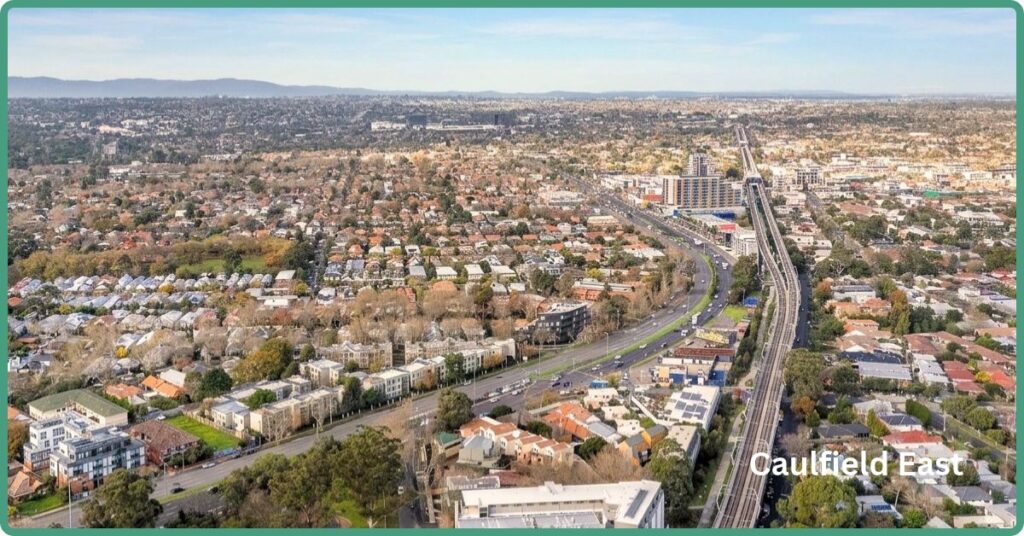
Caulfield East is less a suburb than a crossroads. Fewer than 1,300 people live here, squeezed between the Caulfield Cup’s racecourse, Monash University’s second-biggest campus and a busy train interchange where the Metro Tunnel meets the City Loop, with a strip of noodle bars and cafes on Derby Road feeding the students in between. It suits renters and investors who want trains at the door more than a quiet street. The trade-offs: race-day crowds, a rental market that rises and falls with the university year, and new state planning rules that allow towers of up to 20 storeys around the station.
Caulfield East Boundary and Location Map
Caulfield East sits roughly 10 kilometres south-east of the Melbourne CBD in the City of Glen Eira and covers only about 1.3 square kilometres. Victorian Places describes its edges as Dandenong, Grange, Neerim, Booran and Kambrook Roads, and notes that about half the suburb is taken up by the racecourse, its stables and Glen Huntly Park. It borders Caulfield North to the west and north-west, Malvern East to the north and east, Carnegie and Glen Huntly to the south-east and south, and Caulfield to the south-west.
Quick Facts
| LGA | City of Glen Eira |
| Postcode | 3145 (shared with Malvern East) |
| Population | 1,293 (ABS Census, 2021), down from 1,584 in 2016; 2026 Census results due from June 2027 |
| Growth Rate | Fell between 2016 and 2021, a period that included COVID border closures; the Caulfield activity centre plan (July 2026) allows much more housing near the station |
| Distance from CBD | About 10km south-east (about 12km by road) |
| Character | Racecourse, university campus and train interchange, with small apartment blocks, period houses and the Derby Road food strip |
| Median House Price | About $1.6m (Cotality via Your Investment Property; PropTrack to 31 August 2026), from only 12 to 18 sales a year |
| Median Unit Price | About $355k to $644k depending on source (Cotality, PropTrack, REIV), skewed by small student apartments |
| Transport | Caulfield station (Frankston, Cranbourne and Pakenham lines; Metro Tunnel since November 2025); tram 3; buses 624 and 900 |
| Crime Rate (LGA) | City of Glen Eira 4,616.1 offences per 100,000 (year ending June 2026, down 11.9%), about half the Victorian rate of 8,679.6 |
| Childcare Availability | Adequate: two centres in the suburb (180 places), with more across postcode 3145 and most showing vacancies |
| School Zone Quality | 100% zoned to Glen Eira College for Year 7; primary zones split between Malvern, Glen Huntly, Carnegie and Lloyd Street |
| Parks & Recreation | Caulfield Racecourse Reserve (Caulfield Commons), Glen Huntly Park, Monash’s Campus Green |
| Shopping | Derby Road cafes and restaurants; Coles at Caulfield Village next door; Chadstone about 4km |
| Health | Monash University Health Service (open to the public); Cabrini Malvern (private ED) about 2km; The Alfred about 7.5km |
| Best For | Students, young renters and investors wanting a station and campus on the doorstep |
What Makes Caulfield East Special
The Heath, the Cup and the Horse Platform
Racing came first here. Informal races were run on a stretch known as “the Heath” from the 1850s, the Victoria Amateur Turf Club took over the site in 1876, and the first Caulfield Cup was run in 1879, the same year the railway arrived. The club became the Melbourne Racing Club in 2002. In 2023 the whole racecourse was added to the Victorian Heritage Register (H2415), covering buildings such as the Boomerang Buffet (1919), the main entry gate (1928), the Hiskens Stand (1935) and the Norman Robinson Stand (1960).
Racing shaped the station too. Caulfield station’s current buildings date from 1913 and 1914, designed by Victorian Railways architect J.W. Hardy, and the heritage-listed complex still has a rare horse platform, where racehorses were once unloaded, along with an early subway and signal box. Around the corner at 30 Booran Road, Lord Lodge is a heritage-listed training complex built in 1890 by trainer John Leek, later named after the champion racehorse Lord, who was stabled there in the 1950s.
A Campus Town on Derby Road
Beside the station, the Monash University Caulfield campus at 900 Dandenong Road is the suburb’s other engine. It began as Caulfield Technical School in 1922 and, according to Monash, has had “no less than five different names” before joining Monash in 1990. Monash now calls it “our second biggest campus”, home to faculties including Business and Economics, Arts, and Art, Design and Architecture. Its Campus Green, designed by Taylor Cullity Lethlean on a former car park, has a 90-metre terraced water feature that filters harvested rainwater.
The students show up in the Census. In 2021, 43.3% of residents in education were at university, the median age was 32, and 37.9% of households were people living alone. The 2016 Census was even younger, with a median age of 27 and 22.7% of residents born in China, compared with 6.0% in 2021. The 2021 Census was taken while Australia’s borders were closed, so it likely undercounts the usual student population.
What Is It Like Living in Caulfield East
Life here runs on timetables: lecture times, race meetings and trains. In 2021, 44.8% of households rented, 20.4% had no car, and the median rent was $320 a week. Homely reviewers rate it 4.2 out of 5, although from only four reviews, praising its “central location and great transport links” and calling it “close to the city, still affordable”. The main complaint listed is traffic congestion during racing events.
Transport
Caulfield station on Sir John Monash Drive is the suburb’s biggest asset. Since the Metro Tunnel’s full timetable started on 1 February 2026, Cranbourne and Pakenham line trains run through the tunnel to Anzac, Town Hall and State Library, every 10 minutes on weekdays and about every 4.5 minutes in peak, while all Frankston line trains run around the City Loop. That makes Caulfield the place where the two networks meet (see our Melbourne train guide). The catch is the station layout: only platforms 2 and 3 allow a cross-platform change, so some transfers mean a walk through the subway.
Tram 3 stops at Caulfield station on Derby Road on its way between Melbourne University and East Malvern (see our Melbourne tram guide). Buses 624 and 900 also stop at the station, and the 900 SmartBus is the quickest public transport link to Chadstone and Monash’s Clayton campus. Monash also runs a free intercampus shuttle to Clayton. By car, the CBD is about 12 kilometres away along Dandenong Road, roughly 17 minutes in free-flowing traffic.
There are no level crossings left in Caulfield East, or anywhere in Glen Eira, after the Glen Huntly removals finished in 2023. The nearest Suburban Rail Loop stations will be at Clayton and Monash, with trains due in 2035. From Caulfield, Cranbourne and Pakenham trains run straight to Clayton for the connection.
Healthcare
The only GP inside the suburb is the Monash University Health Service on the Caulfield campus, which is open to the public by appointment on weekdays and bulk bills Monash students. Other GPs are a short walk away, including Enriching Health Medical at Caulfield Village and Auslink Medical Centre on Dandenong Road in Malvern East. Cabrini Malvern’s private emergency department is about 2.3 kilometres by road (it charges an attendance fee, which Cabrini lists as $510 for Medicare cardholders), and the nearest public emergency department is The Alfred, about 7.5 kilometres away. Caulfield Hospital on Kooyong Road focuses on rehabilitation and aged care and has no emergency department. There is no aged care home inside the suburb; Arcare Caulfield on Kooyong Road in Caulfield North is one of the closest.
Schools and Childcare
Our test of the 2026 and 2027 zone maps puts the whole suburb in the zone for Glen Eira College for Year 7. The school sits on Booran Road at the suburb’s south-western edge (883 students, ICSEA 1117, median ATAR 70.0 in 2025) and offers French and Japanese language programs. Primary zones are split: 60% Malvern Primary, 25% Glen Huntly Primary, 10% Carnegie Primary and 5% Lloyd Street Primary in Malvern East (ICSEA 1180). Confirm any address on Find My School.
Childcare is adequate for such a small suburb. Monash Caulfield Child Care on Derby Road (50 places) is open to the wider community and runs a funded kinder program, and Headland Montessori on Grange Road has 130 places. Both are rated Meeting the National Quality Standard by ACECQA. Across postcode 3145, which mostly covers Malvern East, CareforKids shows eight of nine centres with vacancies and an average of about $163 a day (October 2026). Check vacancies on Starting Blocks.
Industry & Work Life
Local jobs centre on the university, the racecourse and the Derby Road shops and cafes. At the 2021 Census, 31.9% of working residents were professionals, 16.5% were managers and 11.3% worked in community and personal services, and 36.8% worked part-time, a sign of how many residents are studying. Commuters have one of the best train connections in the south-east, with the Metro Tunnel running direct to Anzac, Town Hall, State Library and Parkville.
Shopping & Eating Out
Derby Road, beside the station and the campus, is the suburb’s eat street. Its best-known name is Master Lanzhou at 17 Derby Road, the original store of a hand-pulled noodle chain founded in 2017 and covered by both Broadsheet and AGFG. AGFG lists 17 restaurants in Caulfield East, including Derby Thai, Kimchi And Bab and Zagame’s Caulfield, a bistro at 25 Derby Road. None of AGFG’s listed venues holds a Chef Hat, so this is everyday eating rather than fine dining.
For groceries, Caulfield Village on Caulfield Boulevard, just over the border in Caulfield North, has a Coles, Liquorland, a chemist and an Asian grocer. For a big shopping trip, Chadstone is about 4.2 kilometres by road, or a short ride on the 900 bus.
Attractions, Parks and Natural Spaces
The middle of the racecourse is public land. The Caulfield Racecourse Reserve, now branded Caulfield Commons, is 54 hectares of Crown land managed by the Caulfield Racecourse Reserve Trust, with about 30 hectares of open space, two wetlands, barbecues, picnic areas and a fenced off-leash dog area. It opens from 6.30am to 8pm in the warmer months and 7am to 5.30pm from April to September, entered through five gates including two tunnels, but it closes on race days and major events. Monthly markets draw about 2,000 visitors.
The reserve is slowly opening up. A 1.8-kilometre running trail around the inside of the track started construction in October 2025, a new Glen Huntly Park gate opened in December 2025, and in April 2026 the Melbourne Racing Club’s maintenance compound was moved to the edge of the track to free up a central area for future community use. Next door, Glen Huntly Park has a pavilion and tennis courts, according to Caulfield Commons. That matters in a council that says it has “the lowest amount of open space per person in metro Melbourne”.
Crime and Safety
The City of Glen Eira recorded 4,616.1 offences per 100,000 people in the year to June 2026, down 11.9% and about half the Victorian rate of 8,679.6, according to the Crime Statistics Agency. Caulfield East recorded 338 offences, down 19.1% from 418 a year earlier. Because so few people live here and so many pass through, the count is likely to reflect the station, campus and racecourse crowds more than residents.
The most common offences were other theft (39), graffiti (30), theft from cars (29), criminal damage (27) and bicycle theft (24). Lock your bike with a solid lock, keep valuables out of sight in your car and take care around the station late at night.
Big Build and Planning: Towers by the Track
Caulfield is a Stage 2 Train and Tram Zone activity centre, and the state finalised its plan in July 2026. Planning Victoria says building heights “between six to 20 storeys have been applied within the Caulfield core”, with the tallest near the railway and most new homes near the station, shops and racecourse, and a catchment of about 800 metres around it. Glen Eira Council’s summary describes heights of “generally between 6-12 storeys, with up to 20 storeys proposed for a strategic site north of the railway line”, about 2 to 3 storeys higher than its own 2022 Caulfield Structure Plan. Derby Road is protected as a key pedestrian street to keep sunlight on the shops. We could not confirm final heights for individual streets, so check Planning Victoria for any address.
Projects are lining up. Plans for 9 to 13 Derby Road show a 10-storey building with 88 student and residential units, and an extension of time was lodged in 2026 for a 12-storey permit at 9 Derby Road. Just over the border, Caulfield Village has delivered 1,636 homes, and an application for its final East precinct, including student accommodation, was with the Department of Transport and Planning in September 2026. Monash dropped its plan for a retail redevelopment of Caulfield Plaza in August 2025. The Melbourne Football Club has also been pursuing a training base inside the racecourse, but in March 2026 it was moving temporarily to Waverley Park while talks continued. There are no Development Victoria or Homes Victoria projects in the suburb, and the Victorian Planning Authority’s earlier Caulfield Station Precinct work has been handed back to council.
Realty Market
Caulfield East has so few sales that every median comes with a warning. Houses sit at about $1.6 million: Cotality figures published by Your Investment Property show $1,597,500 from just 12 sales, PropTrack has $1.6 million for the 12 months to 31 August 2026 (down 1.7%), and REIV’s latest quarter also has $1.6 million. Domain recorded 18 house sales over the past year, half of them three-bedroom homes. Recently, a three-bedroom house on about 575 square metres at 47 Grange Road sold for $1,606,000. That is well below Caulfield North ($2.43 million) and Malvern East ($2.07 million), and close to Carnegie ($1.73 million, all Cotality).
Units are harder to read. Cotality and PropTrack both put the median at about $355,000, while REIV has $644,000, most likely because small student apartments make up many of the sales. Domain shows recent two-bedroom sales between $350,000 and $470,000. The housing stock is a mix: 38.4% separate houses, 33.9% townhouses and semis and 27.2% apartments in 2021.
Renting is the norm, with 44.8% of households renting in 2021. Cotality puts the median unit rent at $425 a week (a 4.9% gross yield), and Domain’s rental listings show one-bedroom units around $425 and two-bedroom units around $500 a week. The rental market follows the university year: SQM Research shows postcode 3145 vacancies of 2.95% in August 2026, but they climbed to 8.55% in December 2025 as students left for summer.
Our Honest Verdict
Caulfield East suits students, young renters and investors who value a train interchange, a university campus and cheap noodles above leafy calm. Unit buyers can get in for well under $500,000, and the Metro Tunnel has made the commute even better. House buyers get a Glen Eira address and the Glen Eira College zone for about $1.6 million, roughly $800,000 less than Caulfield North.
It is less suited to families who want quiet streets, a big local park that is always open, or a settled neighbourhood, because race days, student turnover and towers of up to 20 storeys near the station are all part of the deal. Investors should plan for summer vacancies. If you want a similar price with a more established family feel and a busy shopping strip, Carnegie (about $1.73 million for houses, Cotality) is the natural comparison.
Frequently Asked Questions
Can you walk through Caulfield Racecourse?
Yes. The reserve in the middle of the track, now called Caulfield Commons, is open daily from 6.30am to 8pm (October to March) or 7am to 5.30pm (April to September), except on race days and major events.
Which trains stop at Caulfield station?
Frankston line trains, which run around the City Loop, and Cranbourne and Pakenham line trains, which have run through the Metro Tunnel to Anzac, Town Hall and State Library since it opened in November 2025.
Which high school is Caulfield East zoned to?
Glen Eira College, for the whole suburb, based on our test of the 2026 and 2027 zone maps.
How tall can buildings be near Caulfield station?
Under the activity centre plan finalised in July 2026, buildings in the Caulfield core can range from 6 to 20 storeys, with the tallest near the railway.
How much does a unit cost in Caulfield East?
Medians range from about $355,000 (Cotality, PropTrack) to $644,000 (REIV), most likely because small student apartments make up many sales. Recent two-bedroom sales were between $350,000 and $470,000.
References
- Australian Bureau of Statistics, 2021 and 2016 Census QuickStats: Caulfield East (SAL20522, SSC20519)
- Victorian Places, “Caulfield” (accessed 6 October 2026)
- Heritage Council Victoria, Caulfield Racecourse registration determination H2415 (20 February 2023); Victorian Heritage Database, Caulfield Railway Station Complex and Lord Lodge (accessed 6 October 2026)
- Monash University, Caulfield campus, history, transport and Caulfield Plaza pages (2023 to 2025); ArchitectureAU, Monash Caulfield Campus Green (December 2015)
- Caulfield Commons (Caulfield Racecourse Reserve Trust), news updates October 2025 to May 2026; Caulfield Racecourse Reserve Trust Annual Report 2024-25
- City of Glen Eira, Caulfield Racecourse Reserve page; activity centres page; Caulfield Structure Plan (20 September 2022); council news (2022, 2023) (accessed 6 October 2026)
- Department of Transport and Planning, Caulfield activity centre page and program timeline (July to October 2026)
- Victorian Planning Authority, Caulfield Station Precinct (modified 7 January 2026)
- Victorian Big Build, Metro Tunnel FAQ (2026); Glen Huntly level crossing removals (30 November 2023); Suburban Rail Loop East Clayton and Monash (modified 23 September 2026)
- ABC News, Metro Tunnel timetable changes (1 February 2026)
- City of Glen Eira, plans for 9 to 13 Derby Road (November 2023); PlanningAlerts, 9 Derby Road (2026); The Urban Developer, Caulfield Village East (18 September 2026)
- SEN, Melbourne Football Club and Waverley Park (10 March 2026)
- Crime Statistics Agency Victoria, Recorded Offences, year ending June 2026 (LGA and suburb tables)
- Department of Education, school zones 2026 and 2027 (DataVic), tested against the Caulfield East boundary on 6 October 2026
- ACARA My School data via schoolrank.com.au and inthesuburbs.com.au, 2025; Glen Eira College enrolment page
- ACECQA National Registers, KindiCare and CareforKids, Caulfield East and 3145 childcare (accessed 6 October 2026)
- healthdirect Australia, Caulfield East GP search; Alfred Health, Caulfield Hospital; Cabrini, emergency department; Arcare Caulfield (accessed 6 October 2026)
- Caulfield Village, stores page; Broadsheet, Master Lanzhou (April 2026); AGFG, Caulfield East restaurants (accessed 6 October 2026)
- Monash University public transport page (2026); Moovit stop listing (accessed 6 October 2026)
- OpenStreetMap Nominatim and OSRM, geocoding and road distances (6 October 2026)
- Your Investment Property (Cotality data), Caulfield East and comparison suburbs (accessed 6 October 2026)
- Barry Plant (PropTrack data), Caulfield East suburb profile, 12 months to 31 August 2026
- REIV, Caulfield East market insights (accessed 6 October 2026)
- Domain, Caulfield East VIC 3145 suburb profile, sold and rental listings (accessed 6 October 2026); Woodards, 47 Grange Road (2026)
- SQM Research, postcode 3145 vacancy rates (to August 2026)
- Homely, Caulfield East VIC 3145 suburb reviews (accessed 6 October 2026)
- Suburb boundary: suburbs.json (Victorian locality boundaries), area and distance calculated 6 October 2026
Want to compare Caulfield East with Carnegie, Caulfield North and the rest of the city? Explore more suburb guides in our Melbourne suburbs guide.