
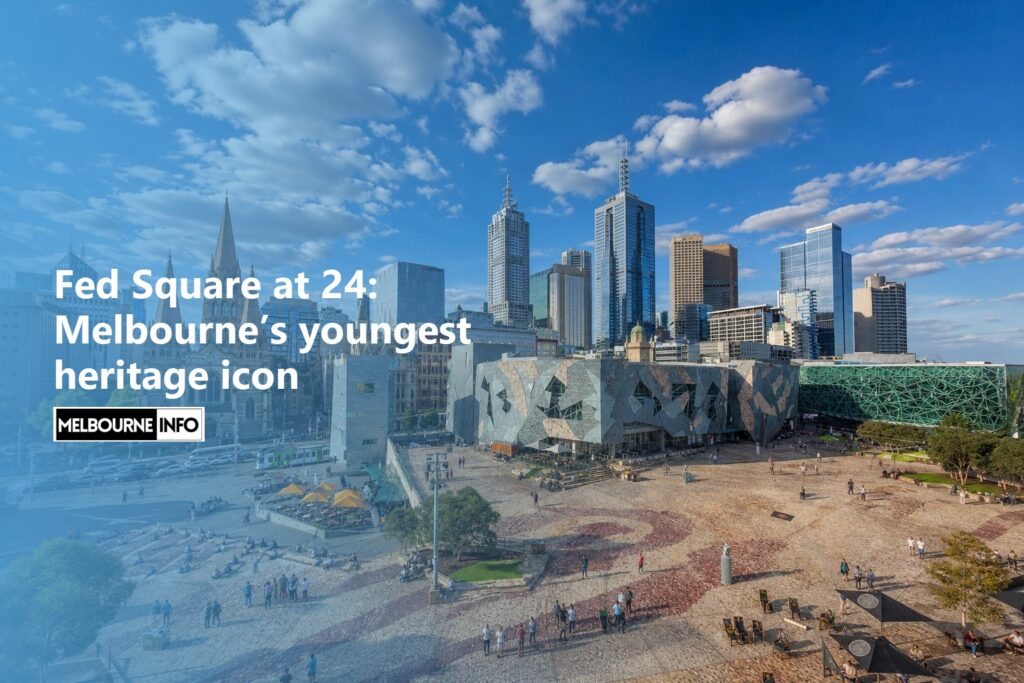
Three thousand sandstone and zinc panels form the jagged, puzzle-piece facade of Federation Square. The design was so bold it forced Melbourne to rethink what a heritage place could be. In 2019, just 17 years after it opened, the square became the youngest site on the Victorian Heritage Register.
Fed Square has been Melbourne’s central gathering spot since 2002. Sitting opposite Flinders Street Station on the Yarra’s edge, it pulls in between 7.5 and 11 million people a year. Entry to the square itself is free, and the calendar is stacked with hundreds of events.
Inside its fractured geometry are three major institutions: the Ian Potter Centre (NGV Australia), the Australian Centre for the Moving Image (ACMI), and the Koorie Heritage Trust. Together they make the square a civic gateway to art, film, and First Nations culture.
Visit Victoria describes the square as “Melbourne’s meeting place… the centre of creativity in a city that’s built around innovation, art, leafy green spaces, a flowing river and contemporary cultural activities and festivals.”
The site replaced the former Gas and Fuel Corporation buildings that once stood at the intersection of Flinders and Swanston streets. The design competition for a modern civic plaza produced Lab Architecture Studio’s deconstructivist vision, and since opening Federation Square has redefined how Melburnians use public space.
The building’s heritage listing recognises more than its age. Each of the 3,000 individual panels was designed to create a complex geometric pattern that shifts with the light and weather. The sandstone, zinc, and glass cladding gives the precinct a textured, almost cubist quality that still polarises opinion but has become unmistakably Melbourne.
Year-round free programming keeps the square humming. Summer outdoor cinema runs on the big screen above the main plaza, while live music stages, major festivals, and public art installations roll through the calendar. On a warm evening, the main square can pack in up to 10,000 people for a film or concert.
If you’re looking for a zero-cost way to experience the city’s cultural pulse, walking into Fed Square is it. You don’t need a ticket to wander the forecourt, watch a live set, or sit on the steps and people-watch. The square is also the easiest meeting point in town, directly across from Flinders Street Station and a short walk from Southbank and the sports precinct.
Some visitors assume they need to pay to enter Fed Square. They don’t. The plaza is always free, though ticketed exhibitions inside ACMI and the Ian Potter Centre may charge. Another misstep is arriving just as a big event kicks off and expecting a front-row view. For the summer cinema or major festivals, you’ll want to claim your spot early.
The main square hits its 10,000-person capacity for the most popular screenings and concerts. Lunchtime and evening peaks around Flinders Street also draw thick crowds. If you want elbow room, a weekday morning visit delivers the architecture with space to breathe.
What distinguishes Fed Square from Melbourne’s celebrated laneways is scale and free access. You can gather with thousands to watch a Final on the big screen without paying a cent. And unlike older European-style squares, this one carries a heritage honour that acknowledges its contemporary design. The riverside position adds a walking link to Southbank’s restaurants and the Arts Centre, making it a launchpad rather than a dead end.
Public transport is the only sensible way in. Flinders Street Station sits right across the road, served by train lines from all directions. Tram routes 1, 3, 5, 6, 16, 64, 67, 72 and 75 stop at Flinders Street, and there is limited paid parking nearby if you must drive, though congestion makes it a gamble.
Once you’ve had your fill of the square, the Yarra promenade leads east to the MCG and west to Southbank’s dining strip. For exhibitions inside ACMI or the Ian Potter Centre, check the What’s On schedule at fedsquare.com. The square is never really quiet – even on a Tuesday morning there is someone crossing the cobbles. That’s the point.
Three thousand panels and 24 years on, Federation Square is still doing what it was built for: pulling Melbourne into one place.
Quick Facts
Federation Square
Melbourne’s central public square and cultural precinct in the CBD, home to major galleries and event spaces. Opened in 2002, it attracts millions of visitors for free events, exhibitions and dining.