
Reservoir is named after a piece of Victorian-era plumbing. The Preston Reservoir, built in 1864 as part of the Yan Yean water scheme, existed to stop pipes bursting from pressure, and the suburb that grew up beside it in the 1920s simply took the infrastructure’s name rather than anything scenic or aspirational. That unglamorous, function-first origin story is a fair preview of the suburb itself: solid, workaday, genuinely diverse, and priced as the sensible alternative to Preston next door rather than a destination in its own right.
Boundary Map
Reservoir sits in the City of Darebin, roughly 11-12km north of the Melbourne CBD by road (14.94km to Southern Cross by rail), covering 19.1km². It borders Preston to the south, Thomastown to the north, Fawkner across Merri Creek to the west, and Bundoora and Kingsbury to the east, with Keon Park effectively a locality within its postal area.
Quick Facts
| Median House Price | $805,000-$930,000 across most sources (2026), with one outlier figure near $1.12 million; no single authoritative number available, get a live quote before relying on any one figure |
| Median Unit Price | $610,000-$621,250, up modestly year-on-year |
| Population | 51,096 (2021 Census), up just 1.23% on 2016; one aggregator’s 2024 estimate of 54,447 implies faster recent growth, but this hasn’t been independently verified against ABS estimates |
| Growth Rate | Modest and established rather than explosive, this is a built-out suburb, not a growth corridor; population trend needs direct ABS verification given conflicting figures |
| Transport | Reservoir, Keon Park and Ruthven stations on the Mernda line (Keon Park rebuilt, opened June 2024); tram route 86 along High Street; a Suburban Rail Loop North station is proposed for Reservoir but remains planning-stage only, with no confirmed funding or construction date |
| Crime Rate (LGA) | Darebin LGA recorded 12,362 offences per 100,000 (year ending September 2025), around 37% above the Victorian average of 9,030 and up 16% on five years ago |
| Childcare Availability | Around 10 long day care centres identified, one holding an Exceeding NQS rating; supply looks broadly adequate for an established, largely built-out suburb rather than visibly lagging as it does in outer growth corridors |
| Zoned School | Reservoir High School (SEAL-accredited, recognised for VCE improvement) anchors government secondary; Better Education rates the area’s schools at a middling 52/100 average |
| Best For | Buyers priced out of Preston who want the same tram corridor and inner-north feel at a genuine discount, not buyers chasing rapid capital growth or a polished dining strip |
Our Verdict
Reservoir is a solid, sensible choice for people who want inner-north access, established infrastructure and a real tram and train corridor without paying Preston prices. It’s not the suburb for anyone chasing fast capital growth or a curated lifestyle precinct, this is a suburb that works rather than one that impresses, and the crime and housing data both come with genuine caveats worth understanding before you commit.
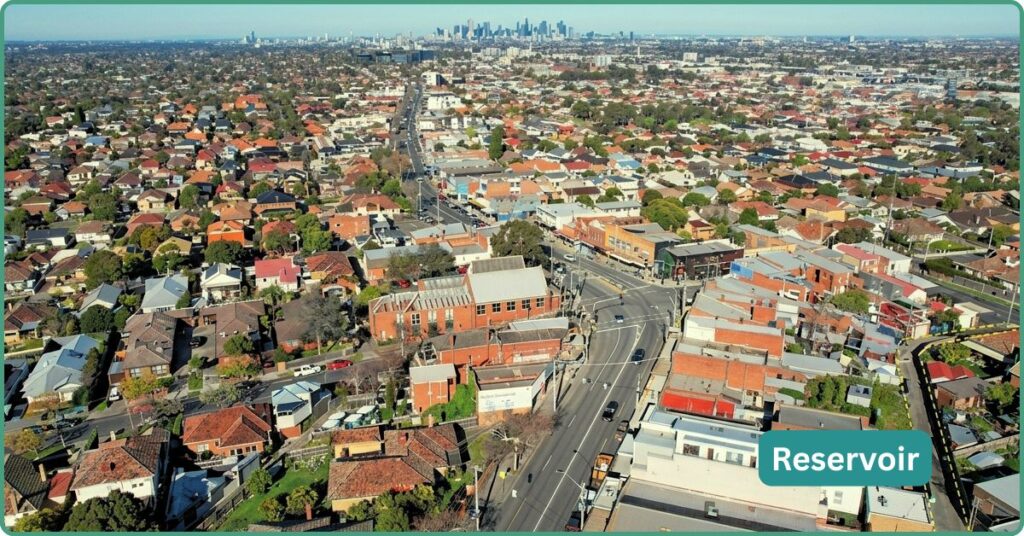
It suits buyers and renters who’ve been priced out of Preston, Thornbury or Northcote but want to stay on the same tram 86 corridor, and anyone who values an established, largely built-out suburb over a still-forming growth estate, childcare and school infrastructure here isn’t racing to catch up with population growth the way it is further out. It’s a weaker fit for investors wanting a clean, confidently-sourced growth story (the population and price data genuinely conflict across sources) and for anyone sensitive to crime statistics, Darebin’s LGA-wide offence rate sits meaningfully above the state average, even though that figure isn’t suburb-specific to Reservoir itself.
Weighed against its closest neighbours, Preston immediately to the south is materially more expensive (around $1.18 million against Reservoir’s $805,000-$930,000) for essentially the same tram corridor and inner-north feel, Reservoir is the value play for anyone who doesn’t need the Preston postcode specifically. Thomastown, one suburb further out on the same Mernda line but across into the City of Whittlesea, undercuts Reservoir on price (around $780,000) and is growing faster off a lower base, but offers less established infrastructure and amenity. If you’re deciding between the two, Reservoir buys you a more finished suburb; Thomastown buys you a lower entry price and more room to grow.
The Backstory: Heritage & Origins
Reservoir takes its name directly from the Preston Reservoir, built in 1864 as part of the Yan Yean water supply scheme, Melbourne’s first engineered water system. The reservoir’s practical job was to break the water pressure from the elevation drop between the Yan Yean Reservoir and Melbourne, which was bursting pipes, while also adding storage capacity and harvesting rainfall run-off from the Great Dividing Range foothills. It was Melbourne’s only service reservoir until 1881, when a second was built at Essendon, and two further reservoirs were added at the Preston site in 1909 and 1913.
The area to the north of Preston became a distinct suburb called Reservoir in the 1920s, named for the adjacent water infrastructure rather than any natural geographic feature, a genuinely unusual, utilitarian origin story compared to most Melbourne suburbs named after people, places or landscape features. Detailed sourcing on the area’s character before that 1920s subdivision wasn’t available for this profile, but it follows the general Melbourne-fringe pattern of the era: farmland and market gardens ahead of residential development.
The Big Build & Growth Story
The clearest delivered infrastructure story is on the Mernda line: the Keon Parade level crossing has been removed and a rebuilt Keon Park station opened to passengers on 21 June 2024, Melbourne’s 77th level crossing removed under the Big Build program. Ruthven station has also had a $1.03 million lighting and facilities upgrade, and a new traction substation at Ruthven is in delivery to enable more frequent Mernda line services.
The single most important thing to get right about Reservoir’s future infrastructure is the Suburban Rail Loop North proposal, which includes a new Reservoir station as one of seven planned stops between Box Hill and Melbourne Airport via Broadmeadows. This is genuinely planning-stage only: Victoria’s Big Build describes station and precinct locations as “preliminary,” with no confirmed construction start date or full funding commitment for the SRL North alignment. Don’t treat this as a near-term drawcard, it’s a long-horizon prospect, not something to factor into a purchase decision today.
On a smaller scale, the Reservoir Streetscape Master Plan has delivered around $1.2 million in bike lanes, pedestrian crossings and laneway art activations around Edwardes Street and Broadway since roughly 2021, a modest but genuinely completed piece of public realm investment.
Getting Around: Transport & Distances
Reservoir, Keon Park and Ruthven stations all sit on the Mernda line, with Regent station just to the south. Reservoir station is roughly 29 minutes to Flinders Street on Metro’s scheduled timetable, though journey-planner aggregators show a wider range up to 35-50 minutes depending on time of day and stopping pattern, so treat 29 minutes as a best-case figure.
Tram route 86 runs along High Street, connecting Reservoir south through Preston, Thornbury, Northcote, Clifton Hill, Collingwood and Fitzroy into the CBD, a slower but frequent alternative to rail, particularly useful if you live toward the High Street side of the suburb.
Crime and Safety, Honestly
Victorian crime data is published at council level, not suburb level, so there’s no Reservoir-specific offence rate, only a Darebin LGA figure. Darebin recorded 12,362 offences per 100,000 people in the year ending September 2025, against a Victorian state average of 9,030, meaning Darebin runs roughly 37% above the state average. The LGA’s crime rate is also reported up 16% compared to five years ago, tracking a broader statewide increase (Victoria’s overall rate rose 9% to a nine-year high over a similar period). Property and deception offences dominate the Darebin figures (13,025 of 18,366 total recorded offences), with 1,889 offences against the person.
Schools and Childcare
Reservoir High School is the main government secondary option, recognised by The Age in 2021 as a “School that Excels” for VCE improvement and accredited to run SEAL (Select Entry Accelerated Learning) classes, a genuine differentiator against many outer-suburban government secondaries. Holy Name School and St Gabriel’s School offer Catholic primary options within the suburb. Worth stating plainly: Better Education rates Reservoir’s roughly dozen local schools at a middling average score of 52/100, not a top-tier result, and no sourced school-zone price premium was found for this profile, a genuine gap rather than a confirmed absence of one.
Childcare supply looks broadly adequate for an established suburb: around 10 long day care centres, with Starfish Early Learning Centre holding an Exceeding NQS rating and most others rated Meeting NQS. Given Reservoir’s modest population growth and largely built-out character, it’s a reasonable inference that childcare demand here isn’t racing ahead of supply the way it does in outer growth corridors like Tarneit or Craigieburn.
Hospitals and Healthcare
The Northern Hospital in Epping, part of Northern Health, is the primary public hospital for the broader catchment including Reservoir, though it sits in Epping rather than within the suburb itself; its emergency department is reported as the busiest in Victoria, treating over 300 people a day. Northern Private Hospital, also in Epping, offers a private alternative in the same precinct. The Epping Priority Primary Care Centre provides urgent, non-life-threatening care as an alternative to a full emergency department presentation, open 7am-10pm daily. Austin Hospital in neighbouring Heidelberg offers a well-known tertiary and specialist referral hospital.
Get Outside: Parks, Attractions & Fitness
Edwardes Lake Park is the suburb’s standout green space, a 26-hectare district park (the second-largest in Darebin after Bundoora Park) drawing an estimated 135,000 visitors a year, centred on the 6.3-hectare Edwardes Lake, an 85-million-litre urban water body on Edgars Creek. It offers a lake walking path, a preserved old train engine, playgrounds, bird watching, and picnic and barbecue facilities, with adjoining sports grounds.
Merri Creek forms Reservoir’s western boundary (shared with Fawkner and Coburg), with a connected shared trail linking to Moomba Park Reserve and further downstream toward Coburg and Brunswick, while Darebin Creek runs along the suburb’s eastern edge with its own associated trail corridor.
Shopping and Dining
Reservoir Village is the suburb’s main retail identity, an open-air neighbourhood shopping precinct of more than 90 stores spanning Edwardes, Spring, Ralph and Byfield streets. Broadway Shopping Centre, at the corner of Broadway and Edwardes Street, is anchored by a supermarket with bakeries and specialty stores, and is described in some sources as a distinct precinct from Reservoir Village proper, with plans to integrate the two more formally under shared place-branding.
High Street, running along the tram 86 corridor, carries additional retail and hospitality character shared with neighbouring Preston. Dining here is genuinely workaday-suburban rather than a curated strip, longstanding bakeries like Sargent’s (operating since the 1950s) sit alongside newer cafes, set your expectations accordingly rather than expecting a destination dining scene.
What It’s Actually Like to Live Here
Reservoir reads as a genuine cross-section rather than a young-family growth-corridor suburb or an established empty-nester enclave: the largest single age cohort is 25-34 year-olds, but roughly 20% of residents are under 20 and roughly 17% are 65 or older, a broad spread with a median age of 38. Owner-occupancy sits at 59.9% (up marginally from 59.3% in 2016), meaning close to 40% of dwellings are rented, a stable split rather than one moving sharply in either direction. Median household income sits around $1,541 a week. Reservoir is known anecdotally, and via Darebin’s broader profile, to have significant Italian, Greek and more recent Middle Eastern and East African communities.
Trade-offs
Darebin’s crime rate runs meaningfully above the Victorian state average, a genuine consideration even though it’s an LGA-wide figure rather than something specific to Reservoir. Population growth figures don’t reconcile cleanly between the 2016-2021 Census trend and a more recent aggregator estimate, so treat any confident “Reservoir is booming” claim with scepticism until we see more recent data issued by the ABS. And the proposed Suburban Rail Loop North station, while a genuinely exciting long-term prospect, is planning-stage only with no funding or construction date confirmed, don’t buy here expecting it to land any time soon.
FAQ
What are property prices like in Reservoir? Median house prices sit somewhere between $805,000 and $930,000 across most sources as of 2026, with one notably higher outlier figure near $1.12 million. No single authoritative number is available, get a live quote before relying on any one figure. Units sit around $610,000-$621,250.
Does Reservoir have a train station? Yes, three: Reservoir, Keon Park (rebuilt, reopened June 2024 as part of the Mernda line level crossing removal) and Ruthven, plus tram route 86 along High Street. A future Suburban Rail Loop North station is proposed for Reservoir but remains planning-stage only.
Is Reservoir safe? Crime is reported at the Darebin council level, not suburb level. Darebin’s offence rate (12,362 per 100,000) sits around 37% above the Victorian state average and has risen 16% over five years, a genuine consideration, though not a Reservoir-specific figure.
What are the best schools zoned for Reservoir? Reservoir High School, recognised for VCE improvement and accredited to run SEAL classes, is the main government secondary option. Better Education rates the area’s schools at a middling average of 52/100, and no documented school-zone price premium was found.
References
- Australian Bureau of Statistics. 2021 Census QuickStats, Reservoir (SAL22161); Community Profiles 2021.
- Crime Statistics Agency Victoria. Key Figures, year ending September 2025.
- Victoria’s Big Build, Department of Transport and Planning. Mernda line level crossing removal fact sheet; Keon Parade level crossing removal; Ruthven substation Q&A; Suburban Rail Loop North.
- Premier of Victoria. Reservoir streetscape revitalisation.
- Melbourne Water. “Accidentally Reservoir: how a suburb got its name.”
- Heritage Victoria. Victorian Water Supply Heritage Study.
- Northern Health. The Northern Hospital, Epping; Urgent and Emergency Care.
- Better Education. Secondary Edu-rating, Reservoir 3073.
- Starting Blocks / ACECQA National Registers. Childcare service NQS ratings, Reservoir.
- Melbourne Playgrounds. Edwardes Lake Park, Reservoir.
- Merri Creek Management Committee. Merri Creek and Environs Strategy.