
Clyde North grew from 8,156 people to 31,681 in five years, a 288% jump that puts it in the top tier of Australia’s fastest-growing suburbs, and current estimates have it pushing past 47,500 already. This is a suburb built almost entirely since 2007, still adding schools as fast as it can (two new government schools opened in the last two years alone), still without a train station, and still genuinely uncertain about when, or if, one is actually coming. If you want the newest possible house at a price meaningfully below the Melbourne median, and you’re prepared to drive everywhere for a few more years, this is one of the more honest growth-corridor stories in Melbourne’s south-east.
Boundary Map
Clyde North sits in the City of Casey, about 46-47km south-east of Melbourne’s CBD in a straight line (realistic driving distance runs closer to 55-57km). It’s bounded by Grices Road and Cardinia Creek to the north, the City of Cardinia to the east, Pattersons Road to the south, and a run of streets including Ferrari Drive and Linsell Boulevard to the west, where it meets Cranbourne East.
Quick Facts
| LGA | City of Casey |
| Median House Price | $735,500-$765,000 depending on source and quarter; $750,000 (CoreLogic) is the most consistently repeated figure |
| Median Unit Price | $612,500, but based on only 14 sales in 12 months, treat as statistically thin |
| Population | 31,681 (2021 Census), up 288% from 8,156 in 2016; current estimates range 47,500-49,185 |
| Growth Rate | Among the fastest-growing suburbs in Australia; combined Clyde/Clyde North corridor projected to exceed 100,000 residents by 2031 |
| Transport | No train station; nearest are Cranbourne, Merinda Park and Berwick via bus. A rail extension has $7m committed for planning only, no construction funding |
| Crime Rate (LGA) | City of Casey LGA offences up 20.5% year to June 2025; suburb-level offence counts conflict sharply between sources (2,671 vs 5,283) |
| Childcare Availability | Genuine documented shortage: 2.8 children under 5 per long day care place, versus ~2 across Greater Melbourne |
| School Zone Quality | Two new government schools opened 2025-2026 (Turrun Primary, Birranga College); too new for a performance track record yet |
| Best For | First home buyers and young families wanting the newest housing stock below the Melbourne median, comfortable driving rather than training for now |
Our Verdict
Take a look here if you’re chasing new-build value and you can genuinely live without a train station for the foreseeable future. Clyde North sells on newness and price: houses run $735,500-$765,000 depending on source, sitting well below Greater Melbourne’s roughly $854,000 median dwelling price, and the suburb is still filling in fast enough that two brand-new government schools have opened in the past two years just to keep pace. That’s real growth-corridor momentum, not a marketing pitch. What it doesn’t have, and won’t have soon, is rail: a $928 million rail extension was an opposition election promise tied to a lost election, and the sitting government has only committed $7 million for planning work. Don’t buy here expecting a station within cooee of your settlement date.
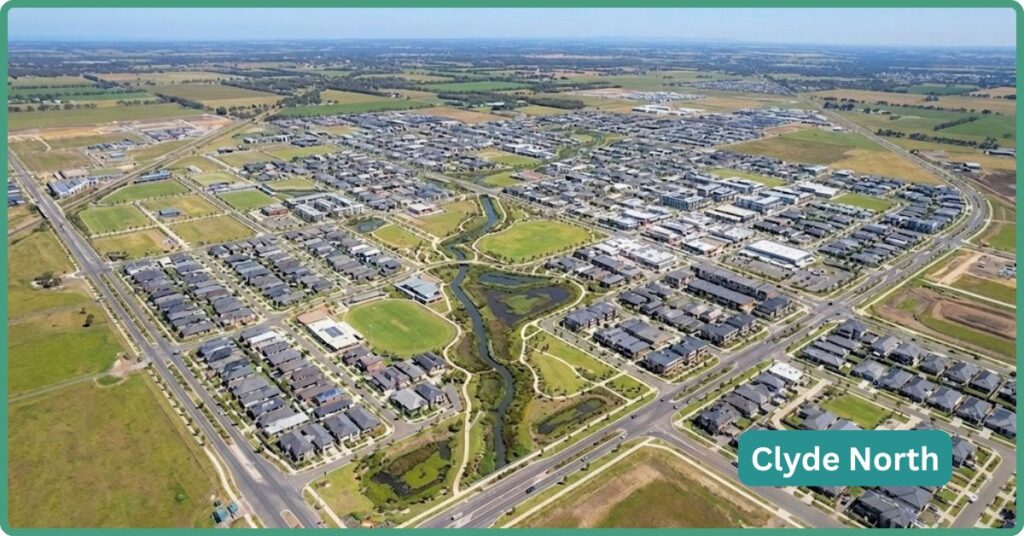
It suits first home buyers and young families who value new housing stock, established masterplanned amenity (Selandra Rise’s wetlands, shopping centre and fitness centre are a genuine drawcard), and a lower price point than Berwick, over buyers who need public transport now or want a school with a multi-year performance record to check before committing. It’s a weaker fit for anyone chasing walkability or an established café culture.
Weighed against its closest neighbours, Officer is the closest like-for-like comparison, another new, railless, south-east growth-corridor suburb sitting at a broadly similar price point ($753,750-$768,000). Cranbourne undercuts Clyde North on price (around $705,000-$725,000) and already has its own train station, a genuine trade-off between an older, more established town centre with rail access versus Clyde North’s newer housing and still-developing retail. Berwick sits meaningfully more expensive with its own station on the Pakenham line and a longer-established school reputation, the natural next step up for buyers who outgrow Clyde North’s price point. And if you’re actually comparing against Clyde itself, the suburb next door sharing its name, that’s typically a trade of even-newer, even-cheaper land against Clyde North’s slightly more established amenity and marginally closer proximity to existing shops and schools.
The Clyde North Backstory: Heritage & Origins
The name comes from Clyde Creek, a watercourse that once ran between two early pastoral runs toward the Koo Wee Rup Swamp, itself likely named after the River Clyde in Scotland. Clyde Post Office opened in 1864, and the area moved through the classic pattern of grazing, then dairying, then market gardening and flower growing across the 20th century, with the sandy loam soils well suited to horticulture. Land to the suburb’s east, outside the current growth corridor, remains classified as green wedge, genuinely rural, unsealed roads and all, with market gardening and dairy farming still active there today, part of what’s known as Melbourne’s food bowl.
Clyde North was governed by the former City of Cranbourne before Victoria’s 1994-95 council amalgamations folded it into the City of Casey. Serious residential development didn’t begin until late 2007, with the estate “Cascades on Clyde” among the first, and the area west of Berwick-Cranbourne Road falling mostly within Melbourne’s official Urban Growth Boundary. In other words, almost everything you see in Clyde North today, its roads, its schools, its shops, has been built within less than two decades.
Clyde North’s Growth Story
It isn’t a single infrastructure project, it’s land supply meeting demand at scale. The population jump from 8,156 in 2016 to 31,681 in 2021, a 288% increase, is the clearest, best-sourced figure, and current 2026 estimates (47,500 to 49,185 depending on source) suggest a further 50%-plus increase is already underway on top of that. City of Casey’s own advocacy material projects the combined Clyde and Clyde North corridor will exceed 100,000 residents by 2031, the figure the council itself uses to argue for rail funding. Various real estate and developer-affiliated sources have called Clyde North one of Australia’s “hottest” suburbs for 2026, worth noting as attributed marketing framing rather than neutral fact, even where the underlying rankings are real and checkable.
The drivers are structural: affordable greenfield land released through Precinct Structure Plans, proximity to the Monash Freeway/South Gippsland Highway corridor, and large masterplanned estates like Selandra Rise and Five Farms delivering new housing at volume. This is a suburb built by land supply and estate development, not by a single hospital or rail project landing, more comparable to Tarneit or Truganina’s earlier growth phase than to a suburb whose story turns on one piece of infrastructure.
The Train Issue
Here’s the fact that should shape any buying decision: Clyde North has no train station, and residents rely entirely on bus connections to Cranbourne, Merinda Park (both on the Cranbourne line) and Berwick (on the Pakenham line) stations. A rail extension of the Cranbourne line to Clyde has been discussed for years, but the status is genuinely unresolved. A $928 million extension was a Coalition election commitment tied to a state election the Coalition didn’t win, making it an unfunded promise, not a government project. The re-elected Labor government has committed $7 million to complete planning for the extension, funding for studies, not construction. Separately, a $750 million Cranbourne line duplication is a more advanced, already-funded project, but it upgrades the existing line rather than extending it to Clyde. Don’t buy here expecting the rail extension to be imminent.
Road infrastructure is genuinely more advanced. The Clyde Road Corridor Upgrade, duplicating up to 14km of arterial road with signalised intersections and shared paths, is under active, funded construction in 2026, with the Sir Gustav Nossal Boulevard/Clyde Road intersection upgrade underway through to at least late April 2026. Freeway access is indirect: getting from the Clyde Road area to the South Gippsland Freeway takes around 7 minutes, then a further 5 to EastLink, a multi-step route rather than a direct on-ramp. By car to the CBD, the fastest theoretical drive is cited at 41 minutes off-peak, but realistic peak travel time runs 60-90 minutes, worth planning around rather than the optimistic figure. Worth a local-knowledge flag: Bells Road and Soldiers Road in Clyde North are not the same roads as the similarly named streets in Berwick, a genuine trap for anyone navigating by GPS.
Crime and Safety, Honestly
Victorian crime data is published at LGA level, not suburb level, so there’s no official Crime Statistics Agency figure specific to Clyde North, only third-party aggregator estimates derived from the underlying data. With that limitation stated plainly: the City of Casey LGA recorded 29,858 offences in the year to June 2025, up 20.5% on the 24,782 recorded the year before. Within the LGA, Clyde North was reportedly the fourth-highest suburb for offences, behind Cranbourne, Narre Warren and Berwick, at 2,671 offences per one local news source. A separate aggregator puts the figure at 5,283 offences for what appears to be a similar period, roughly double, likely reflecting different counting methodologies or reference windows rather than a genuine factual dispute.
That same aggregator reports crime rates up 111% over five years, a bigger jump than the one-year LGA figure, though worth noting the suburb’s population also grew more than 50% in a similar window, meaning a meaningful share of the raw increase in offences likely tracks population growth rather than a rising rate per resident.
Schools and Childcare
This is a suburb visibly racing to keep up with its own population, and the school story shows it plainly. Turrun Primary School opened in 2025 (known during construction as Clyde North Primary School before a community and Traditional Owner consultation renamed it), joining existing options Grayling, Ramlegh Park, Topirum and Wilandra Rise Primary Schools. More significantly, Birranga College welcomed its first Year 7 cohort in Term 1, 2026, the suburb’s first-ever local government secondary school. Before it opened, local secondary options were described as having been “scarce,” which tells you plainly what families here were dealing with until very recently.
On the non-government side, Hillcrest Christian College and Rivercrest Christian College operate locally, and Clyde Grammar is still building out its year levels (currently only Prep to Year 2), another sign of a suburb still under construction in every sense.
Childcare has a genuine, documented shortage: roughly 2.8 children under five per long day care place here, against about 2 per place across Greater Melbourne. Waitlists are described as common, particularly for infant and toddler rooms, with early enquiry recommended. Around 86 childcare services are listed across the broader 3978 postcode, though that figure spans Clyde and Cranbourne East as well, not just Clyde North’s own suburb boundary.
Hospitals and Healthcare
Casey Hospital, in the Berwick/Narre Warren area and run by Monash Health, remains the nearest major public hospital with a full emergency department for Clyde North residents. Closer to home, Cranbourne Community Hospital opened in October 2025, a three-storey day hospital initially offering dialysis, pharmacy, pathology and adult mental health services, explicitly positioned to take pressure off Casey Hospital. An Urgent Care Centre is due to open there in late 2026, a genuinely useful, dated addition intended to further relieve Casey’s emergency department. The hospital is explicitly positioned to serve Cranbourne and Clyde in official messaging; Clyde North itself isn’t named directly in that framing, but given proximity it’s reasonable to treat it as within the hospital’s practical catchment.
Get Outside: Parks, Attractions & Fitness
Selandra Rise Wetlands (Clyde Creek Wetlands) sits within the Selandra Rise estate, a genuine design feature alongside reserve corridors running along Clyde Creek that provide lengthy walking trails. Mick Morland Reserve offer an oval and playground as does Ramlegh Reserve and the Inez Hunter Reserve.
Parks Victoria has reportedly investigated a new regional park on land bounded by Berwick-Cranbourne and Thompson Roads, worth treating as a proposal only, not confirmed or delivered.
Shopping and Dining
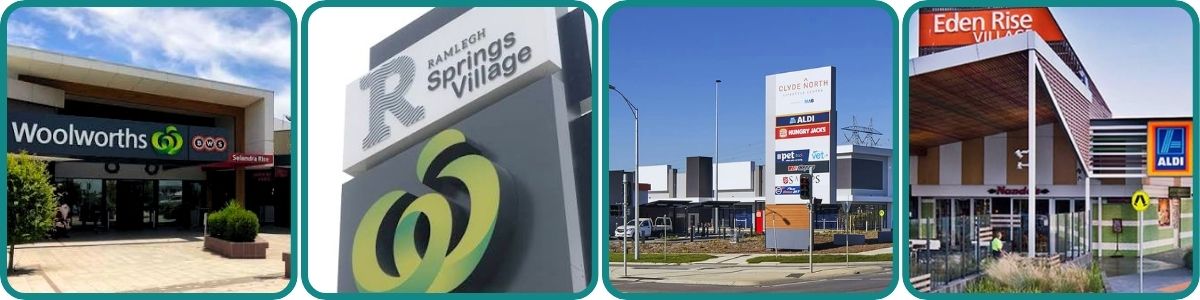
None of the shopping options are anything amazing but they well and truly cover the daily needs with big name stores covered.
Selandra Rise Shopping Centre anchors the suburb’s retail, built around a full-line Woolworths plus a medical centre, dentist, pharmacy, cafes, a fitness centre and specialty stores, all within walking distance of the wetlands and a bus stop.
The Clyde North Lifestyle Centre, opened in late 2019, is anchored by Bunnings and later joined by an Aldi, Repco Auto Parts, and other retailers. There are two gyms here too, one of them open 24/7.
The new Ramlegh Springs Village features 25 stores including Woolworths, Aldi, Bakers Delight, and several cafes/restaurant.
The nearby Eden Rise Village also services the area, offering Coles, Aldi, specialty stores and medical services.
What It’s Actually Like to Live Here
This is a young, family-heavy, first and second-generation migrant suburb. Median age sits around 30, the predominant age band is 30-39, and average household size is 3.3 people, notably higher than the Greater Melbourne average, consistent with a suburb full of young families rather than singles or couples without kids. Owner-occupancy has stayed remarkably stable through the fastest growth years, 74.2% in 2021 versus 73.3% in 2016, suggesting this remains overwhelmingly a suburb of people buying to settle rather than rent and move on. Culturally, 52.4% of residents were born overseas, well above the surrounding region’s 37.3%, with India (18.2%) the largest overseas birthplace after Australia, and 70.6% of residents having both parents born overseas, a strong first and second-generation migrant presence, particularly South Asian.
Day to day, this is a suburb of wide streets, wetland reserves, new schools filling in as fast as they can be built, and a genuine reliance on cars for almost everything. Median household income has climbed from $1,882 to $2,163 a week between 2016 and 2021, and the predominant education level shifted from Certificate to Bachelor over the same period, suggesting the more recent wave of residents is arriving with higher formal qualifications than the suburb’s earlier population. It’s a place still becoming itself, genuinely, not as a marketing line, with two new schools in the last two years as the clearest evidence.
Trade-offs
No train station, and no confirmed timeline for one: the rail extension has $7 million committed for planning only, nowhere near construction funding. Childcare supply is documented as genuinely tight, 2.8 children per long day care place against a metro average of 2, with common waitlists for the youngest age groups. The suburb is car-dependent even relative to its own growth-corridor neighbours, with sparse cycling infrastructure. Local government schools are mostly too new to have any performance track record, a real unknown for families who want to check a NAPLAN history before committing. And LGA-level crime data shows a real, rising offence rate (up 20.5% over the past year), even if the exact suburb-level contribution can’t be pinned down precisely given how sharply the two available estimates disagree.
FAQ
Does Clyde North have a train station? No, and there’s no confirmed construction timeline for one. A $928 million rail extension was an opposition election promise tied to a lost election. The sitting government has committed only $7 million for planning work. Residents currently rely on buses to Cranbourne, Merinda Park and Berwick stations.
Is Clyde North the same suburb as Clyde? No. They’re separate, legally distinct suburbs sharing a boundary at Hardys Road, with Clyde to the south. The naming history is genuinely confusing (the names were effectively swapped in 1915), but real estate listings often blur the two regardless.
What’s the median house price in Clyde North? Figures cluster between $735,500 and $765,000 depending on the data provider and reference quarter, with $750,000 the most consistently cited figure, sitting well below Greater Melbourne’s roughly $854,000 median.
Is Clyde North safe? Crime is reported at the City of Casey LGA level, which recorded a 20.5% increase in offences in the year to June 2025. Suburb-level estimates for Clyde North specifically conflict sharply between sources (2,671 versus 5,283 offences for a similar period), so treat any precise suburb-level figure with real caution.
References
- Victorian Places. Clyde and Clyde North.
- Australian Bureau of Statistics. 2021 Census QuickStats, Clyde North (SAL20582).
- profile.id.com.au. City of Casey, Clyde North about page.
- YourInvestmentPropertyMag. Clyde North, VIC 3978 Suburb Profile & Property Report.
- Property Buzz. “Clyde North emerges as a booming real estate hotspot,” March 2026.
- Barry Plant. Clyde North suburb profile.
- City of Casey. Clyde Rail Link advocacy material; Clyde Road Corridor Upgrade; Berwick-Cranbourne Road and Hardys Road project page.
- Casey Conversations. Clyde Rail Link; Clyde Road Corridor Upgrade.
- Cranbourne Star News. “Coalition loss presents train troubles for Clyde,” December 2022; “Casey’s crime rate up 20%,” September 2025.
- Victoria’s Big Build. Clyde Road Upgrade project update.
- AreaSearch. Clyde North 3978 Child Care Needs Analysis.
- CareforKids.com.au. Clyde North 3978 childcare listings.
- schoolbuildings.vic.gov.au. Turrun Primary School; Birranga College.
- Frasers Property. Clyde North Suburb Guide; “New Victorian Government secondary at Five Farms.”
- Berwick Star News. “Cranbourne Community Hospital to receive Urgent Care Centre,” May 2026.
- Victorian Health Building Authority. Cranbourne Community Hospital.
- Premier of Victoria. “New Community Hospital For Cranbourne Opens.”