
Cranbourne East doesn’t have a train station, doesn’t have the Royal Botanic Gardens, and isn’t the same suburb as the Cranbourne Park Shopping Centre you’ll see it lumped in with online. All three of those things sit in Cranbourne proper, the actual 19th-century township next door. What Cranbourne East does have is a genuinely elite sporting precinct in Casey Fields, a population that’s roughly tripled in scale terms over the past decade, and a very honest identity as one of the newest large suburbs in this corridor, a modern administrative creation carved out of Cranbourne’s eastern paddocks rather than an old town in its own right.
Boundary Map
Cranbourne East sits in the City of Casey, about 50km south-east of the Melbourne CBD, bordered by Cranbourne to the west, Cranbourne North to the north, Clyde and Clyde North further north-east, and open rural land to the south and east.
Quick Facts
| LGA | City of Casey |
| Median House Price | Around $750,000, up roughly 5-6% over the past 12 months (best-supported figure across multiple sources; one outlier source cites $873,463, treat with caution) |
| Median Unit Price | Not clearly available; this is a house-dominant suburb with thin unit stock |
| Population | 24,679 (2021 Census); current estimate around 26,783 (2023), forecast to reach roughly 39,404 by 2041 |
| Growth Rate | Called “the fastest growing suburb in the country” by one outlet in 2018; that’s a historical, not current, title, though it remains genuinely one of Melbourne’s fastest-growing suburbs today |
| Transport | No train station in the suburb itself. Cranbourne station (the line terminus) is in Cranbourne proper; Merinda Park station is in Cranbourne North. A “Cranbourne East station” exists only as a proposed, unfunded future extension |
| Crime Rate (LGA) | City of Casey: around 8,492 offences per 100,000 (as of late 2025 reporting), rising sharply and reported to rank second in Victoria for crime surge, heavily driven by car theft |
| Childcare Availability | Current suburb-specific supply and waitlist data could not be verified; the broader Casey growth corridor has a documented pattern of childcare lagging population growth |
| School Zone Quality | Cranbourne East Secondary College (around 2,100 students) and Cranbourne East Primary School serve the suburb directly; no current NAPLAN or VCE performance data was confirmed |
| Best For | Buyers wanting an established (if young) growth-corridor suburb with genuine elite sporting infrastructure already built, at a mid-pack price for the area |
Our Verdict
Consider here if you want a growth-corridor suburb that already has real, elite-level sporting infrastructure in Casey Fields rather than a promise of amenity still to come, and you’re comfortable that your nearest train station is a drive or bus ride away in a neighbouring suburb, not a short walk from home. At around $750,000 median house price, Cranbourne East sits mid-pack in its immediate comparison set, cheaper than Cranbourne North but roughly level with Clyde North. Don’t buy here expecting a station of your own any time soon: the only “Cranbourne East railway station” that exists is a proposed, unfunded future extension, not a built or funded project.
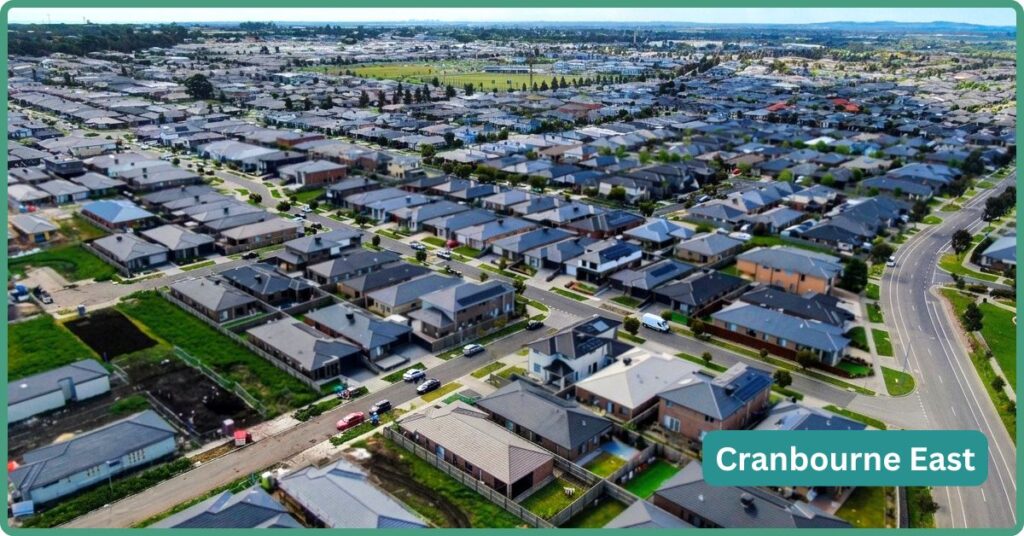
It suits buyers and young families who want space, newer housing stock, and don’t mind driving to Cranbourne or Merinda Park stations for train access. It’s a weaker fit for anyone who specifically wants walkable rail access today, or who’s assuming this suburb includes the Royal Botanic Gardens Cranbourne or Cranbourne Park Shopping Centre, both of which are genuinely in the neighbouring suburb of Cranbourne, not here.
Weighed against its closest neighbours, Cranbourne North runs pricier (around $770,000) but comes with easier access to Merinda Park station. Clyde North sits almost at price parity with Cranbourne East, while Clyde itself is the cheapest of the cluster (around $715,000) but also the least established. Cranbourne proper, the original township next door, remains the place to look if you specifically want the train terminus, the shopping centre, and the botanic gardens within your own suburb boundary rather than a short drive away.
Cranbourne East’s Backstory
This is the section where honesty matters most. Cranbourne East itself has no genuine 19th-century township history, and this profile won’t manufacture one. It’s a modern administrative and planning creation of the growth-corridor subdivision era, carved from what was rural and semi-rural land on Cranbourne’s eastern fringe from roughly the 2000s onward. The real history belongs next door, to Cranbourne proper.
That broader district’s story goes back much further: the Ruffy brothers were among the earliest European settlers, squatting on the “Mayune” pastoral run from 1836, grazing cattle and growing barley and wheat. A community later developed on land leased by Alexander Cameron at Mayune, through which the track to South Gippsland passed, and the township of Cranbourne itself was surveyed in 1856 and formally gazetted in 1861, followed by dairying, market gardens and orchards, a school, churches, a hotel and postal service. Even the name Cranbourne carries some genuine uncertainty: it may have been drawn from a town in Berkshire, England, or from Viscount Cranborne (1821-1865), though sources themselves hedge on which. None of this is Cranbourne East’s own history, but it’s the history the suburb’s name and identity ultimately borrow from.
The Growth Story
The growth numbers here are genuinely striking: 24,679 residents at the 2021 Census, an estimated 26,783 by 2023, and a forecast climbing to around 39,404 by 2041. One outlet called Cranbourne East “the fastest growing suburb in the country” back in 2018, a claim worth treating as a historical marker of that specific moment rather than a current title, since more recent coverage describes it more generally as one of Melbourne’s fastest-growing suburbs without repeating that exact national ranking. Either way, the scale of growth is real and ongoing, not a one-off spike.
What’s already been delivered rather than promised is Casey Fields, a 70-hectare, $30 million multi-sport precinct genuinely located inside Cranbourne East, serving as an AFLW home and training base for Melbourne Football Club, home ground for VFL side Casey Demons and the Cranbourne Cricket Club, and hosting netball, soccer, tennis, cycling, BMX, athletics and rugby league, with elite tenants including Melbourne City FC, Melbourne Storm and Netball Victoria. A further $10.68 million federally-funded Mini-Stadium and Women’s Centre for Excellence is planned on top of what’s already built. This is a genuinely rare thing for a suburb this new: elite-level sporting infrastructure already standing, not just zoned for.
Getting Around: Transport & Distances
This is the single most important correction to make plainly: Cranbourne East does not have its own train station. The Cranbourne line terminus, Cranbourne station, opened in 1888, sits physically in Cranbourne proper, not Cranbourne East. Merinda Park station, opened in 1995 and rebuilt with a second platform and new entrance between 2019 and 2022, is in neighbouring Cranbourne North. A station referred to as “Cranbourne East railway station” does exist as a concept, proposed as a future extension of the line near Casey Fields that would become the new terminus if built, but it remains unfunded and not under construction, a proposal only. Don’t buy here assuming this station is coming soon.
Most people use the Cranbourne Station, although parking can be tight, and there is talk of expanding bus services to connect to the station. Depending on where you are, presently there are three bus lines, 798, 898, and 897, that can connect you to the rail station with a 20-40 minute journey time.
What has genuinely been delivered is substantial level crossing removal work along the Cranbourne line, including the Camms Road crossing removed in November 2023, a year ahead of schedule, via a new rail bridge, as part of a broader program that had removed the large majority of the line’s level crossings as of recent reporting.
On the road side, the Thompsons Road and Berwick-Cranbourne Road intersection upgrade near Clyde North, replacing a roundabout with a signalised intersection, was completed in October 2026, seven months ahead of schedule, a genuine, dated infrastructure win. The Clyde Road Corridor Upgrade is currently under construction, and the wider Thompsons Road Extension toward the South Gippsland Highway is a staged project, with its first stage only partly funded rather than fully delivered.
One more correction worth making: the Suburban Rail Loop does not run through or near Cranbourne East. SRL East connects to the Cranbourne-Pakenham line at Clayton, well to the north, meaning any SRL benefit here is indirect at best and shouldn’t be counted as a reason to expect improved local transport soon.
Crime and Safety, Honestly
Victorian crime data is published at City of Casey LGA level, not suburb level, so there’s no Cranbourne East-specific figure. Casey recorded around 8,492 offences per 100,000 people as of late 2025 reporting, with a 12.7% year-on-year increase in criminal incidents and coverage describing Casey as ranking second in Victoria for its crime surge, driven substantially by vehicle-related offences, with motor vehicle theft and theft from motor vehicles together accounting for more than 20% of all recorded incidents. Car theft specifically is a genuine, current concern rather than background noise.
Schools, Childcare & Healthcare
Cranbourne East Secondary College, with around 2,100 students across Years 7 to 12, and Cranbourne East Primary School are the main government options physically located in the suburb. Casey Fields Primary School is a newer addition to the area. St Peter’s College’s Cranbourne campus offers a Catholic secondary option nearby.
Childcare supply is generally lagging population growth in fast-growing outer suburbs. Treat that as a general corridor-wide caution rather than a confirmed Cranbourne East-specific statistic, and check current availability directly before assuming either a tight or comfortable supply picture.
Casey Hospital in nearby Berwick is the major public facility servicing the broader area. The smaller Cranbourne Community Hospital is a new addition to service the suburb. There is a family clinic, a medical centre, and a dental clinic in the suburb, whilst neighbouring Cranbourne offers a greater array of GP options.
Get Outside: Parks, Attractions & Fitness
Casey Fields is Cranbourne East’s standout asset here: a genuinely elite, already-built 70-hectare multi-sport precinct rather than a future promise. As mentioned in the Growth Story section, it is home to the Melbourne Demons (AFL/AFLW) and Melbourne City Football Club (A-League) plus a staggering 30 fields, tracks and courts, plus a BMX track and criterium cycling track.
Worth a direct correction on two other attractions commonly associated with the wider Cranbourne name: the Royal Botanic Gardens Cranbourne, a major regional attraction with entrances on Botanic Drive and Ballarto Road, is physically located in the suburb of Cranbourne, not Cranbourne East, and shouldn’t be counted as a Cranbourne East amenity even though it shares the district name. If botanic gardens access matters to your decision, it’s a short trip away, not on your own suburb’s doorstep.
Shopping and Dining
Cranbourne Park Shopping Centre, a regional centre that’s operated since 1979 and is owned by Vicinity Centres, sits at 123-139 High Street in the suburb of Cranbourne itself, not Cranbourne East, despite sharing the same 3977 postcode area many residents associate with both suburbs. Cranbourne East residents use this centre regularly, but it isn’t physically part of their own suburb, worth knowing if you assumed otherwise. Specific retail and dining precincts located directly within Cranbourne East itself weren’t independently detailed in this research, a gap worth checking directly if a local shopping strip within walking distance matters to your decision.
What It’s Actually Like to Live Here
This is a young suburb in every sense: median age 31, with 6,380 families and an average household size of 3.3, notably larger than typical Melbourne households, consistent with newer, bigger homes built for growing families. The leading ancestries are English, Australian and Indian. Tenure data carries a genuine internal conflict worth flagging rather than resolving artificially: one source puts owner-occupancy at 71.3% as of 2021, while another source’s breakdown implies a higher combined figure around 75%, and neither cleanly reconciles with the 2016 figure of 76.7% owner-occupied. Read this directionally rather than as a precise number: Cranbourne East remains a strongly owner-occupier, mortgage-heavy suburb, with a renter share that appears to be creeping up over time rather than shrinking. Day to day, this is a suburb still filling in around its residents, genuinely defined by newer estates, a standout sporting precinct, and an honest reliance on neighbouring suburbs for train access and some of the district’s best-known attractions.
Trade-offs
No train station of your own, and the one sometimes referenced as “Cranbourne East station” is an unfunded proposal, not a real project to factor into your decision. Crime is rising across the City of Casey LGA, with vehicle theft a specific, current concern. Childcare supply and waitlist data couldn’t be verified, and the broader corridor pattern suggests it may be tight. Median house price is the best-supported figure available but does carry a genuine outlier in one source worth being aware of. And several attractions commonly associated with “Cranbourne” generally, the botanic gardens, the shopping centre, the historic township, all sit in the neighbouring suburb of Cranbourne, not in Cranbourne East itself.
FAQ
Does Cranbourne East have a train station? No. The Cranbourne line terminus is in Cranbourne proper, and Merinda Park station is in Cranbourne North. A “Cranbourne East railway station” exists only as a proposed, unfunded future extension.
Is Cranbourne East the same as Cranbourne? No, they’re separate suburbs. Cranbourne has the historic 19th-century township, the train terminus, Cranbourne Park Shopping Centre and the Royal Botanic Gardens Cranbourne. Cranbourne East has Casey Fields and the newer housing estates, but no train station and no genuine old-township history of its own.
Is Cranbourne East a good suburb to buy in? It suits buyers wanting newer housing and genuine, already-built sporting infrastructure at a mid-pack price for the corridor. It’s a weaker fit if walkable train access or an established old-town centre within your own suburb boundary matters to you.
What’s the median house price in Cranbourne East? Around $750,000 as of 2026, based on the best-supported cluster of sources, though one outlier source cites a notably higher $873,463; treat the lower figure as more reliable and confirm against a current local appraisal.
References
- Australian Bureau of Statistics. 2021 Census QuickStats, Cranbourne East (SAL20663).
- forecast.id, City of Casey. Cranbourne East population estimates and forecasts, 2023.
- The New Daily. “Fastest growing suburb in the country,” April 2018.
- Your Investment Property Magazine; PropertyValue.com.au; OpenAgent; Woodards; HTAG Analytics. Cranbourne East median house price data, 2026.
- Victoria’s Big Build. Cranbourne line level crossing removals; Camms Road removal, November 2023.
- Public Transport Victoria / Wikipedia. Cranbourne railway station; Merinda Park railway station; proposed Cranbourne East railway station.
- Suburban Rail Loop Authority. SRL East route and Clayton interchange.
- Casey Fields precinct. Melbourne Football Club, Casey Demons, Cranbourne Cricket Club facility information.
- Royal Botanic Gardens Victoria. Royal Botanic Gardens Cranbourne, address and entrance locations.
- Crime Statistics Agency Victoria (via Cranbourne Star News / Berwick Star News reporting). City of Casey recorded offences, 2025-26.
- Victorian Places; local history sources. Cranbourne district origin, Ruffy brothers, Mayune pastoral run, township survey 1856 and gazettal 1861.