
Cranbourne North has the one thing Cranbourne East, its much-discussed neighbour, still doesn’t: an actual, operating train station. Merinda Park has been running since 1995, was rebuilt with a second platform in 2022, and got a further upgrade to its bus interchange and parking in August 2024. Meanwhile Cranbourne East residents have been chasing a promised station since 1999 and are still chasing it. That single, verifiable fact is the clearest reason to understand these two similarly-named, similarly-new suburbs as genuinely different propositions, not interchangeable growth-corridor postcodes.
Boundary Map
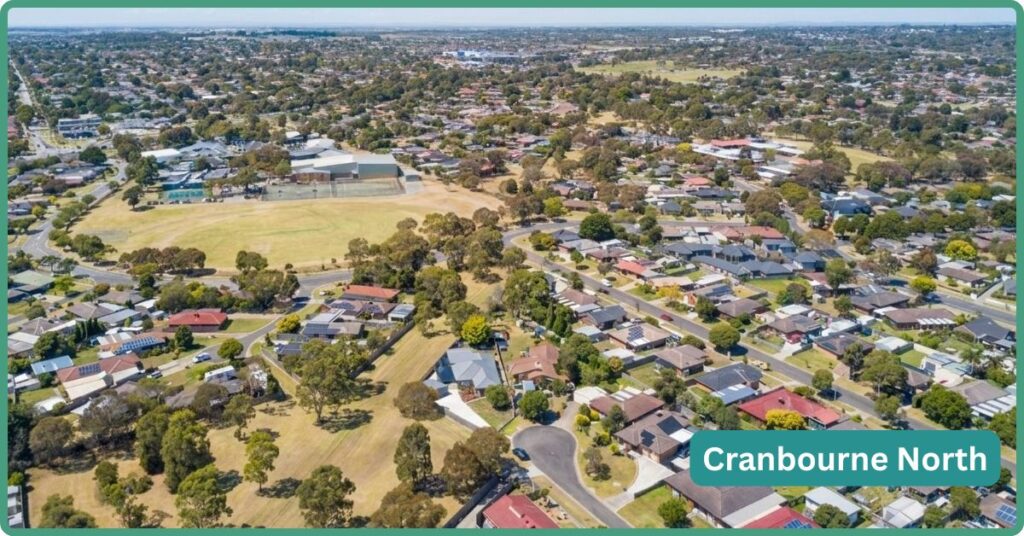
Cranbourne North sits in the City of Casey, about 48km south-east of the Melbourne CBD, bordered by Cranbourne to the south, Cranbourne East to the east, Narre Warren South to the north, and Lyndhurst further west.
Quick Facts
| LGA | City of Casey |
| Median House Price | Genuinely varied between sources, ranging roughly $645,000-$917,000 |
| Median Unit Price | $545,000, up around 9% over 12 months |
| Population | 24,683 (2021 Census); current estimate around 25,771 (2023), no more recent figure confirmed |
| Growth Rate | Established, largely built-out suburb rather than an active greenfield frontier; growth appears modest compared with neighbouring Cranbourne East |
| Transport | Merinda Park station, on Thompsons Road, genuinely located in Cranbourne North. Opened 1995, rebuilt with a second platform (2021-2022), further upgraded (new bus interchange, parking, crossing) in August 2024. Fully delivered, not a promise |
| Crime Rate (LGA) | City of Casey: sources give conflicting figures (around 8,492 offences per 100,000 versus 22,911 criminal incidents, possibly different metrics), both pointing to a rising trend, heavily driven by car theft |
| Childcare Availability | Postcode-level data (shared with Cranbourne and Cranbourne South) shows dozens of services; suburb-specific counts and waitlist figures aren’t confirmed |
| School Zone Quality | Kala Primary School (opened January 2026) and the established Cranbourne North Primary School serve the area, alongside Alkira Secondary College; no confirmed performance data |
| Best For | Buyers who want genuine, delivered train access in this corridor rather than a station still being promised |
Our Verdict
If train access is a genuine priority and you want it delivered now, not promised for later, then it’s a solid candidate. Merinda Park station is real, upgraded, and still being invested in, most recently in August 2024. Be mindful that the station sits at the suburb’s outer southwest corner, meaning residents on the eastern side of the suburb may have up to a 6km journey to get there.
Median house price is harder to pin down than usual, with sources ranging from around $645,000 to $917,000, with numerous factors coming into play, including proximity to rail mentioned previously. Don’t buy here expecting a suburb with its own major shopping centre or a standout old-town history: Cranbourne North borrows its big retail and heritage drawcards from neighbouring Cranbourne, and its own institutional roots, a golf club from 1953 and a primary school from 1962, are modest.
It suits established families who want proven train access, existing schools, and a slightly more settled feel than the newest estates next door, plus, increasingly, downsizers drawn to Summerset’s first Australian retirement village, currently completing here with 161 villas, serviced apartments and a care centre. It’s a weaker fit for buyers chasing the newest possible housing stock or the fastest capital growth, since Cranbourne North reads as more established and less frontier than Cranbourne East.
Weighed against its closest neighbours, the comparison is straightforward on transport: Cranbourne North has Merinda Park station, Cranbourne East doesn’t, full stop, and that’s a genuine, delivered structural advantage rather than a marketing claim. Cranbourne proper, immediately south, holds the district’s actual shopping centre and the Royal Botanic Gardens Cranbourne, neither of which sits inside Cranbourne North’s own boundary despite how often they’re associated with it. Clyde North, further north-east, is comparably family-heavy and has its own new school (Birranga Secondary College, opened 2026), but doesn’t have a train station of its own either, making Cranbourne North’s Merinda Park advantage hold up against that comparison too.
The Backstory: Heritage & Origins
Honestly, Cranbourne North has no standalone old-township history of its own, and this profile won’t invent one. Like Cranbourne East, it’s an administrative slice carved from the broader, genuinely historic Cranbourne district rather than a town that grew up under its own name. The boundary runs from Merinda Park station in the west to Berwick-Cranbourne Road in the east, and north to Glasscocks Road and Narre Warren South, a modern line drawn on a map rather than an old settlement pattern.
What gives Cranbourne North slightly deeper roots than a pure 2000s-2010s growth suburb is a couple of mid-century institutions. The Cranbourne Golf Club was founded in 1953, when this area was still open paddock, making it one of the district’s older continuously-operating organisations. A second state primary school opened in the area in 1962 under the name “Cranbourne North,” though at the time it actually sat within Cranbourne proper’s boundary, before suburb lines were later redrawn, a genuinely interesting nuance showing that even the name “Cranbourne North” predates the suburb as it’s defined today. The broader Cranbourne district’s real history, Boonwurrung Traditional Owners knowing the area as “Mar-ne-bek,” meaning excellent country, the Ruffy brothers’ Mayune pastoral run from 1836, the township surveyed in 1856 and gazetted in 1861, belongs to Cranbourne itself, not to this modern administrative neighbour.
The Growth Story
Cranbourne North’s population sat at 24,683 at the 2021 Census, with an estimated 25,771 by 2023. Compared with the explosive growth rates seen in Cranbourne East and other newer corridor suburbs in this series, Cranbourne North is a more settled, largely built-out suburb rather than an active greenfield frontier, consistent with its slightly older institutional roots.
The genuinely new addition here is Summerset’s first Australian retirement village, currently nearing completion in 2026: 161 villas, 34 serviced apartments, a 72-bed care centre, an indoor pool, gym and cinema, with the main building opened around a May 2026 investor showcase and further residential stages still underway. This adds a downsizer and retiree dimension to a suburb otherwise defined by young families, a genuinely different demographic story to most of the growth-corridor suburbs covered elsewhere in this series.
Transport
This is Cranbourne North’s clearest, most defensible advantage. Merinda Park station, on Thompsons Road, opened in 1995 and has been rebuilt as part of the Cranbourne Line Upgrade and Level Crossing Removal Project, gaining a second platform, with the works substantially complete by February 2022 and full line duplication between Dandenong and Cranbourne enabling roughly 10-minute peak services. A further round of amenity upgrades, a new bus interchange, additional walking paths, 119 new or upgraded car parking spaces and a new zebra crossing, was completed in August 2024, showing this is an asset still being actively invested in rather than a one-off delivery.
The contrast with neighbouring Cranbourne East is worth stating plainly since it’s the defining transport story of this part of the corridor: a station for Cranbourne East was first promised at the 1999 state election, briefly appeared in the 2002-03 budget, was dropped the following year, and has remained unfunded ever since, with residents still publicly calling for it as recently as May 2026 despite roughly $4.9 million collected via rail levies. Cranbourne North’s residents, at least those on the western side of the suburb, simply don’t have that problem.
The Suburban Rail Loop has no relevance to this suburb: SRL East runs from Cheltenham to Box Hill via Clayton, Monash, Glen Waverley and Burwood, well away from this corridor, with the only tangential connection being a same-line interchange at Clayton, many stops to the north, not an SRL station or extension serving Cranbourne North directly.
Crime and Safety, Honestly
Victorian crime data is published at City of Casey LGA level, not suburb level, so there’s no Cranbourne North-specific figure. One source cites 31,016 offences at a rate of 8,492 per 100,000 for 2025, while a separate Crime Statistics Agency release for the year ending December 2025 cites 22,911 criminal incidents, up 12.7% on the prior year. These may reflect different underlying metrics, offences versus incidents. What’s consistent across both: the trend is rising, and vehicle-related crime is a specific, significant driver, with motor vehicle theft and theft from motor vehicles together accounting for more than a fifth of all recorded incidents, and coverage describing Casey as ranking second in Victoria for its crime surge.
Schools, Childcare & Healthcare
Kala Primary School, whose name is a Boonwurrung word meaning “dog” chosen through community and Traditional Owner consultation, opened in Term 1 on 29 January 2026 under founding principal Tracy Knight, one of 19 new Victorian government schools to open that year, alongside a new kindergarten with two rooms catering for up to 66 children. The established Cranbourne North Primary School, on Tucker Street, predates Kala and serves as the area’s longer-running government primary option, with Alkira Secondary College serving the area at secondary level.
Childcare data for this suburb is complicated by postcode boundaries: the commonly cited figure of around 44 centres covers the whole 3977 postcode, which spans Cranbourne North, Cranbourne and Cranbourne South together, so the true Cranbourne-North-only count isn’t confirmed. Most centres in the broader area meet the National Quality Standard, with at least one standout, Arbourlea Kindergarten, rated “Exceeding NQS.”
Casey Hospital in nearby Berwick server the broader area including Cranbourne North while five GP/Medical Centres locate themselves in the eastern side of the suburb.
Parks, Attractions & Fitness
The Cranbourne Golf Club, established in 1953, is one of the area’s oldest continuously operating institutions and a genuine piece of local recreation history predating the current suburb boundary. There are small local community reserves located across the suburb but nothing spectacular by any means. However, just outside the suburbs north eastern corner is Casey Central Park, which offers a playground, picnic area, walking trails and large open greenspace. Also notable is Royal Botanic Gardens Cranbourne, which sits 7km or so south of the suburb. Also worth remembering, the beautiful Seaford foreshore and its beaches are only 15km away.
Shopping and Dining
Here’s an honest trade-off worth stating plainly rather than softening: Cranbourne North doesn’t have a major shopping centre of its own. Cranbourne Park Shopping Centre, with more than 150 stores including Kmart, Target and Cole. Casey Central sits in Narre Warren South, and Hunt Club Village, anchored by Woolworths and Aldi, is in Cranbourne East. Cranbourne North’s retail and dining draw is genuinely borrowed from its neighbours rather than owned within its own boundary, a real factor to weigh if walkable local shopping matters to you.
What It’s Actually Like to Live Here
This is a strongly family-oriented, owner-occupier suburb: median age 32, with couples with children making up 59.8% of households, one-parent families 16.3%, and couples without children 22.5%. Tenure skews heavily toward ownership, with 57.5% owned with a mortgage and a further 16.1% owned outright, against 26.4% renting, a genuine family-buyer market rather than an investor or renter-dominated one. Median household income sits at $1,941 a week.
Day to day, this is a settled, established growth-corridor suburb, less frontier than Cranbourne East, borrowing its big-ticket amenities from neighbours but holding a genuine, delivered transport advantage of its own, with a new wave of retirement-village residents now adding a different demographic thread to what’s otherwise a young-family suburb.
Trade-offs
No major shopping centre or standout park sits inside Cranbourne North’s own boundary, its retail and recreation draw is borrowed from Cranbourne, Cranbourne East and Narre Warren South. Unless you are into golf, greenspace and sports facilities are somewhat lacking. Both of those point to a car-dependent suburb with lots of micro commutes. Growth here is more modest than in neighbouring Cranbourne East, a trade-off depending on whether you’re chasing capital growth or established stability.
FAQ
Does Cranbourne North have a train station? Yes, Merinda Park station, on Thompsons Road, has operated since 1995 and was rebuilt with a second platform by 2022, with further upgrades completed in August 2024.
Is Cranbourne North a good suburb to buy in? It suits buyers prioritising proven train access and established schools over the newest possible housing stock. It’s a weaker fit if you want a suburb with its own major shopping centre or standout old-town history, both of which sit in neighbouring Cranbourne instead.
What’s the median house price in Cranbourne North? Genuinely contested across sources, ranging roughly $645,000 to $917,000, with a $760,000-$770,000 cluster most commonly cited. Treat this as an unresolved range rather than a confirmed figure and check a current local appraisal.
Does Cranbourne North have its own shopping centre? No. Cranbourne Park Shopping Centre and the Royal Botanic Gardens Cranbourne are both physically located in neighbouring Cranbourne, not Cranbourne North.
References
- Australian Bureau of Statistics. 2021 Census QuickStats, Cranbourne North (SAL20664).
- profile.id. Cranbourne North suburb profile, 2023 estimated resident population.
- Victoria’s Big Build. Cranbourne Line Upgrade and Level Crossing Removal Project; Merinda Park station rebuild.
- Berwick Star News. Merinda Park station amenity upgrades, August 2024.
- Cranbourne Star News. Kala Primary School opening, January 2026; Cranbourne East residents’ calls for a promised rail station, May 2026.
- Wikipedia. Cranbourne East railway station; Merinda Park railway station.
- Crime Statistics Agency Victoria. City of Casey recorded offences and criminal incidents, 2025-26.
- Your Investment Property Magazine; Woodards; PropertyValue.com.au; HtAG Analytics; MELBZ. Cranbourne North median house and unit price data, 2026.
- The Weekly Source. Summerset retirement village, Cranbourne North, 2026.
- Gary Maas MP. Naming of Kala Primary School, Cranbourne North.