
Hampton Park breaks the pattern this series has settled into. Cranbourne North, Cranbourne East, Clyde North, Berwick, Pakenham and Officer are all growth-corridor suburbs in some stage of new estate development. Hampton Park isn’t: it was substantially built out by the 1970s through 90s, has no active greenfield estates left to fill in, and today reads as the affordability floor of this whole corridor, priced below every one of its immediate neighbours. It’s also one of the more genuinely multicultural suburbs in Melbourne’s south-east, and one of the more honestly disadvantaged ones, and this profile treats both facts as real rather than picking one to emphasise.
Boundary Map
Hampton Park sits in the City of Casey, about 40km south-east of the Melbourne CBD, bordered by Hallam to the north, Narre Warren South to the west, Cranbourne North to the south, and Lynbrook and Lyndhurst further east.
Quick Facts
| LGA | City of Casey |
| Median House Price | Genuinely contested between sources, roughly $700,000-$720,000 (2026 data); one outlier source cites $871,347, treat as unreliable |
| Median Unit Price | Also contested, roughly $510,000-$585,000 depending on source |
| Population | 26,082 (2021 Census), up modestly from around 25,300 in 2016; no confirmed current estimate, though a fresh Census figure is due later in 2026 |
| Growth Rate | Established, largely built-out suburb, not a growth corridor; modest population change over the past Census period |
| Transport | No railway station within the suburb itself. Nearest are Merinda Park (Cranbourne line) and Hallam (Pakenham line), both a walk away rather than in Hampton Park. Not the same as Hampton station on the Sandringham line, a different, unrelated suburb entirely |
| Crime Rate (LGA) | City of Casey: 23,284 criminal incidents for the year to March 2026, up 9.1%, heavily driven by car theft; no suburb-specific figure exists |
| Childcare Availability | Around 30-32 services locally, most showing vacancies, a notably more comfortable supply picture than the newer growth-front suburbs in this series |
| School Zone Quality | Hampton Park Secondary College (established 1986, around 1,184 students) and St Kevin’s Catholic primary (with a genuine Indonesian-language program) serve the area; no independent performance ranking was confirmed |
| Best For | Buyers and investors prioritising genuine affordability and an already-established, multicultural community over new housing stock or rail access |
Our Honest Verdict
Take a look here if affordability is your priority and you’re comfortable with an established suburb rather than a new one: even at the higher end of the price range found in research, Hampton Park sits meaningfully below Narre Warren, Hallam and Lyndhurst, all in the same corridor. Don’t consider here expecting a train station of your own; there isn’t one, and the nearest options are a genuine walk away on two different lines. And go in with eyes open on the socioeconomic picture: Hampton Park’s own disadvantage indices sit in the bottom national quintile, described locally as among the more disadvantaged areas in Melbourne’s south-east, a real factor worth weighing honestly.
It may suit buyers and investors chasing genuine value in an established suburb with real multicultural depth, adequate rather than tight childcare supply, and an active current renewal push in its own town centre. It’s a weaker fit for anyone who specifically wants rail access within walking distance, new housing stock, or a suburb with a stronger measured socioeconomic profile.
Weighed against its immediate neighbours, Hampton Park is genuinely the cheapest of the cluster. Cranbourne runs at a broadly similar price point but has its own train station, a real advantage Hampton Park lacks. Hallam, directly next door, prices meaningfully higher despite the proximity, largely on the back of its own level crossing removal and rebuilt station. Narre Warren (around $800,000) and Lyndhurst (around $938,000) both sit well above Hampton Park, trading affordability for newer stock and stronger retail and civic infrastructure. If price is your primary lever in this corridor, Hampton Park is arguably where it pulls hardest.
The Backstory: Heritage & Origins
Unlike most of the growth-corridor suburbs covered elsewhere in this series, Hampton Park has a genuine pre-suburban history distinct from simply being paddock a decade or two ago. The area was originally part of the Parish of Eumemmerring, and before it had its own name, residents here were recorded as living in Eumemmerring, Dandenong or Lyndhurst. Locally, it was known as “Garner’s Paddock,” after the Garner family of Dandenong, who owned the land.
The formal subdivision took place in 1917-1918, and after the First World War, the “Hampton Park Estate,” forty lots ranging from five to twenty-six acres each, was offered for sale, a genuinely early 20th-century farming subdivision story rather than a modern master-planned estate. The suburb’s name is most consistently attributed to the Hampton family, the original landowners at that time (as much as we know).
The Big Build & Growth Story
There isn’t one, and that’s genuinely the point. Population grew only modestly from around 25,300 in 2016 to 26,082 at the 2021 Census, consistent with a suburb that’s largely finished being built rather than one still filling in new estates. What is genuinely current and worth watching is Hampton Park Central, the suburb’s own shopping precinct, which is mid-renewal: Casey councillors endorsed a Draft Updated Hampton Park Central Development Plan on 17 March 2026, backed by a $250,000 state government grant, part of a broader $6 million fund for multicultural business hubs across Victoria, aimed at revitalising shopfronts and public space, with plan adoption targeted for June 2026. Separately, the long-stalled former Hampton Park Food Market site was greenlit for redevelopment as of mid-2025 reporting, expected to bring more than 100 apartments alongside retail and office space, a real, if modest, densification story for an otherwise settled suburb.
The Transport Issue
Hampton Park has no railway station of its own, and this is worth stating plainly rather than glossing over. The nearest options are Merinda Park station, on the Cranbourne line, roughly a 16-minute walk from parts of the suburb, and Hallam station, on the Pakenham line, about 2km or a 26-minute walk away, meaning Hampton Park sits between two rail lines without direct access to either. One easy mix-up worth correcting explicitly: this has nothing to do with “Hampton” station on the Sandringham line, a completely different, unrelated suburb more than 30km away.
The Hallam Road level crossing, on the Pakenham line, was removed by elevating the rail line, with early works from October 2020 and the crossing gone by April 2022, delivered as a roughly $248 million project that also produced a rebuilt, more accessible Hallam station with a new car park and secure bike storage. This genuinely benefits Hampton Park residents living nearby, but it’s worth being precise: it’s located in neighbouring Hallam, not inside Hampton Park’s own boundary, so credit it as next-door infrastructure rather than a Hampton Park project.
The Hallam Road upgrade itself, adding an extra lane each direction and improving the Hallam Road, South Gippsland Highway and Evans Road intersection, was completed in 2020. The Suburban Rail Loop has no relevance here at all: SRL East runs from Cheltenham to Box Hill, an entirely different corridor. City of Casey has separately advocated for a Cranbourne-to-Clyde rail duplication and extension, but this remains an unfunded proposal, and its relevance to Hampton Park itself is indirect at best, since it would primarily serve the Cranbourne and Clyde growth corridor rather than this suburb.
Crime and Safety, Honestly
Victorian crime data is published at City of Casey LGA level, not suburb level, so there’s no Hampton Park-specific figure. For the year ending March 2026, Casey recorded 23,284 criminal incidents, up 9.1% on the prior year, following a similar rise the year before that, with theft from motor vehicles, criminal damage, breaches of family violence orders and motor vehicle theft the leading offence types. Coverage has described Casey as ranking second in Victoria for its crime surge, with vehicle-related offences alone accounting for more than a fifth of all recorded incidents. These figures come from local media reporting of Crime Statistics Agency data rather than direct agency data, worth noting, but the trend itself, rising, car-theft-driven, is consistent across reporting periods and is worth noting.
Schools, Childcare and Healthcare
Hampton Park Secondary College, established in 1986 on Fordholm Road, is the main government secondary option, with around 1,184 students and roughly 98 teaching staff as of recent data, a student-to-teacher ratio near 1:12. No independent performance ranking data was confirmed for the school in this research, so this profile won’t invent one. Hampton Park Primary School and River Gum Primary School serve as local government primary options. St Kevin’s School, a Catholic primary established in 1988 and relocated to its current Hallam Road site in 1990, has around 548 students from Prep to Year 6, with roughly 65% from a language background other than English and a genuine, notable Indonesian-language program running from the early years, a real, specific detail most generic suburb pages would never surface. No independent, non-Catholic private school was confirmed as physically located within Hampton Park itself; families wanting that option likely look to neighbouring suburbs. Consistent with the suburb’s socioeconomic profile, no evidence of a meaningful school-zone price premium was found, and this profile won’t invent one.
Childcare tells a genuinely more comfortable story here than in the newer growth-front suburbs covered elsewhere in this series: around 30 to 32 services operate locally, and the large majority, roughly 28 of 32 in one aggregator’s snapshot, show current vacancies rather than full waitlists. Quality ratings do range meaningfully, from “Meeting” up to “Exceeding” National Quality Standard, so it’s not uniformly strong, but supply itself looks adequate rather than acutely tight, a real, positive differentiator worth stating plainly rather than assuming every outer suburb in this corridor faces the same shortage.
Casey Hospital in nearby Berwick is the major public facility for this part of the corridor. In central Hampton Park there are 6 GP/Medical centre facilities on offer.
Get Outside: Parks, Attractions & Fitness
The Hallam Valley Trail is a genuine, underused local asset: a 10km flat, wide, all-abilities walking and cycling path through the Hallam Creek Valley, accessible from KM Reedy Reserve on Pound Road in Hampton Park itself, taking around two and a half hours to walk in full.
The River Gum Creek Reserve is a popular greenspace, and rightly so, offering a near-3 km trail with native bushland character and lakes that present an array of birdlife to admire. You can extend this trail into a near 6km loop by following it around to the east and Amberly Park Drive Reserve. The Robert Booth Reserve, Cairns Road Reserve, and KM Reedy Reserve offer football/cricket grounds and further walking trails.
Hallam Recreation Reserve, recently redeveloped with a new community room, kitchen and upgraded sports grounds, technically sits in neighbouring Hallam but functionally serves Hampton Park residents too.
The suburb’s multicultural community is reflected in various local religious and cultural facilities, including St Kevin’s Catholic parish community and a visible Islamic community presence consistent with the suburb’s demographic makeup.
Shopping and Dining
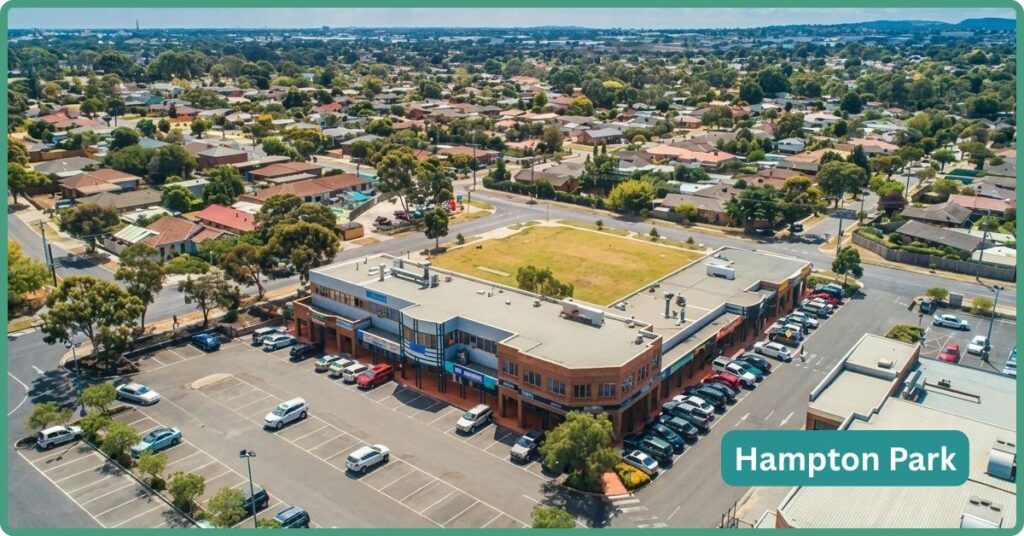
Hampton Park Central is the suburb’s own shopping precinct, and it’s currently mid-renewal rather than static: the Draft Updated Hampton Park Central Development Plan, endorsed by council in June 2026 and backed by a $250,000 state grant, aims to revitalise shopfronts and public space. The long-stalled former Hampton Park Food Market site has also been greenlit for redevelopment, expected to bring more than 100 apartments alongside new retail and office space. This is a suburb actively reinvesting in its own centre rather than relying entirely on neighbouring retail, though it’s worth noting Hampton Park doesn’t have the scale of retail that Narre Warren’s Fountain Gate precinct or Cranbourne’s shopping centre offer nearby.
What It’s Actually Like to Live Here
This is a genuinely, deeply multicultural suburb. More than 56% of residents were born overseas, and only 43.1% of households speak English only at home, meaning a majority speak another language, with Dari and Hazaraghi (reflecting a significant Afghan community, around 5.2% Afghanistan-born) and Samoan (reflecting a larger Pacific Islander presence than most south-eastern Melbourne suburbs) among the most common. Islam represents the second-highest population share of any suburb in this corridor after Noble Park, alongside a substantial Christian community. Owner-occupancy sits at 67.8%, down slightly from 69.9% in 2016, meaning a modestly growing renter share of around 32%.
The honest counterweight to this genuine cultural strength is Hampton Park’s measured socioeconomic profile: its disadvantage and education-occupation indices sit in the bottom national quintile, and local reporting has described it as among the more disadvantaged areas in Melbourne’s south-east, a real, sourced fact that shouldn’t be softened or omitted, even as it sits within a City of Casey LGA that scores considerably better overall. Day to day, this reads as a suburb defined by genuine cultural depth and real affordability, carrying real socioeconomic challenges that are worth knowing rather than discovering after you’ve bought.
Trade-offs
No train station within the suburb, and the two nearest options each require a genuine walk on two different lines. Median house and unit prices are both contested across sources rather than settled on one clean figure. Hampton Park’s own socioeconomic indices sit in the bottom national quintile, a real factor to weigh honestly. No independent school performance ranking was confirmed for the local secondary college. And the suburb’s own retail centre, while actively being renewed, doesn’t match the scale of Fountain Gate or Cranbourne’s shopping centre nearby.
FAQ
Does Hampton Park have a train station? No. The nearest options are Merinda Park (Cranbourne line) and Hallam (Pakenham line), both requiring a walk from most parts of the suburb. This is unrelated to “Hampton” station on the Sandringham line, a different suburb entirely.
Is Hampton Park a good suburb to buy in? It suits buyers and investors prioritising genuine affordability and an established, multicultural community over new housing stock or rail access. It’s a weaker fit if you want walkable train access or a suburb with a stronger measured socioeconomic profile.
What’s the median house price in Hampton Park? Sources disagree, ranging roughly $700,000 to $720,000 as of 2026, with one notably higher outlier figure best treated with caution. Check a current local appraisal rather than relying on a single source.
Is Hampton Park a safe suburb? Crime data in Victoria is published at City of Casey LGA level, not suburb level. Casey recorded a 9.1% rise in criminal incidents for the year to March 2026, driven substantially by car theft, but there’s no official figure specific to Hampton Park itself.
References
- Australian Bureau of Statistics. 2016 and 2021 Census QuickStats, Hampton Park (SAL21133).
- Woodards; Your Investment Property Magazine; PropRadar. Hampton Park median house and unit price data, 2026.
- Level Crossing Removal Project, Victoria’s Big Build. Hallam Road level crossing removal and Hallam station rebuild.
- Crime Statistics Agency Victoria (via Star Community / Star News reporting). City of Casey recorded criminal incidents, year ending March 2026.
- Toddle.com.au; CareforKids.com.au. Hampton Park childcare services and NQS ratings, 2026.
- Hampton Park Secondary College; St Kevin’s School. School profiles and enrolment data.
- City of Casey. Draft Updated Hampton Park Central Development Plan, March 2026; former Hampton Park Food Market site redevelopment.
- Star Community / local history sources. Garner’s Paddock, Parish of Eumemmerring, Hampton Park Estate subdivision 1917-1918.
- Australian Bureau of Statistics. Socio-Economic Indexes for Areas (SEIFA), Hampton Park, 2021.