
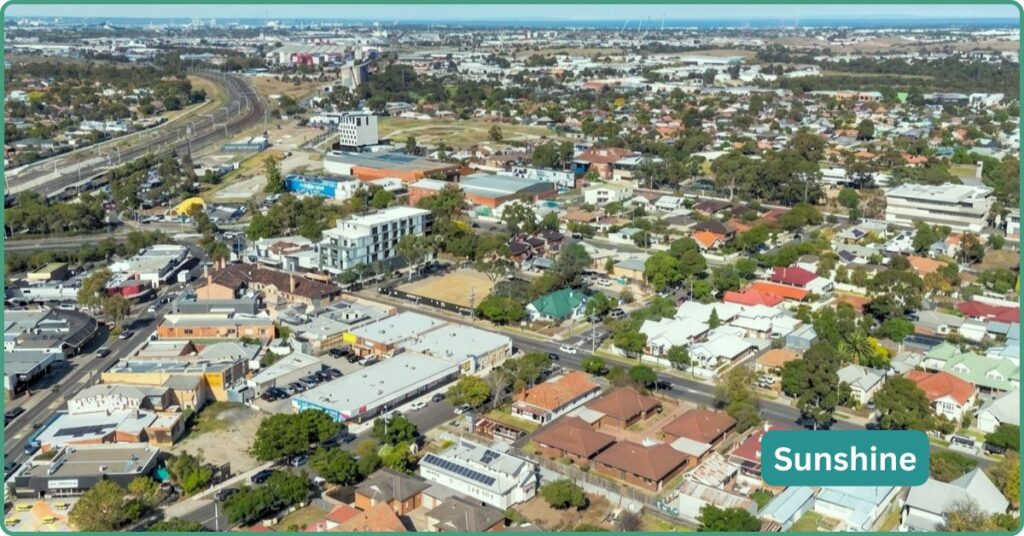
Sunshine got its name from a harvester factory, and a hundred-plus years later it’s still defined by what gets built and moved through it. This is the suburb where every V/Line corridor out of Melbourne’s west converges, where a $4.1 billion rail interchange is currently being built underneath the existing station, and where “Australian” and “English” ancestry now sit in a statistical tie with Vietnamese ancestry as the most common response on the Census form. Don’t come here for a quiet, settled family suburb; come here for a transport-hub suburb mid-transformation, with a genuinely excellent Vietnamese food strip and prices that haven’t yet fully caught up to what’s about to land on its doorstep.
Boundary Map
Sunshine sits 12km west of the Melbourne CBD in the City of Brimbank, a compact 4.9km² suburb bordered by Sunshine North, Sunshine West and Albion (all sharing the same 3020 postcode), Braybrook and Tottenham to the east, West Footscray to the south-east, and Ardeer to the west. Worth knowing before you go house-hunting: locals and most real estate listings use “Sunshine” more loosely than the official suburb boundary, often folding in Albion and parts of Sunshine North and West, so postcode-level data (3020) can include areas well outside this suburb’s own tight footprint.
Quick Facts
| Median House Price | $821,000-$855,000 (Woodards / CoreLogic-style aggregator data, 12 months to July 2026), up roughly 7% year-on-year |
| Median Unit Price | No single clean current figure available; unit values grew around 22% over the past 12 months on available aggregator data, a live Domain/PropTrack check is recommended before relying on any specific dollar figure |
| Population | 9,445 (2021 Census), down slightly from 9,768 (2016 Census), likely reflecting boundary effects rather than genuine decline |
| Growth Rate | Suburb-level Census count is small and volatile; the real growth story is the redevelopment pipeline, not population figures |
| Transport | Major rail hub already delivered (Metro, V/Line to Ballarat and Geelong); $4.1bn Melbourne Airport Rail “Sunshine Superhub” under construction, targeted 2030 |
| Crime Rate (LGA) | Brimbank LGA recorded 18,798 offences (most recent reporting period), up 1.5% on the year before; Sunshine itself logged 3,284 offences, second-highest in the LGA after St Albans |
| Childcare Availability | Multiple services operate locally; exact service count and NQS ratings need direct ACECQA verification |
| Zoned School | Sunshine Primary School; Sunshine College (government secondary, Years 7-12) in neighbouring Sunshine West |
| Best For | Buyers and renters who want strong public transport access and multicultural food and retail now, and are willing to bet on a suburb mid-transformation |
Our Honest Verdict
If you want a settled, quiet, established family suburb, Sunshine isn’t it, its population skews heavily toward 20-somethings, renters outnumber outright owners, and the suburb is in the middle of a decade-long construction project right at its centre. If what you actually want is a genuine transport hub (Metro trains plus V/Line services to Ballarat and Geelong, soon joined by direct airport rail) at a price that hasn’t yet caught up to that infrastructure, Sunshine is one of the more defensible transport-arbitrage choices in Melbourne’s west right now.
It suits renters and first-home buyers who prioritise train access above all else, investors chasing rental demand from a young, transport-dependent population (renters make up over 40% of households here, well above the state average), and anyone who wants to live inside one of Melbourne’s most genuinely multicultural food and retail precincts. It’s a weaker fit for buyers chasing a quiet, low-density family-suburb feel, or anyone who wants to avoid years of construction noise around the station precinct while the Sunshine Superhub gets built.
Weighed against its closest neighbours, the trade-offs are concrete. St Albans, just north, is the cheaper entry point on the same Sunbury line, useful if price is your only lever. Albion, immediately next door and on the same postcode, offers a smaller, less-established retail base but sits on the same rail corridor and will benefit from the same infrastructure spend, worth a look if you want Sunshine’s upside at a lower entry price. Braybrook, just east in a different council area, competes on affordability but has a noticeably smaller commercial centre than Sunshine’s Marketplace and Hampshire Road strip. Sunshine’s edge over all three is that it’s the actual interchange hub, the suburb everything else is being built to connect to, not just a suburb that benefits from proximity to one.
The Backstory: Heritage & Origins
Sunshine started life in the 1880s as Braybrook Junction, named for its position where the Bendigo and Ballarat railway lines met; the station opened in 1885. The name changed for good reason: in 1904 industrialist Hugh Victor McKay bought the local implement works and, in 1906, relocated his agricultural machinery business here from Ballarat, renaming it the Sunshine Harvester Works. At its peak it was the largest manufacturing plant in Australia and reportedly the largest industrial complex in the Southern Hemisphere, employing more than 3,000 workers and exporting harvesters as far as Tsarist Russia. In 1907, following a resident and worker petition, the station, post office and shire riding names all changed from Braybrook Junction to Sunshine in the factory’s honour.
That same factory produced one of the foundational moments in Australian industrial law: the 1907 Harvester Judgement, which established the concept of a minimum living wage. McKay also built the Sunshine Estate, a Garden City-style company town for his workers complete with electric street lighting, parks, schools and a library, earning the suburb the nickname “the Birmingham of Australia.” The original factory site, later operating as Massey Ferguson, was demolished in 1992 and became the Sunshine Marketplace shopping centre in 1998. The former Harvester Works’ bulk store, factory gates, clock tower and gardens are Victorian Heritage Register-listed, and the H.V. McKay Memorial Gardens on Anderson Road, established in 1909, are one of only two remaining “industrial gardens” left in Australia. Notable Sunshine connections include AC/DC’s Bon Scott (who lived here as a child), Olympic gold medallist Lydia Lassila, and cricket great Keith Miller.
Sunshine’s Big Build Growth Story
The single biggest thing happening in Sunshine right now, and arguably in Melbourne’s west generally, is Melbourne Airport Rail’s Sunshine Superhub. This $4.1 billion joint federal-state project, covering roughly 6km of new and realigned track between West Footscray and Albion, two new rail bridges and two new regional platforms, is under construction, with enabling works (utility relocation) underway as of mid-2026 and full completion targeted for 2030. A further $143 million in state funding is going into station precinct upgrades: walking and cycling links over the rail corridor, a new bus interchange, and additional open space. Be precise about what’s confirmed here: the 2030 date is for the Superhub interchange itself, not necessarily for direct airport-to-Sunshine trains running in service, that later milestone doesn’t yet have a confirmed date and shouldn’t be assumed to land at the same time.
Sunshine also sits at the centre of the state-designated Sunshine National Employment and Innovation Cluster, a 20km² precinct stretching from the Sunshine town centre to St Albans, anchored by Sunshine Hospital, Victoria University, the Western Centre for Health Research and Education, and the Joan Kirner Women’s and Children’s Hospital. The framework plan was released back in 2017 and the anchor institutions are already operating; treat the cluster as a long-term, multi-decade jobs and precinct strategy rather than a single dated construction project.
Getting Around: Transport & Distances
Sunshine railway station, 12.25km from Southern Cross by rail, is a Premium-classified station with four platforms: Metro services to Flinders Street and to Sydenham/Watergardens-Sunbury, plus V/Line regional platforms serving Ballarat, Ararat, Maryborough and Geelong (Bendigo-line trains pass through without stopping). That makes Sunshine the point where all three of Victoria’s main western V/Line corridors converge, a genuinely unusual level of connectivity for a suburb this size. The current station building was fully reconstructed in 2014 under the Regional Rail Link project, and a bus interchange directly adjacent handles roughly 18 routes, including a cluster running along Ballarat Road.
Ballarat Road is the suburb’s key east-west arterial, connecting to the Western Freeway at Ravenhall and meeting the Western Ring Road (M80) at Ardeer. Census figures show the payoff of all this rail investment clearly: 11.8% of employed Sunshine residents use public transport to get to work, against just 4.4% Victoria-wide, and 5.4% commute by train alone versus 1.6% statewide. Drive time to the CBD is commonly estimated at 20-30 minutes depending on traffic, treat that as a general estimate rather than a verified constant.
Crime and Safety, Honestly
Victorian crime data is published at council level. Brimbank LGA recorded 18,798 offences in the most recent reporting period, up 1.5% on the year before and described by local media as the highest offence count since the COVID-era rise. Within the LGA, Sunshine itself logged 3,284 offences, the second-highest raw count after St Albans (4,066), ahead of Deer Park, Sunshine North and Taylors Lakes.
Schools and Education
Sunshine Primary School serves the suburb directly, with Sunshine College, the local government secondary option for Years 7-12, located just over the boundary in Sunshine West. Be aware that Victorian government school zone boundaries in this area were updated as recently as 2025, so confirm current catchments directly with the Department of Education before assuming a specific address is zoned for a specific school. Marian College, a Catholic secondary college in Sunshine West, draws from the wider Sunshine catchment; a specific Catholic primary option for the suburb wasn’t confirmed in current research and should be checked against the Catholic Diocese of Melbourne’s school directory. Victoria University runs a Sunshine campus, a significant local institution and employer (yes, the “Sunshine TAFE” jokes in Kath & Kim have a real basis).
Hospitals and Healthcare
Sunshine Hospital, part of Western Health, anchors the suburb’s health precinct and sits within the broader Sunshine Health, Wellbeing and Education Precinct. The Joan Kirner Women’s and Children’s Hospital, on the same site, opened in May 2019, a nine-storey facility delivering 237 beds of increased maternity and paediatric capacity for Melbourne’s west and creating more than 400 new jobs. The Western Centre for Health Research and Education is co-located on the same precinct, making Sunshine a genuine health-services hub for the region rather than a suburb with just one hospital.
Parks, Attractions & Fitness
The Sunshine Leisure Centre, in the heart of the suburb, offers indoor and outdoor 25m lap pools, a program pool with ramp entry, an outdoor splash pad, spa, steam room, cycle studio and 24-hour gym access. Brimbank Council also runs a separately-branded Brimbank Aquatic and Wellness Centre with a similar facility list.
The H.V. McKay Memorial Gardens on Anderson Road, a heritage-listed industrial garden dating to 1909, double as genuine public green space with real historical weight. The Kororoit Creek Trail handles walking and cycling through the suburb, and local sporting clubs (Sunshine Kangaroos football, Sunshine Crows cricket, Sunshine Georgies soccer, Sunshine Eagles baseball) give the suburb a real amateur-sport backbone. The Village 20 Sunshine Megaplex cinema at Sunshine Marketplace is the main indoor entertainment option in-suburb.
Shopping and Dining
Sunshine Marketplace, a roughly 74-store regional shopping centre with a food court and cinema, anchors the suburb’s retail, built in 1998 on the site of the old Harvester Works factory.
The real drawcard for most visitors, though, is Hampshire Road, the heart of Sunshine’s Vietnamese food scene, with restaurants and grocers reflecting a migration history that runs from postwar Maltese, Italian, Greek and ex-Yugoslav communities through to Vietnamese arrivals from the late 1970s and, more recently, Sudanese, Burmese and Indian communities. The Hue Quang Temple, a Vietnamese Buddhist temple, is also located in the suburb.
Sunshine was named one of Melbourne’s 20 most walkable middle-ring suburbs in a 2018 study, a somewhat dated data point now but a reasonable indicator of the suburb’s compact, amenity-dense layout.
What It’s Actually Like to Live Here
Sunshine’s Census profile is genuinely distinctive for Melbourne. Only 45.8% of residents were born in Australia, against 65% statewide, and Vietnam is by far the largest overseas birthplace at 13.5% of the population, nearly ten times the state rate.
Vietnamese ancestry (15.7%) sits in a statistical tie with English (17.0%) and Australian (15.7%) as the top ancestry responses, a genuinely unusual profile where the historic Anglo-Australian identity is no longer a clear majority of the ancestry mix. Over 57% of households speak a language other than English at home, nearly double the state rate, and Buddhism (10.2%) and Hinduism (6.7%) combined account for a meaningfully higher share of religious affiliation than in Victoria overall.
Renters make up 40.4% of households, well above the 28.5% state average, and one-parent families are notably over-represented (20.3% of families versus 15.2% statewide).
Median household income sits about 11% below the Victorian median. This is a young, transport-dependent, first-and-second-generation migrant community, not a settled, established-family suburb, and the Census data backs that up clearly rather than just anecdotally.
Trade-offs
Population data itself is a little murky: the suburb’s own Census count actually fell slightly between 2016 and 2021, likely a boundary effect rather than genuine decline, but worth knowing rather than glossing over. House price sources disagree by tens of thousands of dollars, and a reliable current median unit price isn’t that easy to establish. Crime counts in Sunshine run second-highest in the Brimbank LGA on a raw-numbers basis, and a proper population-adjusted rate needs checking directly rather than assumed. And the suburb is, quite literally, a construction zone around its own station for years to come as the Sunshine Superhub gets built, real upside if you’re patient, real disruption if you’re not.
FAQ
What are property prices like in Sunshine? House medians sit in the $821,000-$855,000 range (mid-2026), up roughly 7% year-on-year. A reliable current median unit price wasn’t available in research for this guide, check a live Domain or PropTrack listing directly.
Does Sunshine have a train station? Yes, a major one. Sunshine station serves Metro suburban trains plus V/Line regional services to Ballarat, Ararat, Maryborough and Geelong, and is currently being expanded into a $4.1 billion interchange (“Sunshine Superhub”) as part of Melbourne Airport Rail, targeted for completion by 2030.
Is Sunshine safe? Crime is reported at the Brimbank council level. Brimbank recorded 18,798 offences in the most recent reporting period; Sunshine itself logged 3,284 offences, the second-highest raw count in the LGA after St Albans. A precise population-adjusted rate for Brimbank needs direct verification against Crime Statistics Agency Victoria’s tool.
What are the best schools zoned for Sunshine? Sunshine Primary School serves the suburb directly, with Sunshine College (government, Years 7-12) just over the boundary in Sunshine West. School zone boundaries in the area were updated in 2025, so confirm current catchments directly with the Department of Education.
References
- Australian Bureau of Statistics. 2021 Census All Persons QuickStats, Sunshine (SA2/SAL); 2016 Census comparison figures.
- City of Brimbank / forecast.id, profile.id. Population forecasts and profile data for Brimbank LGA and Sunshine.
- Crime Statistics Agency Victoria. Key Figures releases and Crime by Location data, Brimbank LGA.
- Victoria’s Big Build, Department of Transport and Planning. Melbourne Airport Rail and Sunshine Superhub project pages and works notices.
- Victorian Planning Authority. Sunshine National Employment and Innovation Cluster, Draft Framework Plan (2017).
- Western Health. Sunshine Hospital and Joan Kirner Women’s and Children’s Hospital.
- Victorian Heritage Database. Sunshine Harvester Works heritage listings; H.V. McKay Memorial Gardens.
- Wikipedia. “Sunshine, Victoria”; “Sunshine railway station”; “Sunshine Marketplace”; “Sunshine Harvester Works” (used as an aggregator citing primary sources including Museum Victoria, Trove and Public Record Office Victoria).
- Brimbank City Council. Explore Sunshine; Parks around Sunshine; Sunshine Leisure Centre.
- Victorian Department of Education. School zone information, Sunshine College and Sunshine Primary School.