
Taylors Hill is what a Melton-corridor suburb looks like once the paddock has fully grown over: two master-planned estates, Watervale and Taylors Hill, now filled in with big houses, big families and a genuinely low rental share, sitting a full generation ahead of the greenfield suburbs like Cobblebank and Fraser Rise still being built elsewhere in this LGA. It shares a name, and a namesake, with next-door Taylors Lakes, a different suburb in a different council, and it has never had a train station of its own. Neither of those things has stopped it becoming one of the more settled, family-dense pockets of Melbourne’s outer west.
Boundary Map
Taylors Hill sits in the City of Melton, bordered by Hillside to the north-west, Taylors Lakes to the north, Sydenham to the north-east, Caroline Springs to the west and south-west, Delahey to the east, Burnside to the south and Kings Park to the south-east.
Quick Facts
| LGA | City of Melton |
| Median House Price | $920,000–$950,000, depending on the data source |
| Median Unit Price | Essentially no unit stock exists (0% of dwellings recorded as flats/apartments), so a meaningful unit price isn’t really available either |
| Population | 15,419 (2021 Census, ABS direct) |
| Growth Rate | Modest and mature: 14,921 (2016 Census) to 15,419-19,539 depending on source in 2021, a world away from the double-digit growth in newer Melton estates |
| Transport | No train station. Nearest is Watergardens (Sunbury line), connected via bus routes running the Watergardens-Caroline Springs corridor |
| Crime Rate (LGA) | City of Melton LGA-wide: 16,964 offences, roughly 9,479 per 100,000 (2026 data release) |
| Childcare Availability | Good (note: early enrollment often rqd) |
| School Zone Quality | Taylors Hill Primary School and Gilson College (K-12 independent) both confirmed operating locally; no ranking data available |
| Best For | Established families wanting a finished, house-heavy suburb with genuine parkland, who don’t need a local train station |
Our Verdict
Buy here if you want a settled, overwhelmingly owner-occupied family suburb with large houses, real parkland and creek reserves, and you’re comfortable driving or busing to a train station rather than walking to one. Don’t buy here expecting rental stock or unit options: only 9.5% of dwellings are rented, against a Victorian average of 28.5%, and there’s essentially no apartment stock at all.
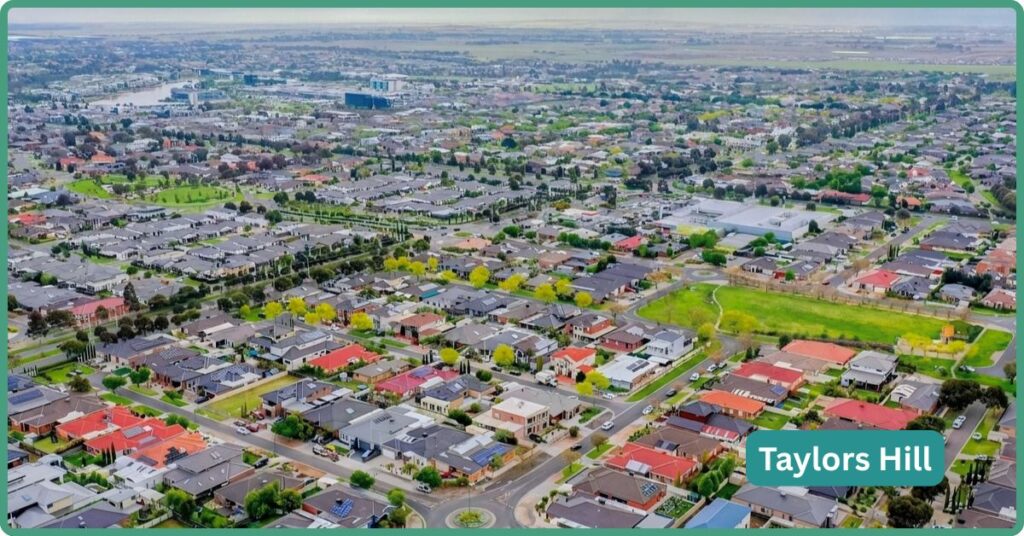
It suits established families who’ve already worked out they want space, four-plus bedrooms and a quiet, low-turnover street, evidenced by the suburb’s 68.2% share of four-bedroom-plus homes and its notably elevated share of school-age children. It’s a weaker fit for renters, unit buyers, or anyone who needs walkable train access, since Taylors Hill was built without a station and has stayed that way.
Weighed against its neighbours, Taylors Hill sits in an interesting spot. Caroline Springs, directly bordering it to the west, offers its own retail centre and station access nearby, generally commanding a premium for that convenience. Sydenham and Taylors Lakes, both connected via the shared Watergardens transport hub, offer the train access Taylors Hill itself lacks, though Taylors Lakes sits in a different council (Brimbank) with its own rates and planning regime. Burnside, immediately south, is a comparable, similarly car-dependent option. The honest pitch for Taylors Hill specifically is house size and settled family character, not transport convenience.
The Backstory: Heritage & Origins
Here’s a genuine point of clarity worth stating plainly, since the name invites confusion: Taylors Hill and neighbouring Taylors Lakes are both named after the same person, William Taylor, a Scottish settler who built the Overnewton homestead in 1849. The land that’s now Taylors Hill was directly part of Taylor’s Overnewton pastoral estate, subdivided for closer settlement in 1905.
Taylors Lakes, by contrast, takes its name indirectly, via Taylors Creek, itself named after the same Taylor. They’re not just similarly named suburbs sitting next to each other by coincidence: they share a common namesake and a shared pastoral history, even though they now sit in different council areas.
One tangible survival from that earlier era remains: Dalgook homestead, built in 1906 on Hume Drive as one of the original farm homesteads on the site, has been refurbished as a community centre and sits in a reserve that still holds fragments of the original farm, a genuine physical link to the pastoral land Taylors Hill was built on top of.
The Big Build & Growth Story
Taylors Hill grew from 11,785 people at the 2011 Census to 14,921 in 2016, then to 15,419 in 2021. The trajectory is clearly one of steady, moderate growth through the 2010s rather than the sharp, ongoing expansion still playing out in newer Melton-corridor suburbs like Cobblebank or Fraser Rise. The suburb itself is effectively built out across its two component estates, Watervale and Taylors Hill, both confirmed to have opened their local shopping precincts by 2010 and 2011 respectively.
Getting Around: Transport & Distances
Taylors Hill has no train station, and Census data backs up how car-dependent that makes daily life here: only 1.7% of employed residents travelled to work by train and just 3.4% used public transport by any mode on Census day, both near or below the Victorian average despite the suburb having no local station at all, while 54.9% drove to work as a sole driver, above the state figure of 49.9%.
The nearest station is Watergardens, on the Sunbury line in neighbouring Sydenham (City of Brimbank). It’s a 6 min drive or 12-20 min bus ride (bus 461 or 462) from central Taylors Hill. From Watergardens station, it’s a 50 min journey to the city.
Caroline Springs station, 12 mins to the south by car, offers access to the V/Line Ballarat Line, which opens up opportunities for easy train getaways in regional Victoria.
Bus routes running the corridor between Watergardens and Caroline Springs, including routes 460, 461 and 462, connect Taylors Hill’s two nearest transport and retail hubs, along with a Friday and Saturday night route running Watergardens through Caroline Springs to Melton.
Crime and Safety, Honestly
City of Melton’s LGA-wide crime data, per the most recent aggregator data release, shows 16,964 offences and a rate of roughly 9,479 per 100,000, using the 2021 Census population as the denominator (meaning the true current rate is likely somewhat lower given how fast the LGA has grown since 2021). The rate has risen over the past decade, from 11,807 total offences in 2016 to 16,964 now, with property and deception offences the largest single category.
Schools and Childcare
Taylors Hill Primary School operates as the suburb’s government primary option (616 pupils recorded in 2014). Gilson College, a Seventh-day Adventist independent school, runs a co-educational K-12 campus on Taylors Road, having relocated here from Pascoe Vale in 1987, with around 1,300 students and 105 teaching staff across a 10-hectare site.
Childcare is a strength of Taylors Hill, with multiple long day care centres, kindergarten programs and family day care options available locally. As an established family suburb, it avoids the childcare shortages often experienced in newer outer-growth estates, although popular centres can still require early enrolment planning. Families have access to several long day care options within the suburb, including:
- Goodstart Early Learning – a purpose-built centre offering long day care and funded kindergarten programs.
- Journey Early Learning Centre – a larger centre with approved capacity for 132 places and long day care hours.
- Taylors Hill YMCA Early Learning Centre – another local early learning option.
The broader area is also supported by nearby centres in Hillside, Sydenham and Caroline Springs, giving parents additional choices within a short drive.
Get Outside: Parks, Attractions & Fitness
Taylors Hill Recreation Reserve offers a skatepark, playground, walking trail and sports field. Taylors Hill has several small neighbourhood reserves plus a linear reserve and wetland running north-south that offers the closest thing to native bushland in the area. This linear reserve includes several parks and connects at the southern end to Burnside Heights Recreation Reserve that offers two ovals and a larger reserve area that fronts Kororoit Creek.
Morton Homestead (formerly Dalgook Homestead), the refurbished 1906 farmhouse on Hume Drive, sits within a reserve holding fragments of the original farm, a genuine piece of pre-suburban heritage embedded in the parkland network. It now functions as a community centre.
Shopping and Dining
Taylors Hill Village, on Gourlay Road, is the suburb’s local shopping centre, anchored by Coles alongside smaller tenants. Watervale Shopping Centre at the southern end of the suburb offers a Woolworths and smaller tenants. Depending on where you live, some locals head to CS Square in neighbouring Caroline Springs, which offers an attractive retail escape. For a bigger retail day out and dining, locals head to Watergardens Town Centre about 5-10 mins to the north.
What It’s Actually Like to Live Here
Taylors Hill doesn’t have a train station, and they genuinely don’t care; they’ve been living for decades without one. It’s middle-class multicultural Australia, clean, car-dependent, and by all standards a quiet place.
Taylors Hill’s 2021 Census profile shows a median age of 35, younger than the Victorian median of 38, and a distinctly multicultural, family-dense character. Only 61.4% of residents were born in Australia against a state figure of 65.0%, with India (6.4%), Vietnam (3.1%), the Philippines (2.5%), North Macedonia (2.0%) and Malta (1.4%) the leading overseas birthplaces. The Maltese ancestry figure is genuinely striking: 9.9% of residents claim Maltese ancestry, against just 1.3% across Victoria, roughly 7.6 times the state average, likely reflecting overflow from the historically Maltese-heavy Keilor, Sunshine and St Albans pocket of Melbourne’s west. Only half of residents, 50.1%, speak English only at home, against 67.2% statewide.
Tenure is heavily skewed toward ownership: 86.4% of dwellings are owned outright or with a mortgage, against just 9.5% rented, a rate well under a third of the Victorian average of 28.5%, meaning renters genuinely have little choice here. Households run large: 90.3% are family households (Victoria 70.1%), averaging 3.5 people per household against a state figure of 2.5, with 68.2% of dwellings holding four or more bedrooms. The suburb’s age profile confirms this is a settled, school-years family suburb rather than a fresh estate full of infants: 10.5% of residents are aged 10-14 and 8.9% are aged 5-9, both well above the Victorian average of roughly 6%.
FAQ
Does Taylors Hill have a train station? No. The nearest is Watergardens, on the Sunbury line in neighbouring Sydenham, connected via bus.
Is Taylors Hill the same as Taylors Lakes? No, they’re separate suburbs in different councils (Melton and Brimbank respectively), though they’re named after the same person, William Taylor, and directly border each other.
How many people live in Taylors Hill? The 2021 Census gives 15,419 according to the ABS’s own live figures, though Wikipedia’s infobox cites 19,539 for the same Census code, a discrepancy this profile can’t resolve.
Is Taylors Hill safe? City of Melton LGA-wide data shows a rate of roughly 9,479 offences per 100,000, though this is LGA-level, not suburb-specific, and a genuine data conflict exists in how “Melton” crime figures get reported depending on whether the suburb or the whole LGA is meant.
References
- Australian Bureau of Statistics. 2021 Census QuickStats, Taylors Hill (Vic.), SAL22473.
- Victorian Places (State Library of Victoria-affiliated reference). “Taylors Hill” entry. Accessed 2026-08-05.
- Taylors Hill Primary School (taylorshillps.vic.edu.au); Taylors Hill Village (taylorshillvillage.com.au). Accessed 2026-08-05.
- aucrimetracker.com (citing Crime Statistics Agency Victoria data). City of Melton LGA and Melton suburb offence rate data, 2026 data release.