
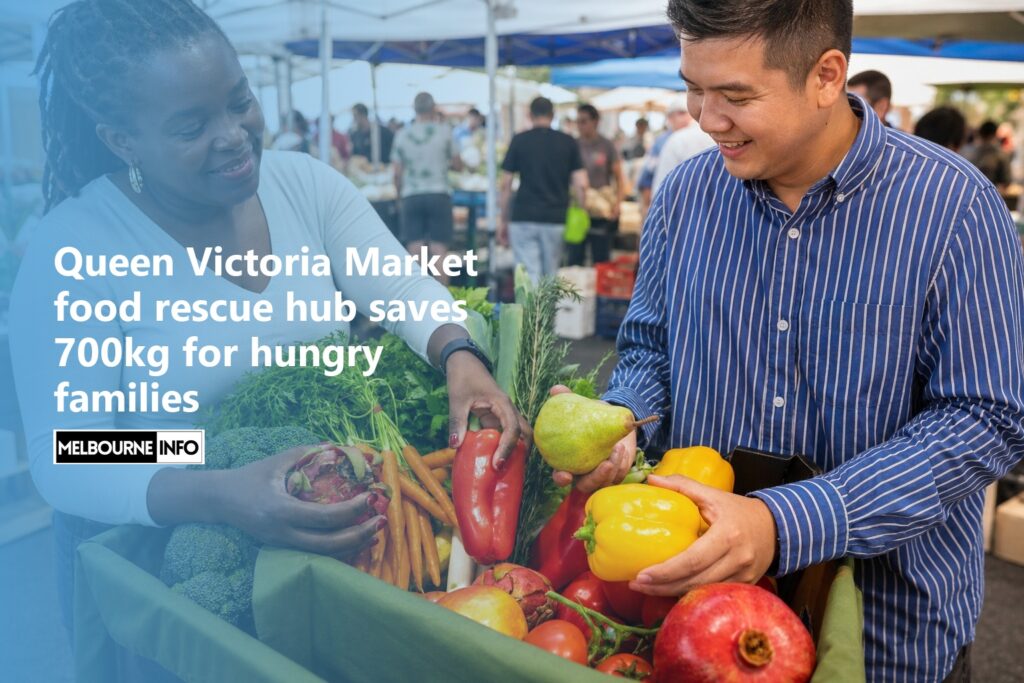
Mehmet Tilki cannot bring himself to throw away good fruit. The Queen Victoria Market trader, who runs 4 Seasons Veggie and Fruit, watched for years as unsold produce that was still perfectly edible went into the bin. “I don’t want to put it in the rubbish bin because I feel so bad,” he said.
Now that food feeds people who are skipping meals. Since April 2026, a new Melbourne Food Rescue Network hub under Shed A has quietly collected and redistributed more than 700 kilograms of surplus fresh produce from Tilki and a handful of other vendors, delivering it to charities across the city.
The scale of the problem at the market is staggering. Queen Victoria Market generates up to 800 tonnes of surplus food each year and 97 per cent of it is edible. Until now, most of that was composted or sent to landfill. City of Melbourne data shows 47 per cent of residents experienced food insecurity in 2025, with one in five running out of food and 28 per cent skipping meals because they could not afford them.
“This is an absolutely shocking and unacceptable situation in an Australian city,” Lord Mayor Nick Reece said. “In a country as prosperous as ours, people should not be missing out on meals.”
The hub is a joint effort between the market, City of Melbourne, STREAT’s Purpose Precinct, SecondBite and frontline charities. Each trading day, produce that is still fresh but not sold is collected from the five participating stalls, sorted and delivered by SecondBite logistics to organisations such as Meals with Impact, which feeds up to 600 people each week with culturally appropriate halal meals.
Llawela Forrest from STREAT’s Purpose Precinct said redirecting food to human consumption was the highest-value use. “So much of that produce is edible, so using it for humans to eat and get their nutrition needs, particularly when they’re going hungry or don’t have access to it, is really important,” she said.
Demand is only growing. Mat Reiffel, SecondBite’s Victorian manager, said every charity they speak with reports the same thing. “When we talk to the charities, the largest thing that they’re all saying is the growing cost-of-living pressures is increasing the demand,” he said.
For the vendors, donating feels better than dumping. Muz Ozdemir, who runs Market Boys, said it changed his relationship with unsold stock. “When you don’t sell it, you don’t look at it like ‘there goes a loss in profit’. You do good by the man upstairs and hopefully he looks after you,” he said.
The logistics are what make the difference for small charities. Harris Ryan, co-founder of Meals with Impact, said his organisation simply could not pick up donated food on its own. “We don’t have a source of logistics to go and pick up any food … so the support is huge for us knowing that the produce comes to us,” he said. “For a moment, they can feel a sense of belonging just through a shared meal.”
The program is still small. Only five of the market’s 35 produce stalls are involved so far. Forrest said the onboarding process is slow but the ambition is to expand to meat, seafood and other sections, and eventually to scale city-wide. It mirrors earlier work by STREAT in Kensington, where more than 18 tonnes of food was diverted, and at the Purpose Precinct, which turns waste into meals and products.
For families doing the Saturday shop, the existence of the hub means you can support food relief simply by buying from participating stalls and asking about donations. If you or someone you know needs help, the City of Melbourne’s Community Food Guide and Map shows local relief services. Do not assume every stall is part of the network yet, but also do not assume market surplus is wasted: nearly all of it is now being saved.
Unlike earlier QVM waste programs that focused on composting, this initiative puts edible food directly onto plates. And while Prahran Market has investigated its own waste-reduction projects, the QVM hub is specifically about fresh produce donation, with a cold-chain and logistics backbone that gets food to charities within hours.
To visit the market, public transport is the best option. Tram routes 19, 57 and 59 all stop at Victoria Market, while Flagstaff and Melbourne Central train stations are a short walk away. On-site parking is limited. While you are there, you can drop into Purpose Precinct activations or keep an eye on other markets such as Prahran, which is watching the program closely.
A quiet morning at Shed A now means trays of spinach, oranges and tomatoes are going to families who were skipping meals last year. For Tilki and his fellow traders, that is worth more than any price tag.
Quick Facts
Queen Victoria Market
Australia’s largest open-air market and a major Melbourne landmark in the CBD, operating since 1878 as the city’s primary fresh produce hub with hundreds of traders.
City of Melbourne
Local government authority responsible for the central Melbourne municipality, including sustainability programs, community food security initiatives and partnership with QVM on waste reduction.
SecondBite
Major Australian not-for-profit food rescue organisation that collects surplus edible food from retailers and growers and redistributes it to charities and community groups across Victoria and nationally.