
Trams get the postcards and trains get the commute. Buses are the quiet workhorse filling the gaps: the airport run, the cross-suburban orbital, the 3am ride home after a Friday show. Melbourne runs roughly 350 to 400 metropolitan bus routes, and from July 2025, every new bus on the road has to be zero-emission, so the fleet you board now is quieter and cleaner than the one locals grew up with.
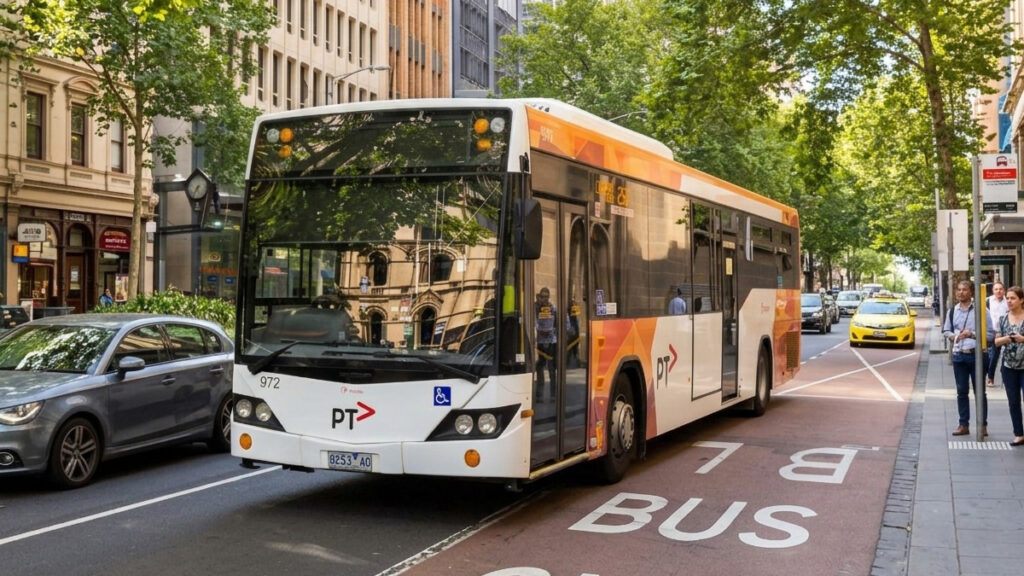
Here is the honest brief for visitors: you probably will not catch a regular PTV bus unless you are staying in the outer suburbs or heading somewhere trams and trains do not reach. What you will use is SkyBus for the airport, possibly a Night Network bus after a late gig, and maybe SmartBus Route 901 if you are watching every dollar. This guide covers all of it.
For the wider network, start at the Melbourne transport hub. For the rail side of things, see metro trains and trams.
Free travel window in effect: all Victorian public transport is free for every passenger until 31 May 2026 and half-price fares from June 1 until 1 January 2027 – read more.
Melbourne City Bus Network Map
Zoomable full network map | Download a PDF version or JPG Image | See here for outer region bus maps
Using Public Buses in Melbourne
Everyday bus travel in Melbourne runs on Myki, the same reloadable card you use for trains and trams. Tap on when you board, tap off when you alight. Standard metro fares apply, capped daily, and the two-hour ticket lets you hop across bus, tram and train without paying again. For the full card breakdown, see our transport apps and Myki guide.
Two things worth knowing in 2026:
- The contactless bank card trial (tap your Visa or Mastercard directly) started on trains in March 2026. Buses are still Myki-only at time of writing, with a rollout expected to follow.
Finding the right route
Bus numbers in Melbourne are dense and not always intuitive. Do not try to memorise them: use an app.
- PTV App (official): real-time tracking, journey planning, Myki top-up, service alerts
- Google Maps: excellent for door-to-door with bus legs
- Citymapper and Transit App: both solid, Transit is particularly clean for bus arrivals
One visitor told us: “The PTV app made navigating buses so much easier: it tells you which stop to get off at and notifies you when you’re approaching it.” If you are new to the city, that notification alone is worth the download, see transport.vic.gov.au.
The SmartBus network
SmartBus is the backbone of cross-suburban travel. Nine orbital routes loop around Melbourne connecting suburbs without forcing you through the CBD, and they have barely changed since 2010 (stability is a feature when the rest of the network is shifting).
- High-frequency: every 15 minutes on weekdays, every 30 minutes evenings and weekends
- Extended operating hours compared to regular buses
- Kinetic Melbourne runs 7 of the 9 routes
- The Eastern Freeway Busway, open since April 2023, gives dedicated lanes that keep eastern SmartBus services running on time
For a visitor, SmartBus matters in two scenarios: budget airport transfers via Route 901, and late evenings when tram and train frequency drops off.
Night Network: Buses After Midnight
Zoomable full network map | Download a PDF version or JPG Image
Friday and Saturday nights (and selected public holidays) the city switches on the Night Network. Buses run roughly 1am to 6am at no fare surcharge: the same Myki rates as daytime.
- 21 routes in total (unchanged since 2017)
- 10 routes radiate out from the CBD
- 11 routes connect suburban railway stations to their catchment areas
- Frequency: every 30 to 60 minutes depending on the route
A traveller we spoke to captured the surprise factor: “We used the Night Network buses after a late show in the city on a Friday: didn’t even realise they existed until we checked the PTV app.” Worth knowing before you book a rideshare at surge pricing.
Night Coach: late-night V/Line to the regions
If your plans stretch beyond Melbourne, V/Line runs Night Coach services from Southern Cross Station between 1am and 2:15am on Friday and Saturday nights, heading to Ballarat, Bendigo, Geelong, Seymour and Traralgon. Return services leave the regional cities late evening. V/Line fares apply (not standard metro Myki). For Geelong specifically, compare options in our Melbourne to Geelong guide.
FlexiRide: Melbourne’s On-Demand Bus Service
FlexiRide replaced the old Telebus system in October 2021. It is an app-based on-demand service (iOS and Android): book a ride inside a defined zone, the bus reroutes to pick you up, and you pay standard Myki fares.
Service zones currently cover:
- Eastern: Croydon, Lilydale, Mooroolbark
- South-eastern: Rowville
- Western: Melton South, Tarneit North
- Mornington Peninsula: Rosebud
- Regional: Woodend, Yarrawonga/Mulwala
Eligible passengers can book accessible home pickup. Honest take: FlexiRide is not tourist-facing. It exists to serve outer suburbs with limited fixed-route coverage, so unless you are staying in one of those zones, you will not need it.
Practical Tips
- Download the PTV app before you land. Real-time tracking makes suburban buses usable for first-time visitors.
- SkyBus does not take Myki. Buy online, in the SkyBus app, at airport kiosks, or from the driver. Contactless card works.
- No cash on regular PTV buses. Myki only. Get a card (or Myki Explorer pack) before you board, available at 7-Eleven, train stations and PTV Hubs.
- Contactless on buses is coming, not here. The March 2026 trial covers trains first. Until buses are switched on, stick with Myki.
- Tap on and tap off. Forgetting to tap off can default you to the maximum zone fare.
- Night Network is free of surcharge but runs Fri and Sat only. Tuesday at 2am, you are on a rideshare.
- New electric fleet from July 2025. Quieter buses, often without the diesel rumble you might remember from past visits.
FAQs
Do Melbourne buses use Myki?
Yes. Every regular PTV bus runs on Myki at standard metro fares. Tap on when you board, tap off when you alight. SkyBus is the exception: it does not accept Myki and needs a contactless card, app payment, kiosk ticket or cash.
How do I get from Melbourne Airport into the city by bus?
SkyBus City Express is the direct option: Airport to Southern Cross Station in around 30 minutes, $24.90 one-way for an adult in 2026, running every 10 minutes during the day. If you want to skip the CBD, Peninsula Express, Eastern Express and Sunshine Express cover St Kilda/Frankston, Box Hill and Sunshine Station respectively. The budget alternative is SmartBus Route 901 with a train connection at Broadmeadows, which takes about an hour and 45 minutes but costs roughly $5.30 on Myki.
Does SkyBus accept Myki?
No. SkyBus is a privately operated service separate from the Myki network. Pay with a contactless bank card, through the SkyBus app, at an airport kiosk, or in cash to the driver. The Myki Explorer pack is valid on regular PTV buses but not on SkyBus.
Do Melbourne buses run overnight?
Only on Friday and Saturday nights (and selected public holidays) through the Night Network: 21 routes running roughly 1am to 6am at standard Myki fares. On weeknights, buses stop at regular service hours and you will need a rideshare or taxi. For travel to regional cities late on Fri or Sat, V/Line Night Coach services leave Southern Cross between 1am and 2:15am to Ballarat, Bendigo, Geelong, Seymour and Traralgon.
Are Melbourne buses electric now?
Increasingly yes. Under the 10-year zero-emission bus franchise contracts that began in July 2025, every new bus added to the fleet must be electric. Existing diesel buses are being replaced progressively. The SkyBus Sunshine Express (launched November 2025) runs an all-electric fleet.
Is there a free tourist bus in Melbourne?
No. The Melbourne Visitor Shuttle closed in September 2017 and has not been replaced. The free transport option for visitors is the Free Tram Zone in the CBD and Docklands. City Sightseeing runs a commercial hop-on hop-off bus with 24-hour and 48-hour passes if you want a guided loop.